- UPSC Exam
- State PCS
- One Day Exam
- Current Affairs
- PT Quiz
- Downlaods
- About Coaching
- Blog
- Videos

| (Prelims: General Issues Related to Environmental Ecology, Biodiversity, and Climate Change) (Mains, General Studies Paper 3: Conservation, Environmental Pollution and Degradation, Environmental Impact Assessment, Disaster and Disaster Management) |

Following widespread opposition to the Gadgil Report, the Environment Ministry constituted a high-level working group in 2012, headed by space scientist K. Kasturirangan, to re-examine its recommendations.
Based on this report, the central government has issued six draft ESA notifications, the most recent in August 2024. Disagreements with the states persist, and the committee headed by former Director General of Forests Sanjay Kumar, tasked with finalizing the boundaries of the Western Ghats, is still working.
About Madhav Gadgil (1942–2026)Birth Madhav Gadgil was born in Pune in 1942. He was considered one of India's most influential and powerful voices in the field of environmental and ecological conservation. Key Contributions
Major Awards and Honors
|
| Prelims: (Science & Technology + CA) Mains: (GS 2 - Governance, Public Policy; GS 3 - Cyber Security, Technology) |
The Union Government is considering legally enforcing the Indian Telecom Security Assurance Requirements (ITSAR) for smartphones, introducing 83 mandatory security standards covering source code disclosure, software controls, logging requirements, and user-permission restrictions.
The proposal has triggered strong resistance from major global smartphone manufacturers such as Apple, Samsung, Google, and Xiaomi, who argue that several provisions lack global precedent, threaten proprietary technologies, and may undermine innovation and ease of doing business in India.
.jpg)
India is the world’s second-largest smartphone market, with nearly 750 million users, making device-level security a matter of national importance.
Contextual Drivers
The proposed ITSAR framework aligns with the government’s broader emphasis on digital sovereignty, cyber resilience, and national security, similar to earlier interventions such as:
The Indian Telecom Security Assurance Requirements (ITSAR) are a set of security compliance standards framed under the telecom security ecosystem to ensure that devices operating on Indian networks meet robust cybersecurity and data protection benchmarks.
Under the current proposal, ITSAR would be legally enforced for smartphones, making compliance mandatory for manufacturers selling devices in India.
Industry Response:
Concerns:
Industry Concern:
Concerns:
Industry View:
Industry Objection:
Challenge:
Concerns:
FAQs1. What is ITSAR ? ITSAR refers to Indian Telecom Security Assurance Requirements, a framework of security standards proposed to strengthen device-level cybersecurity. 2. Why is ITSAR being proposed for smartphones ? To address rising cybercrime, data breaches, and national security concerns in a large and growing smartphone ecosystem. 3. Why are global smartphone makers opposing ITSAR ? They argue that provisions like source code disclosure lack global precedent and threaten proprietary technologies. 4. What is the biggest concern with source code disclosure ? It may expose trade secrets and intellectual property, impacting innovation and corporate security. 5. What is the suggested way forward for ITSAR ? Adopting a risk-based, globally aligned approach with stakeholder consultation and independent audits instead of intrusive controls. |
| Prelims: (Science & Technology + CA) Mains: (GS 2 – International Relations, Governance; GS 3 – Defence Technology, Internal & External Security) |
Amid heightened global geopolitical tensions and growing fears of escalation between major powers, the Boeing E-4B Nightwatch, popularly known as the United States military’s “Doomsday Plane,” made a rare and unexpected appearance over Los Angeles, triggering public anxiety and widespread speculation.
The aircraft’s movement is closely monitored worldwide due to its association with nuclear war preparedness and continuity of government operations during extreme national emergencies.

The concept of an airborne command centre emerged during the Cold War, when the threat of nuclear conflict raised concerns over the survivability of ground-based leadership and communication infrastructure.
Key drivers behind such platforms include:
The Boeing E-4B is a critical pillar of the US doctrine of deterrence, ensuring that no adversary can incapacitate American leadership through a decapitating strike.
The Boeing E-4B Nightwatch is the United States’ National Airborne Operations Center (NAOC) — a highly secure, airborne military command post designed to serve as the nerve centre of government during catastrophic scenarios.
It enables the US President, Secretary of Defense, and senior military leadership to:
The aircraft is an integral component of the Nuclear Command, Control, and Communications (NC3) architecture, ensuring command authority under all conditions.
Other major powers maintain similar capabilities:
This highlights the centrality of command survivability in modern strategic doctrines.
FAQs1. What is the Boeing E-4B Nightwatch ? It is the US military’s National Airborne Operations Center, designed to act as a flying command post during nuclear war or national emergencies. 2. Why is it called the “Doomsday Plane” ? Because it is meant to keep the US government operational even during catastrophic scenarios such as nuclear war. 3. What role does it play in nuclear command ? It is a key component of the Nuclear Command, Control, and Communications (NC3) system, enabling secure nuclear decision-making. 4. Why did its appearance cause panic ? The aircraft usually flies discreetly; visible deployments are often associated with high-alert situations. 5. Is the E-4B being replaced ? Yes, the US is planning a next-generation replacement under the SAOC programme to address ageing and emerging threats. |
| Prelims: (Polity & Governance + CA) Mains: (GS 2 - Governance, Federalism; GS 3 - Internal Security, Disaster Management, Security Preparedness) |
The Indian Army recently conducted Exercise “Sanjha Shakti”, a joint Military–Civil Fusion (MCF) exercise, at the Dighi Hills (Diggi) Range, Khadki Military Station, under the aegis of the Maharashtra, Gujarat and Goa Area of the Southern Command.
The exercise aimed at strengthening coordination between the armed forces and civilian agencies to effectively respond to complex security challenges, disasters, and public safety emergencies.
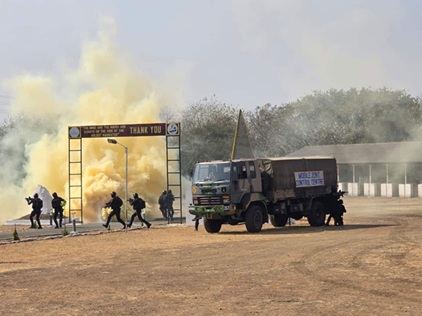
India’s internal security and disaster response framework relies heavily on close coordination between civil administration and the armed forces.
Exercises like Sanjha Shakti are designed to operationalise this coordination in real-world scenarios.
Exercise Sanjha Shakti is a joint Military–Civil Fusion (MCF) exercise conducted to enhance inter-agency coordination, preparedness, and operational synergy.
The exercise was conducted through realistic, mission-oriented scenarios, enabling participants to:
Effective fusion ensures complementarity rather than overlap.
FAQs1. What is Exercise Sanjha Shakti ? It is a joint Military–Civil Fusion exercise conducted to enhance coordination between the Indian Army and civilian agencies. 2. Where was Exercise Sanjha Shakti conducted ? At the Dighi Hills (Diggi) Range, Khadki Military Station, Maharashtra. 3. Which agencies participated in the exercise ? The Indian Army, Maharashtra Police, Force One, fire and emergency services, and other civil authorities. 4. What was the primary objective of the exercise ? To improve interoperability, communication, and rapid response during security challenges and emergency situations. 5. Why are such exercises important for India ? They strengthen civil–military cooperation, enhance disaster response capability, and improve internal security preparedness. |
| Prelims: (Social Issues + CA) Mains: (GS 2 - Polity, Judiciary, Social Justice; GS 4 - Ethics, Social Issues) |
The Supreme Court of India has recently flagged the misuse of the Protection of Children from Sexual Offences (POCSO) Act, 2012, particularly in cases involving consensual adolescent relationships, thereby reopening the debate on India’s age of consent.
The observations come amid rising concerns that a law designed to protect children from sexual abuse is increasingly being applied to criminalise voluntary relationships between adolescents, especially those aged 16–18 years.

The age of consent refers to the legally prescribed age at which an individual is considered capable of giving valid consent for sexual activity.
India’s current framework prioritises absolute child protection, adopting a strict age threshold to prevent exploitation, abuse, and trafficking. However, evolving social realities, early adolescence, and increased reporting under POCSO have intensified calls for a nuanced review.
Judicial observations reflect growing discomfort with outcomes, but without altering the legislative framework.
The debate highlights the need for a calibrated and balanced approach, rather than a binary choice between protection and autonomy.
Such measures can reduce misuse of the law while ensuring that genuine cases of abuse remain effectively addressed.
FAQs1. What is the age of consent in India ? The age of consent in India is 18 years under the POCSO Act, 2012. 2. Why is the age of consent being debated again ? Because a large number of POCSO cases involve consensual relationships between adolescents aged 16–18. 3. Does consent of a minor have legal validity in India ? No. Under current law, consent of anyone below 18 is legally irrelevant. 4. What are “Romeo–Juliet” exemptions ? They are close-in-age exceptions used in some countries to prevent criminalisation of consensual adolescent relationships. 5. What is the main challenge in reforming consent laws ? Balancing adolescent autonomy with the need for strong protection against exploitation, abuse, and trafficking. |
| Prelims: (Governance + CA) Mains: (GS 2 - International Institutions, Global Governance; GS 3 - Indian Economy, Growth & Development, Public Investment) |
The United Nations Department of Economic and Social Affairs (UN DESA) has projected that India will grow by 7.4% in the current financial year, driven primarily by strong domestic consumption and sustained public investment. The projection was made in a recently released UN DESA report assessing global and regional economic prospects amid persistent geopolitical uncertainties and uneven global recovery.
International multilateral institutions regularly assess India’s economic performance due to its role as:
India’s recent growth momentum has been supported by:
UN DESA’s projections add to global assessments by bodies such as the IMF and World Bank, reinforcing India’s position as a relative bright spot in the world economy.
The United Nations Department of Economic and Social Affairs (UN DESA) is the UN’s principal body responsible for advancing the development pillar of the United Nations.
UN DESA works to integrate the economic, social, and environmental dimensions of sustainable development.
UN DESA’s work addresses cross-cutting development challenges affecting livelihoods worldwide, with a focus on the most vulnerable.
UN DESA performs multiple critical functions within the UN system:
UN DESA is a leading source of authoritative global development assessments, including:
These reports are widely used by governments, researchers, and international institutions.
While the outlook remains positive, risks persist:
Addressing these challenges will be crucial to maintaining long-term growth.
India’s growth trajectory must balance economic expansion with inclusivity and sustainability, consistent with the UN DESA framework.
FAQs1. What is UN DESA ? UN DESA is a UN department responsible for advancing economic, social, and environmental dimensions of sustainable development. 2. Where is UN DESA headquartered ? It is based at the United Nations Headquarters in New York, USA. 3. Why is UN DESA’s projection for India important ? It reflects global confidence in India’s growth prospects and influences international economic assessments. 4. What are the main drivers of India’s projected growth ? Strong domestic consumption and sustained public investment. 5. Which major reports are published by UN DESA ? World Economic Situation and Prospects Report, World Social Report, and the SDGs Report. |
M-STrIPES (Monitoring System for Tigers: Intensive Protection and Ecological Status) is an IT-based advanced monitoring system used in India for the protection, surveillance, and scientific management of tigers and other wildlife. Recently, forest personnel have been using the M-STrIPES application during tiger and wildlife census operations in the Anamalai Tiger Reserve.

M-STrIPES consists of two major components:
M-STrIPES is based on the following modern technologies:
Important Fact: In India, the smallest administrative unit of forest management is the “Beat”, generally managed by a Forest Guard.
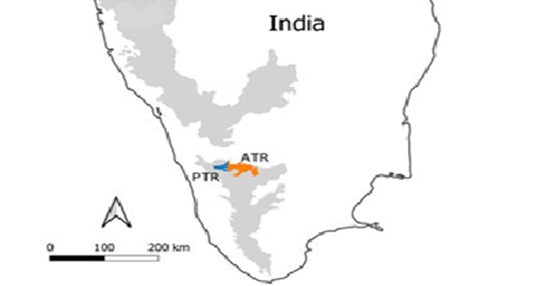
The reserve is inhabited by six indigenous communities:
The reserve supports diverse forest types:
Other distinctive habitats include:
The region is rich in wild relatives of agricultural crops, such as:
Major wildlife species found in Anamalai Tiger Reserve include:
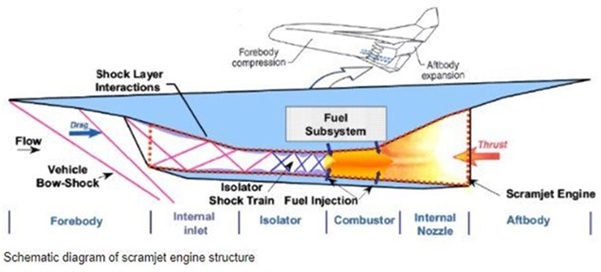
A Scramjet (Supersonic Combustion Ramjet) is an air-breathing engine designed to operate efficiently at hypersonic speeds (Mach 5 and above).
It is fundamentally different from conventional jet engines because it does not use rotating compressors or turbines.
India has become the fourth country in the world to successfully demonstrate scramjet engine flight testing, highlighting its growing technological capability.
A scramjet engine operates in a sequential manner:

Our support team will be happy to assist you!

 Contact Us
  New Batch : 9555124124/ 7428085757
  Tech Support : 9555124124/ 7428085757