
- UPSC Exam
- State PCS
- One Day Exam
- Current Affairs
- PT Quiz
- Downlaods
- About Coaching
- Blog
- Videos

| Prelims: (Science & Technology + CA) Mains: (GS 2 – International Relations, Governance; GS 3 – Defence Technology, Internal & External Security) |
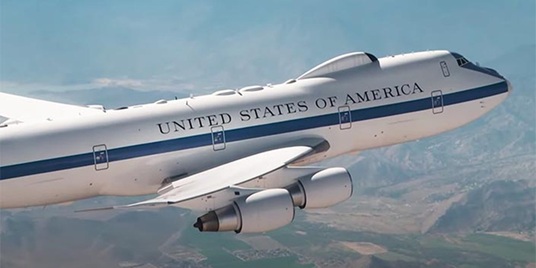
Amid heightened global geopolitical tensions and growing fears of escalation between major powers, the Boeing E-4B Nightwatch, popularly known as the United States military’s “Doomsday Plane,” made a rare and unexpected appearance over Los Angeles, triggering public anxiety and widespread speculation.
The aircraft’s movement is closely monitored worldwide due to its association with nuclear war preparedness and continuity of government operations during extreme national emergencies.
The concept of an airborne command centre emerged during the Cold War, when the threat of nuclear conflict raised concerns over the survivability of ground-based leadership and communication infrastructure.
Key drivers behind such platforms include:
The Boeing E-4B is a critical pillar of the US doctrine of deterrence, ensuring that no adversary can incapacitate American leadership through a decapitating strike.
The Boeing E-4B Nightwatch is the United States’ National Airborne Operations Center (NAOC) — a highly secure, airborne military command post designed to serve as the nerve centre of government during catastrophic scenarios.
It enables the US President, Secretary of Defense, and senior military leadership to:
The aircraft is an integral component of the Nuclear Command, Control, and Communications (NC3) architecture, ensuring command authority under all conditions.
Other major powers maintain similar capabilities:
This highlights the centrality of command survivability in modern strategic doctrines.
FAQs1. What is the Boeing E-4B Nightwatch ? It is the US military’s National Airborne Operations Center, designed to act as a flying command post during nuclear war or national emergencies. 2. Why is it called the “Doomsday Plane” ? Because it is meant to keep the US government operational even during catastrophic scenarios such as nuclear war. 3. What role does it play in nuclear command ? It is a key component of the Nuclear Command, Control, and Communications (NC3) system, enabling secure nuclear decision-making. 4. Why did its appearance cause panic ? The aircraft usually flies discreetly; visible deployments are often associated with high-alert situations. 5. Is the E-4B being replaced ? Yes, the US is planning a next-generation replacement under the SAOC programme to address ageing and emerging threats. |



Our support team will be happy to assist you!

 Contact Us
  New Batch : 9555124124/ 7428085757
  Tech Support : 9555124124/ 7428085757