
- UPSC Exam
- State PCS
- One Day Exam
- Current Affairs
- PT Quiz
- Downlaods
- About Coaching
- Blog
- Videos

The Government e-Marketplace (GeM) has completed 10 years of its launch (9 August 2016–9 August 2026). Over the last decade, GeM has emerged as India's largest digital public procurement platform, enabling transparent, paperless and efficient procurement while supporting Digital India, Make in India, Aatmanirbhar Bharat, Vocal for Local and Ease of Doing Business.
This digital transformation has improved transparency, accountability, competition, and ease of doing business.
These features improve purchasing efficiency and promote value for money.
GeM is increasingly becoming the backbone of India's integrated procurement ecosystem through strategic digital integration.
Major integrations include:
These integrations create a unified procurement framework across various government organizations.
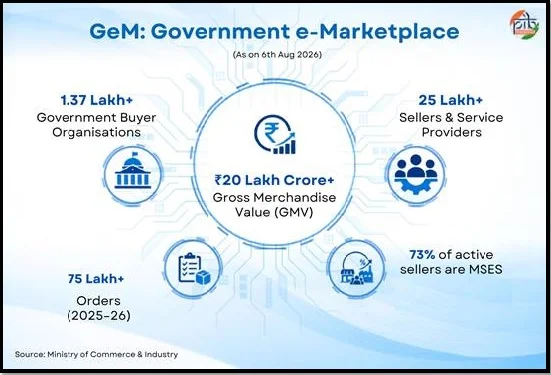
GeM has achieved remarkable scale since its launch.
The platform offers products ranging from medical equipment, computers, furniture, handicrafts, and fire safety equipment to services such as transport, catering, vehicle hiring, and manpower services.
GeM has emerged as a significant procurement platform for India's defence sector.
As of 6 August 2026:
GeM continues to evolve through policy reforms and technological upgrades.
Recent reforms include:
These reforms have simplified procurement while improving ease of doing business.
GeM has established partnerships with government institutions, financial organizations, industry bodies, and international agencies.
Collaborations with:
These partnerships promote research, training, policy development, and knowledge sharing in public procurement.
In June 2026, GeM partnered with CSC e-Governance Services India Limited (CSC-SPV) to establish 50 GeM Suvidha Kendras on a pilot basis across selected States and Union Territories.
These centers provide:
The initiative particularly supports:
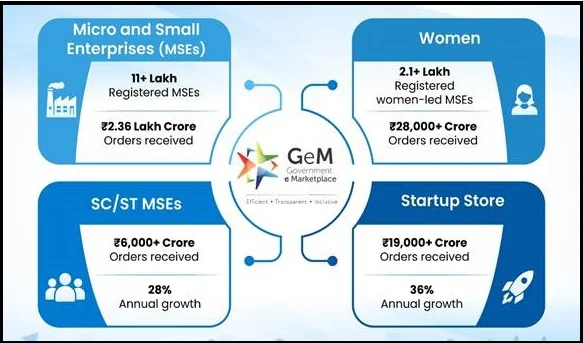
GeM has significantly expanded market access for underrepresented businesses.
This initiative offers startups a dedicated marketplace to showcase innovative products and services to government buyers.
Q1. What is the Government e-Marketplace (GeM)?Answer:-The Government e-Marketplace (GeM) is a 100% Government-owned Section 8 company established under the Department of Commerce, Ministry of Commerce and Industry. Launched on 9 August 2016, it is India's national online public procurement platform that enables government organizations to procure goods and services through a paperless, cashless, and contactless digital ecosystem. Q2. Which ministry administers GeM?Answer:-GeM functions under the Department of Commerce, Ministry of Commerce and Industry, Government of India. |
| Prelims: Sangeet Natak Akademi | Akademi Ratna | Akademi Puraskar | Performing Arts | Music | Dance | Theatre | Folk & Tribal Arts | Puppetry | Ministry of Culture Mains: GS Paper I – Indian Culture | Art & Culture | Preservation and Promotion of India’s Intangible Cultural Heritage Keywords: Sangeet Natak Akademi, Akademi Fellowship, Akademi Ratna, Akademi Puraskar, Performing Arts, Indian Classical Music, Classical Dance, Folk Arts, Theatre, Ministry of Culture, Cultural Heritage |
The President of India will confer the Sangeet Natak Akademi Fellowships (Akademi Ratna) and Sangeet Natak Akademi Awards (Akademi Puraskar) for the years 2024 and 2025 on 13 August 2026 at Vigyan Bhawan, New Delhi.
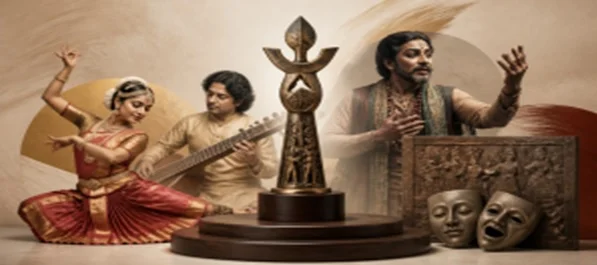
The honours cover diverse traditions, including:
The Sangeet Natak Akademi Fellowship, popularly known as Akademi Ratna, is the highest honour of the Akademi. For the 2024–2025 honours, 7 eminent personalities have been selected as Follows:
The Fellowship carries a purse of ₹3 lakh, along with a Tamrapatra and Angavastram.
The Akademi Puraskar recognises outstanding contribution to specific fields of performing arts.
The award carries:
The 2024 and 2025 awardees represent a broad range of artistic traditions from across India.
Sangeet Natak Akademi Awards 2024
The 2024 Music category includes artists from Hindustani, Carnatic and other major musical traditions.
|
Artist |
Field |
|
Arun Nagesh Kashalkar |
Hindustani Vocal |
|
Nirmalya Dey |
Hindustani Vocal – Dhrupad |
|
Bharat Bhushan Goswami |
Hindustani Instrumental – Sarangi |
|
Sanjay Mukherjee |
Hindustani Instrumental – Tabla |
|
Krishna Vageesh |
Carnatic Vocal |
|
N. Vijay Siva |
Carnatic Vocal |
|
A. S. Krishnan |
Carnatic Instrumental – Morching |
|
Komanduri Seshadri |
Carnatic Instrumental – Violin |
|
Rakesh Chaurasia |
Creative & Experimental – Flute |
|
Prabhati Mukherjee |
Sugam Sangeet |
|
Anand Bhate |
Abhang |
|
Samandar Khan Manganiar |
Mand |
The awardees represent almost the entire spectrum of India’s major classical dance traditions.
|
Artist |
Field |
|
Rajeswari Sainath |
Bharatanatyam |
|
Bipul Chandra Das |
Kathak |
|
Rajkumari Thambalsana Devi |
Manipuri |
|
Veena Murthy Vijay |
Kuchipudi |
|
Bichitrananda Swain |
Odissi |
|
Prema Ozah Borbayan |
Sattriya |
|
Sreedevi Rajan |
Mohiniattam |
|
Nripen Sahis |
Chhau |
|
Shashidharan Nair |
Creative & Experimental |
|
Kalamandalam Unnikrishnan |
Music for Dance – Kathakali |
|
Kumara Surya Narayana |
Music for Dance |
Theatre awardees include practitioners of direction, acting, lighting and traditional theatre.
|
Artist |
Field |
|
Satish Dave |
Direction |
|
T. S. Nagabharana |
Direction |
|
Ravi Chaturvedi |
Direction |
|
Om Katare |
Direction |
|
Gummadi Gopala Krishna Rao |
Acting |
|
Vagai Chanderasekar |
Acting |
|
Arun Nalavde |
Acting |
|
Dhiren D. Merchant |
Allied Theatre Arts – Lighting |
|
Dinesh Kumar Poddar |
Allied Theatre Arts – Lighting |
|
Mukund Ram Marathe |
Traditional Theatre – Sangeet Natak |
This category highlights India’s diverse community-based cultural traditions.
Important awardees include:
The 2024 honours also recognise broader contributions to performing arts:
The 2025 Music awardees include prominent practitioners of Dhrupad, Hindustani and Carnatic music.
|
Artist |
Field |
|
Krishna Mohan Pathak |
Hindustani Vocal – Dhrupad |
|
Suresh Gandharv |
Hindustani Vocal |
|
Shailesh Bhagwat |
Hindustani Instrumental – Shehnai |
|
Jyoti Ganpati Hegde |
Hindustani Instrumental – Rudra Veena |
|
Pantula Rama |
Carnatic Vocal |
|
Papanasam Ashok Ramani |
Carnatic Vocal |
|
Tripoonithura N. Radhakrishnan |
Carnatic Instrumental – Ghatam |
|
Anoor R. Anantha Krishna Sharma |
Carnatic Instrumental – Mridangam |
|
D. Srinivas |
Carnatic Instrumental – Veena |
|
Yugantar Sindoor |
Sugam Sangeet |
|
Satchidananda Das |
Mardala |
|
Seema Anil Sehgal |
Sugam Sangeet |
The 2025 Dance category covers Bharatanatyam, Kathak, Kathakali, Manipuri, Sattriya, Mohiniattam, Chhau and other traditions.
Major awardees include:
The 2025 Theatre category recognises direction, acting, music for theatre and traditional theatre forms.
|
Artist |
Field |
|
Kapildev Chandrakant Shukla |
Direction |
|
Kallol Bhattacharyya |
Direction |
|
Navdeep Kaur |
Direction |
|
Pramod Dnyandeo Pawar |
Direction |
|
Subodh Patnaik |
Direction |
|
Chetana Das |
Acting |
|
Suresh Kumar Hazzu |
Acting |
|
Makhan Lal Saraf |
Acting |
|
Ashok Patki |
Allied Theatre Arts – Music for Theatre |
|
Usha Nangiar |
Nangiarkooth |
The 2025 awardees reflect the geographical and cultural diversity of India.
Notable awardees include:
The 2025 awards also recognise wider contributions to performing arts:
The Sangeet Natak Akademi Awards are significant because they recognise not only mainstream classical traditions but also India’s folk, tribal, traditional and community-based performing arts.
The awards help:
India possesses an enormous diversity of performing arts, but many traditional forms face challenges such as:
Therefore, awards such as the Sangeet Natak Akademi honours are important, but they need to be complemented by institutional support, documentation, digital preservation, cultural education and sustainable livelihoods for artists.
UPSC Prelims MCQQ. Consider the following statements regarding the Sangeet Natak Akademi Awards:
Which of the statements given above is/are correct? A. 1 and 2 only Explanation: The Sangeet Natak Akademi recognises a wide range of performing arts, including theatre, folk and tribal arts, puppetry and allied traditions. Hence, statement 3 is incorrect. UPSC Mains Question“Recognition of traditional artists is essential for preserving India’s intangible cultural heritage, but awards alone cannot ensure its survival.” Discuss. |
1. What is the Sangeet Natak Akademi?The Sangeet Natak Akademi is India’s national academy for music, dance and drama. It promotes and preserves the country’s diverse performing arts traditions. 2. What is Akademi Ratna?Akademi Ratna is the popular name for the Sangeet Natak Akademi Fellowship, the Akademi’s highest honour. 3. When were the Sangeet Natak Akademi Awards started?The awards have been conferred since 1952. 4. What is the difference between Akademi Ratna and Akademi Puraskar?Akademi Ratna refers to the Fellowship, while Akademi Puraskar refers to the annual Sangeet Natak Akademi Awards. The Fellowship carries ₹3 lakh, while the Award carries ₹1 lakh, besides a Tamrapatra and Angavastram. 5. Why is the award important for UPSC?The topic links directly with Indian culture, performing arts, intangible cultural heritage, cultural institutions and preservation of traditional knowledge, making it relevant to UPSC and State PCS examinations. |

The Act derives its strength from the constitutional vision of equality, dignity, and social justice.
Q1. What is the SC/ST (Prevention of Atrocities) Act, 1989?Answer :-The Scheduled Castes and the Scheduled Tribes (Prevention of Atrocities) Act, 1989 is a special law enacted to prevent caste-based atrocities against members of Scheduled Castes (SCs) and Scheduled Tribes (STs), ensure speedy justice, and provide relief, rehabilitation, and protection to victims. Q2. What is the difference between the SC/ST (Prevention of Atrocities) Act and the Protection of Civil Rights Act, 1955?Answer :-The Protection of Civil Rights Act, 1955 primarily deals with offences related to untouchability under Article 17 of the Constitution, whereas the SC/ST (Prevention of Atrocities) Act, 1989 covers a much wider range of caste-based atrocities, including violence, humiliation, land alienation, social boycott, and economic exploitation. |
| Prelims: BRICS, Cross-Border Payments, Central Bank Digital Currency (CBDC), Fast Payment Systems, Rupee Internationalisation, RBI, Local Currency Trade, Artificial Intelligence in Banking Mains: GS Paper III – Indian Economy, Banking & Financial Technology; Science & Technology – AI and Emerging Technologies Keywords: BRICS 2026, RBI, Sanjay Malhotra, CBDC, UPI, Fast Payment Systems, Cross-Border Payments, Rupee Internationalisation, Local Currencies, Responsible AI |
Members of the BRICS grouping are discussing the possibility of linking their respective fast payment systems and Central Bank Digital Currencies (CBDCs) to make cross-border payments faster, cheaper and more efficient.
The discussions focus on exploring two major possibilities:
Another option under consideration is creating mechanisms through which the CBDCs of participating countries can interact with each other. CBDCs are digital forms of sovereign currency issued by central banks.
A connected CBDC ecosystem could potentially enable:
However, the proposal remains at the discussion stage and does not represent a finalized BRICS payment system.
International payments can involve multiple intermediaries, currency conversions and settlement systems.
These processes can increase:
For emerging economies, cheaper and faster payment mechanisms can support trade, remittances, investment and financial inclusion. BRICS cooperation could therefore contribute to building alternative payment channels that complement existing global financial infrastructure.
The RBI Governor also stated that the central bank will continue efforts to internationalise the Indian rupee and encourage the use of local currencies in cross-border payments and trade.
Rupee internationalisation refers to increasing the use of the Indian rupee in:
Greater use of the rupee could reduce India's dependence on foreign currencies for certain international transactions and potentially lower currency-conversion risks.
Despite the potential benefits, connecting national payment systems and CBDCs would involve several challenges.
AI can potentially improve:
However, uncontrolled use of AI can create risks related to cybersecurity, model errors, bias, data protection and governance. The RBI's approach therefore emphasises a balance between innovation and safety.
Prelims MCQQ. With reference to the proposed BRICS cooperation on cross-border payments, consider the following statements:
Which of the statements given above is/are correct? A. 1 and 2 only Mains Practice QuestionQ. How can interoperability of fast payment systems and CBDCs among BRICS countries transform cross-border payments? Discuss the opportunities and challenges for India. |
1. What is the BRICS payment-system proposal?BRICS members are discussing possible linkages between their fast payment systems and CBDCs to facilitate cheaper and faster cross-border payments. 2. What is a CBDC?A Central Bank Digital Currency is a digital form of sovereign currency issued and backed by a country's central bank. 3. How can this benefit India?It could support cross-border trade, promote rupee internationalisation, reduce transaction costs and strengthen India's role in digital payments. 4. Does this mean BRICS is creating a common currency?No. The current discussions concern payment-system and CBDC interoperability. They do not amount to the creation of a common BRICS currency. 5. Why is this important for UPSC?The topic connects BRICS, international economic cooperation, digital payments, CBDCs, rupee internationalisation, financial technology, cybersecurity and India's role in global governance, making it relevant for both Prelims and GS Paper III. |
| Prelims: National Biodiversity Authority (NBA) | Access and Benefit Sharing (ABS) | Biological Diversity Act, 2002 | Nagoya Protocol | Kunming-Montreal Global Biodiversity Framework | People’s Biodiversity Registers | Biodiversity Management Committees Mains: GS Paper III – Environment & Biodiversity | Conservation of Biological Resources | Access and Benefit Sharing | Community Participation Keywords: Mustard Genetic Resources, ABS Proceeds, National Biodiversity Authority, Pioneer Overseas Corporation, State Biodiversity Boards, UT Biodiversity Councils, Biological Diversity Act 2002, Nagoya Protocol, Kunming-Montreal GBF |
The National Biodiversity Authority (NBA) has released ₹15.52 crore as Access and Benefit Sharing (ABS) proceeds from M/s. Pioneer Overseas Corporation, which developed 10 commercial hybrid varieties of mustard (Brassica juncea) using India's biological resources.

Mustard is an important oilseed crop grown mainly for its seeds, which are used to produce edible mustard oil. Its seeds are also used as a spice and in food products.
Access and Benefit Sharing is the principle that benefits arising from the utilisation of biological resources and associated traditional knowledge should be shared fairly and equitably with the providers and custodians of those resources. In simple terms:
Biological Resource → Commercial Use → Economic Benefit → Sharing with Conservation Institutions/Communities
ABS seeks to ensure that commercialisation of biological resources does not benefit only the user or company, but also contributes to conservation and sustainable use of biodiversity.
M/s. Pioneer Overseas Corporation developed 10 mustard hybrid varieties.
The NBA obtained mustard cultivation-area data from ICAR–Indian Institute of Rapeseed-Mustard Research (ICAR-IIRMR), Bharatpur, Rajasthan, and used this data to calculate the State-wise shares.
|
Rank |
State |
Amount Released |
|
1 |
Rajasthan |
₹6.43 crore |
|
2 |
Uttar Pradesh |
₹2.28 crore |
|
3 |
Madhya Pradesh |
₹1.86 crore |
|
4 |
Haryana |
₹1.21 crore |
|
5 |
West Bengal |
₹1.10 crore |
|
6 |
Jharkhand |
₹0.73 crore |
|
7 |
Assam |
₹0.53 crore |
|
8 |
Gujarat |
₹0.48 crore |
|
9 |
Bihar |
₹0.15 crore |
|
10 |
Punjab |
₹0.08 crore |
|
11 |
Others |
₹0.67 crore |
Rajasthan receives the largest share, accounting for nearly 42% of India's mustard cultivation, followed by Uttar Pradesh and Madhya Pradesh.
The SBBs and UTBCs are required to utilise the funds for biodiversity-related activities under Section 32 of the Biological Diversity Act.
Major areas include:
This creates a link between: Commercial utilisation → ABS revenue → State/UT biodiversity institutions → Conservation → Community livelihoods
The Biological Diversity Act, 2002 provides the legal framework for regulating access to India's biological resources and ensuring equitable sharing of benefits arising from their utilisation.
The National Biodiversity Authority is a statutory body functioning under the Ministry of Environment, Forest and Climate Change (MoEFCC).
The framework also involves:
The National Biodiversity Authority (NBA) was established under the Biological Diversity Act, 2002.
Despite the legal framework, ABS implementation faces several challenges:
Prelims MCQQ. With reference to Access and Benefit Sharing (ABS), consider the following statements:
Which of the statements given above is/are correct? A. 1 and 2 only Mains Practice QuestionAccess and Benefit Sharing can transform biodiversity conservation from a regulatory obligation into a community-oriented economic mechanism. Discuss in the context of India’s Biological Diversity framework. |
Q1. What is Access and Benefit Sharing (ABS)?ABS is the mechanism through which benefits arising from the utilisation of biological resources and associated knowledge are shared fairly and equitably with relevant stakeholders. Q2. Why was ₹15.52 crore released in the mustard case?The amount represents ABS proceeds from the commercial utilisation of Indian mustard genetic resources by Pioneer Overseas Corporation. Q3. Why is Rajasthan receiving the highest share?Rajasthan accounts for nearly 42% of India's mustard cultivation, so it receives the largest share under the cultivation-area-based distribution mechanism. Q4. Which institution regulates India's biological resources under the Biological Diversity Act?The National Biodiversity Authority (NBA) is the statutory national-level authority responsible for implementing the framework. Q5. Why is ABS important for UPSC?ABS connects biodiversity conservation, genetic resources, community rights, sustainable development and international environmental agreements, making it relevant to Environment, Ecology and International Relations sections of the UPSC syllabus. |

Our support team will be happy to assist you!


 Contact Us
  New Batch : 9555124124/ 7428085757
  Tech Support : 9555124124/ 7428085757

