- UPSC Exam
- State PCS
- One Day Exam
- Current Affairs
- PT Quiz
- Downlaods
- About Coaching
- Blog
- Videos

The eighth edition of the India-U.S. Navy Explosive Ordnance Disposal (EOD) Exercise 2026 concluded on 14 August 2026 at the Southern Naval Command in Kochi.
During the exercise, personnel from both navies participated in professional exchanges and joint training covering several specialised areas, including:
The India-U.S. Navy EOD Exercise 2026 provided a platform for both navies to exchange expertise and strengthen specialised capabilities in maritime explosive threat management. The exercise further contributes to greater interoperability, operational coordination and defence cooperation between India and the United States.
Prelims QuestionQ. Consider the following statements regarding the India-U.S. Navy EOD Exercise 2026:
Which of the statements given above is/are correct?
Mains QuestionQ. India-U.S. defence exercises have contributed significantly to strengthening military interoperability and strategic cooperation. Discuss with reference to the India-U.S. Navy EOD Exercise 2026. |
Q1. What is the India-U.S. Navy EOD Exercise 2026?Ans. It is a bilateral naval exercise focused on Explosive Ordnance Disposal (EOD) and specialised maritime operations. Q2. Which countries participated in the EOD Exercise 2026?Ans. The Indian Navy and the U.S. Navy participated in the exercise. Q3. Which edition of the India-U.S. Navy EOD Exercise was held in 2026?Ans. The eighth edition was held in 2026. Q4. Where was the India-U.S. Navy EOD Exercise 2026 conducted?Ans. It was conducted at the Southern Naval Command in Kochi, Kerala. Q5. When did the India-U.S. Navy EOD Exercise 2026 conclude?Ans. The exercise concluded on 14 August 2026. |
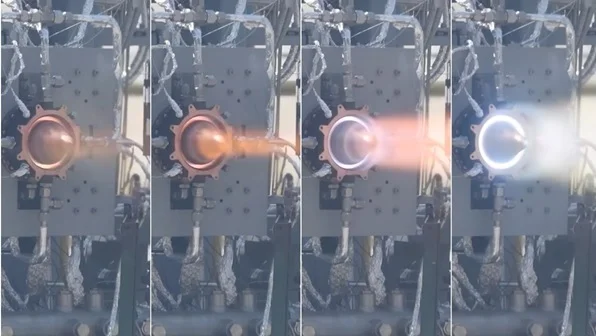
India-based defence start-up D-Propulse recently announced the successful demonstration of a Rotating Detonation Engine (RDE) at a Defence Research and Development Organisation (DRDO) facility in Hyderabad.
In simple terms:
Conventional Engine → Fuel burns through a flame
RDE → Fuel-air mixture undergoes rapid supersonic detonation
Understanding the RDE requires understanding two different forms of combustion.
Deflagration: Most conventional engines, including many gas-turbine engines, depend on deflagration.
In deflagration:
Detonation: In detonation:
RDE technology attempts to continuously harness this detonation process for propulsion.
Fuel + Oxidiser Injection
↓
Ignition
↓
Supersonic Detonation Wave
↓
Wave Rotates Around Annular Chamber
↓
High-Pressure Gas Generation
↓
Thrust
Prelims MCQQ. With reference to Rotating Detonation Engine (RDE), consider the following statements:
Which of the statements given above are correct? A. 1 and 2 only Mains Practice QuestionQ. What is a Rotating Detonation Engine (RDE)? Discuss its working principle, potential advantages and significance for India’s future aerospace and defence propulsion capabilities. |
1. What is a Rotating Detonation Engine (RDE)?An RDE is an advanced propulsion system that uses continuously rotating supersonic detonation waves to generate thrust. 2. How is an RDE different from a conventional engine?Conventional combustors primarily use subsonic deflagration, whereas RDEs use supersonic detonation for rapid energy release. 3. Why are RDEs considered more efficient?Their pressure-gain combustion can potentially provide higher thermodynamic efficiency and better fuel utilisation than conventional combustors. 4. Why is RDE technology important for India?It could strengthen India’s indigenous capabilities in advanced propulsion for missiles, high-speed aircraft, UAVs and space systems. 5. Are Rotating Detonation Engines currently operational?RDEs are still largely in the research and development stage and are not yet widely deployed in operational commercial or military platforms. |
| Prelims: Project-75I (P-75I) | Thyssenkrupp Marine Systems (TKMS) | Mazagon Dock Shipbuilders Limited (MDL) | Type-214 | Air Independent Propulsion (AIP) | Diesel-Electric Submarine Mains: GS Paper III – Defence Technology & Indigenisation | Maritime Security | Strategic Autonomy | Defence Manufacturing | Technology Transfer | Indian Ocean Region | Military Logistics | India-Germany Strategic Partnership Keywords: P-75I, TKMS, MDL, German submarines, AIP, Type-214, Indian Navy, conventional submarines, underwater warfare, strategic autonomy, Make in India, defence indigenisation, technology transfer, India-Germany relations, I2U2, maritime security |
India is moving towards finalising the long-delayed Project-75I (P-75I) programme for six advanced conventional submarines, to be built in India with German technological assistance from Thyssenkrupp Marine Systems (TKMS) and Indian shipbuilder Mazagon Dock Shipbuilders Limited (MDL).
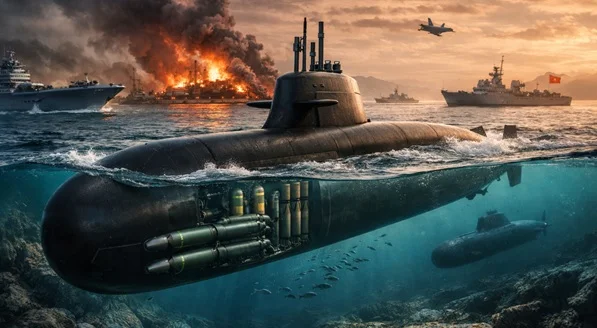
The programme is expected to provide capabilities including:
The strategic importance of P-75I lies in the combination of fleet modernisation + technology transfer + industrial capacity creation.
India's conventional submarine fleet has been under pressure for years.
The Navy operates a mixed fleet comprising:
The progression India should seek is:
Buyer → Assembler → Manufacturer → Systems Integrator → Designer → Technology Owner
Air Independent Propulsion (AIP) enables a conventional submarine to remain underwater for substantially longer periods without depending entirely on atmospheric oxygen.
For India's maritime strategy, this translates into:
In an Indian Ocean environment where maritime surveillance is becoming increasingly sophisticated, underwater endurance can be strategically decisive.
1. Sea Denial: Submarines can make strategically important maritime zones dangerous for hostile naval forces.
2. Anti-Ship Warfare: They can attack enemy surface combatants and other high-value maritime targets using torpedoes and anti-ship weapons.
3. Intelligence, Surveillance and Reconnaissance: Their stealth allows them to monitor naval movements and maritime traffic.
4. Protection of Sea Lines of Communication: India's economic security depends heavily on maritime trade. Submarines can contribute to protecting important sea routes.
5. Strategic Deterrence: Although P-75I submarines are conventional platforms and not SSBNs, their survivability contributes to India's broader maritime deterrence architecture.
6. Potential Land-Attack Capability: Depending on the final weapons configuration, such platforms can potentially contribute to long-range precision strike missions.
For India, the partnership therefore offers three major advantages:
1. Lifetime Logistics Guarantee
India should negotiate legally enforceable arrangements for spare parts and technical support throughout the submarine's service life.
2. Export-Control Protection
The contract should minimise the possibility that future licensing restrictions could affect India's operational readiness.
3. Deep Technology Transfer
Technology transfer must mean more than receiving manuals.
India needs access to manufacturing processes, engineering know-how, testing procedures and maintenance expertise.
4. Indigenous Maintenance
Critical maintenance and refit capabilities should progressively move to Indian facilities.
5. Local Manufacturing of Spares
Indian companies should manufacture an increasing proportion of critical components.
6. Software and Data Security
Mission-critical software, technical data and upgrade capabilities must be protected from future political or commercial disruptions.
7. Indigenous AIP Capability
India should use P-75I to accelerate its own fuel-cell AIP ecosystem rather than creating permanent dependence.
India and Israel already enjoy a deep defence partnership.
Combining German submarine technology with Indian industrial capacity and Israeli operational experience could create an important new maritime cooperation architecture.
However, such cooperation should be viewed as a strategic possibility, not an established component of the P-75I contract.
|
Feature |
Details |
|
Programme |
Project-75I |
|
Number |
6 conventional submarines |
|
Indian Shipbuilder |
Mazagon Dock Shipbuilders Limited |
|
Foreign OEM |
Thyssenkrupp Marine Systems, Germany |
|
Propulsion |
Diesel-electric + AIP |
|
AIP |
Fuel-cell based |
|
Construction |
India |
|
Model |
Strategic Partnership |
|
Primary Objective |
Conventional submarine fleet modernisation |
|
Strategic Objective |
Technology absorption + indigenous submarine ecosystem |
|
Key Concern |
Long-term foreign dependence |
|
Long-Term Goal |
Indigenous submarine design capability |
Prelims MCQQ. With reference to Project-75I, consider the following statements:
Which of the statements given above is/are correct? A. 1 and 2 only Mains Practice QuestionQ. “Project-75I represents both an opportunity for India's maritime capability enhancement and a potential source of long-term strategic dependency.” Discuss. |
1. What is Project-75I?Project-75I is India's programme to construct six advanced conventional diesel-electric submarines equipped with Air Independent Propulsion for the Indian Navy. 2. Who is building the P-75I submarines?The submarines are planned to be constructed in India by Mazagon Dock Shipbuilders Limited (MDL) in collaboration with Germany's Thyssenkrupp Marine Systems (TKMS). TKMS and MDL entered formal contract negotiations in 2025. 3. Why is AIP important?AIP allows conventional submarines to remain underwater for longer periods without depending on atmospheric oxygen to recharge batteries, improving stealth and survivability. 4. Why is the P-75I deal strategically important for India?It addresses the ageing conventional submarine fleet while offering an opportunity to develop India's domestic submarine manufacturing, technology and industrial ecosystem. 5. What is the biggest challenge associated with the German submarine deal?The biggest long-term challenge is strategic dependency. India must ensure that future political, commercial or export-control changes in Germany cannot compromise the availability, maintenance or upgrade of Indian submarines. |
The Ministry of Youth Affairs and Sports has announced the National Sports Awards 2025, honouring 17 sportspersons with the Arjuna Award for their outstanding performances. However, the Major Dhyan Chand Khel Ratna Award, India’s highest sporting honour, was not awarded to anyone in 2025.

The Arjuna Award is given to sportspersons for outstanding performance over the previous four years, along with qualities of leadership, sportsmanship and discipline.
|
S. No. |
Sportsperson |
Sport |
|
1 |
Tejaswin Shankar |
Athletics |
|
2 |
Muhammed Ajmal V |
Athletics |
|
3 |
Priyanka Goswami |
Athletics |
|
4 |
Treesa Jolly |
Badminton |
|
5 |
Pullela Gayatri Gopichand |
Badminton |
|
6 |
Narender |
Boxing |
|
7 |
Vidit Santosh Gujarathi |
Chess |
|
8 |
Divya Jitendra Deshmukh |
Chess |
|
9 |
Dhanush Srikanth |
Deaf Shooting |
|
10 |
Lalremsiami |
Hockey |
|
11 |
Rajkumar Pal |
Hockey |
|
12 |
Surjeet |
Kabaddi |
|
13 |
Pooja |
Kabaddi |
|
14 |
Rudransh Khandelwal |
Para-Shooting |
|
15 |
Ekta Bhyan |
Para Athletics |
|
16 |
Arvind Singh |
Rowing |
|
17 |
Akhil Sheoran |
Shooting |
|
Award |
Awardee / Organisation |
Sport / Field |
|
Arjuna Award (Lifetime) |
I. Arumainayagam |
Football |
|
Dronacharya Award |
Parveer Singh |
Athletics |
|
Dronacharya Award |
Chhote Lal Yadav |
Boxing |
|
Dronacharya Award |
Neha Nandkumar Chavan |
Shooting |
|
Dronacharya Award (Lifetime) |
Dharmendra Singh Yadav |
Boxing |
|
Dronacharya Award (Lifetime) |
Virender Kumar |
Wrestling |
|
Rashtriya Khel Protsahan Puraskar |
Army Paralympic Node, Pune |
Sports Promotion |
The National Sports Awards recognise athletes, coaches and organisations that have made significant contributions to Indian sports. The awards also encourage excellence, discipline, leadership and sportsmanship among sportspersons.
The National Sports Awards 2025 recognised outstanding contributions across several sporting disciplines. While 17 sportspersons were honoured with the Arjuna Award and five coaches received the Dronacharya Award, the absence of a Khel Ratna recipient was the most significant feature of this year's awards.
Prelims QuestionQ. Consider the following statements regarding the National Sports Awards 2025:
Which of the statements given above is/are correct?
Mains QuestionQ. “National Sports Awards play an important role in promoting sporting excellence and building a culture of sports in India.” Discuss the significance of such awards in the development of Indian sports. |
Q1. Who received the Arjuna Award in National Sports Awards 2025?Ans. A total of 17 sportspersons received the Arjuna Award for outstanding performance in sports and games. Q2. Who received the Arjuna Award (Lifetime) in 2025?Ans. Former footballer I. Arumainayagam received the Arjuna Award (Lifetime). Q3. Was the Major Dhyan Chand Khel Ratna Award given in 2025?Ans. No. No sportsperson was selected for the Major Dhyan Chand Khel Ratna Award in 2025. Q4. Who received the Dronacharya Award 2025 in the regular category?Ans. Parveer Singh (Athletics), Chhote Lal Yadav (Boxing), and Neha Nandkumar Chavan (Shooting) received the Dronacharya Award. Q5. Who received the Dronacharya Award (Lifetime) in 2025?Ans. Dharmendra Singh Yadav (Boxing) and Virender Kumar (Wrestling) received the Dronacharya Award (Lifetime). |
| Prelims: NASA Moon Base | Artemis Programme | Artemis Accords | ISRO | Gaganyaan | Bharatiya Antariksh Station | Lunar South Pole | Human Spaceflight Mains: GS Paper II – India-US Relations | GS Paper III – Space Technology | Strategic Autonomy | Space Governance Keywords: NASA Moon Base, ISRO, Artemis Accords, Gaganyaan, Bharatiya Antariksh Station, Human Moon Mission, Lunar Exploration, India-US Space Cooperation |
India has reportedly received an invitation to participate in NASA’s Moon Base programme, which seeks to develop a sustained human and robotic presence on the Moon. The proposal is significant for ISRO because India is simultaneously pursuing Gaganyaan, Bharatiya Antariksh Station (BAS) and a human Moon-landing mission by 2040.
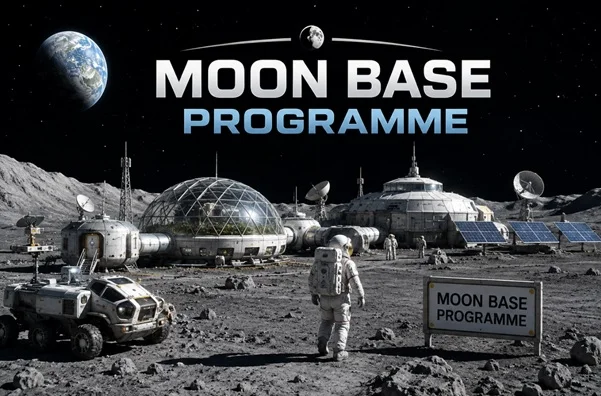
The programme aims to move beyond short-duration lunar missions towards creating infrastructure that can support astronauts and robots on the Moon for prolonged periods.
It could involve:
The Artemis Accords, launched in 2020, provide principles for peaceful and responsible space exploration.
They cover areas such as:
India became the 27th signatory to the Artemis Accords in June 2023.
However: Artemis Accords ≠ Artemis Programme
Signing the Accords does not automatically make India a participant in NASA's Artemis missions. Specific participation requires separate agreements.
The Artemis framework is sometimes viewed as a US-led effort to shape rules for future lunar exploration and resource utilisation, particularly because major space powers China and Russia remain outside it.
1. Faster Technology Development: ISRO needs several advanced technologies for future human and lunar missions. Participation would allow India to gain practical experience rather than independently developing every technology from scratch. This could significantly reduce development time and help India leapfrog technologically.
2. Support India's Human Spaceflight Roadmap: India has an ambitious sequence of missions:
Gaganyaan → Bharatiya Antariksh Station (2035) → Human Moon Landing (2040)
Experience from an international lunar programme could directly contribute to these missions. In particular, long-duration human spaceflight, docking, habitation and lunar-surface operations would be valuable for both BAS and India's eventual crewed Moon mission.
3. Economic Advantage: Maintaining an independent human-spaceflight programme, space station and lunar programme simultaneously would require enormous expenditure. International cooperation allows India to:
Share Cost + Share Infrastructure + Gain Experience + Avoid Technology Duplication
India can retain sovereign capabilities in critical areas while collaborating on infrastructure that does not need to be developed independently.
4. Boost to Indian Space Industry: Participation could provide opportunities for Indian companies in:
Robotics | Electronics | Advanced Materials | AI | Communications | Precision Manufacturing
It could also integrate India's private space sector into advanced global space supply chains.
5. Technology Spin-offs: Technologies developed for lunar exploration can have applications on Earth.
Areas such as robotics, AI, water recycling, advanced materials, energy storage, telecommunications and medical technology could benefit from such collaboration. Thus:
Space Cooperation → Technology Development → Industrial & Economic Benefits
Prelims MCQQ. With reference to the Artemis Accords, consider the following statements:
Which of the statements given above are correct? A. 1 and 2 only UPSC Mains QuestionQ. How can India's participation in NASA-led lunar exploration strengthen its human-spaceflight ambitions while preserving strategic autonomy? Discuss. |
1. What is NASA’s Moon Base Programme?It aims to establish a sustained human and robotic presence on the Moon for scientific research, exploration and future utilisation of lunar resources. 2. Why is NASA’s Moon Base Programme important for India?Participation could help ISRO gain experience in lunar habitats, life-support systems, robotics, docking and deep-space operations, accelerating India’s human-spaceflight programme. 3. What are the Artemis Accords?They are a set of principles for peaceful, transparent and responsible space exploration, including interoperability, scientific cooperation and space-resource utilisation. 4. How can Moon Base cooperation support India’s future space missions?The experience could complement Gaganyaan, Bharatiya Antariksh Station and India’s goal of sending astronauts to the Moon by 2040. 5. What is the main concern for India in joining such a programme?India must avoid excessive technological dependence and protect its strategic autonomy while benefiting from international cooperation—“Interoperability without Dependency.” |

Our support team will be happy to assist you!

 Contact Us
  New Batch : 9555124124/ 7428085757
  Tech Support : 9555124124/ 7428085757