- UPSC Exam
- State PCS
- One Day Exam
- Current Affairs
- PT Quiz
- Downlaods
- About Coaching
- Blog
- Videos


Following the implementation of the PROG Act in October 2025, users increasingly shifted from regulated Indian gaming platforms to offshore betting websites.
Studies conducted by CUTS International reported a significant rise in offshore participation after the implementation of the Act.
|
Region |
Offshore Usage Before Ban |
Offshore Usage After Ban |
|
Delhi NCR |
68.3% |
82% |
|
Tamil Nadu |
67.8% |
83% |
|
Maharashtra |
66.7% |
91.7% |
In Tamil Nadu, offshore participation increased by approximately 15.2 percentage points, indicating a major behavioural shift toward foreign gambling platforms.
These figures indicate that rather than abandoning online gambling, users increasingly relied on offshore platforms operating outside Indian laws and regulatory oversight.
The growing use of offshore gambling websites has raised several concerns.
Offshore platforms may facilitate :
Since these platforms remain outside domestic oversight, monitoring financial activities becomes difficult.
Users accessing offshore gambling platforms often lack :
As a result, users face greater vulnerability to fraud and exploitation.
Illegal offshore operators use sophisticated technologies to bypass government restrictions and enforcement measures. These include :
Whenever authorities block one website, users are quickly redirected to alternative platforms with minimal disruption.
The widespread use of VPNs and encrypted communication channels weakens enforcement efforts and reduces the effectiveness of outright bans.
Across industries, strict prohibitions rarely eliminate consumer demand. Instead, bans often shift activities toward underground or unregulated channels.
This challenge is particularly significant in digital markets because users can easily access global platforms through the internet.
The Ministry of Electronics and Information Technology informed the Lok Sabha during the Budget Session that the government had blocked 8,376 URLs to curb illegal betting networks and cybercrime activities linked to offshore operators.
Despite these enforcement efforts, reports of gambling-related fraud and financial distress continue to emerge, demonstrating the limitations of prohibition.
A major online gambling and fraud racket uncovered in Sivaganga district of Tamil Nadu illustrates the risks posed by illegal offshore networks.
The accused promoted a fraudulent “Old Coin Purchase Task” scheme through Telegram groups, promising high returns through fake old-coin investment activities.
Victims were persuaded to invest money, while villagers from Sivaganga, Paramakudi, and Kalayarkovil were encouraged to open “mule accounts” in exchange for small payments. These accounts were later used to divert illegal funds.
The incident demonstrated how offshore-linked networks can exploit vulnerable populations and support organised financial crimes.
Although the UAE historically maintained strict restrictions on gambling activities, it introduced a regulated federal licensing framework in 2023.
The framework includes :
The objective is to reduce illegal offshore activity while ensuring accountability and regulatory oversight.
Sri Lanka is also moving toward a regulated framework through the establishment of a centralised Gambling Regulatory Authority, expected to become operational by June 2026.
The authority aims to :
These international examples indicate that several countries are shifting from prohibition toward regulated governance systems.
A regulated online gaming ecosystem could provide several benefits.
Regulation could introduce :
Regulation would enable authorities to :
A regulated gaming ecosystem could also generate tax revenue.
These funds could be used for :
Several Western countries have adopted similar approaches successfully.
Addressing illegal online gambling requires coordinated action among :
A combined approach involving regulation, technological monitoring, enforcement, and public awareness may provide a more sustainable solution than prohibition alone.
Recently, the Union Minister for Science & Technology dedicated the UMMID Programme, a national initiative aimed at improving healthcare services for individuals and families affected by inherited and rare genetic disorders.
The programme marks an important step toward strengthening early diagnosis, genetic counselling, and affordable healthcare support for patients suffering from rare diseases in India.
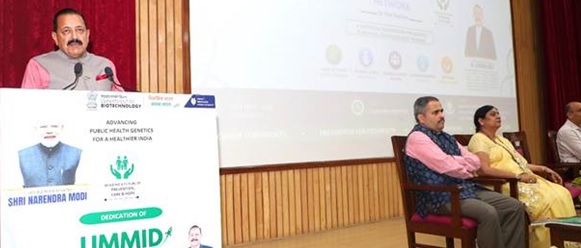
UMMID (Unique Methods of Management of Inherited Disorders) is a national programme launched to address rare genetic disorders and inherited diseases in India.
The initiative focuses on promoting early intervention, timely diagnosis, and affordable healthcare services for affected families.
It aims to improve the diagnosis, management, and prevention of inherited and rare genetic disorders through an integrated public health approach.
The UMMID Programme has been introduced with the following objectives :
The UMMID Programme represents India’s first comprehensive national initiative specifically designed to address inherited genetic disorders through an integrated framework.
The programme adopts a multi-dimensional approach covering :
This integrated strategy seeks to establish structured systems for managing rare genetic diseases at the national level.
The programme operates through three major pillars :
NIDAN Kendras serve as specialised centres for :
These centres aim to strengthen early detection and improve patient management.
The programme includes outreach activities in Aspirational Districts to improve access to healthcare services in underserved regions.
The outreach component focuses on :
The initiative establishes specialised training centres to build capacity among healthcare professionals.
These centres provide :
The UMMID Programme supports the implementation of the National Policy for Rare Diseases (NPRD), 2021.
It contributes by creating structured care pathways for patients suffering from inherited and rare disorders.
The programme helps improve :
The programme is implemented under the leadership of the Department of Biotechnology.
The Department of Biotechnology (DBT) under the Ministry of Science & Technology serves as the nodal agency responsible for implementing the initiative.
The UMMID Programme is significant because it :
The initiative is expected to improve healthcare outcomes and reduce the burden of inherited genetic disorders in India.
The UMMID Programme represents a major step in India’s healthcare system by creating an integrated framework for managing inherited and rare genetic disorders.
Through diagnostics, counselling, outreach activities, training, and public awareness, the programme seeks to strengthen early intervention and ensure better healthcare access for affected families.
By supporting the National Policy for Rare Diseases, 2021, the initiative is expected to improve long-term care systems and advance India’s rare disease management ecosystem.

Finding no factual or legal error in the case, the Punjab and Haryana High Court dismissed the insurance company's petition and upheld the order awarding the wife an insurance payment of ₹14.22 lakh.
Taiwan Travelogue by Yáng Shuāng-zǐ, translated by Lin King, won the 2026 International Booker Prize. The novel received global recognition for its rich portrayal of Taiwanese culture, identity and history through an engaging literary narrative.

Loktak Lake was recently in the news because of its unique floating islands known as phumdis, which are considered one of the most remarkable ecological features in the world. Scientists and environmentalists have highlighted the need to conserve the lake due to increasing ecological pressures and changes in water flow patterns.


Indian states primarily manage electricity for their consumers through two strategies :
|
Management Method |
Share/Proportion |
Description |
|
Contractual Supply (PPA) |
85% – 90% |
Long-term Power Purchase Agreements (PPAs) are signed between DISCOMs and power producers for several years to meet the average electricity demand. |
|
Power Exchange |
10% – 15% |
States purchase relatively expensive electricity from real-time power markets during sudden demand surges, power plant outages, or supply shortages. |
Electricity demand has increased by a staggering 37% over the past five years (from 183 gigawatts in December 2020 to exceed 250 gigawatts in April 2026). This rapid growth has posed a dual threat to states:
The role of renewable sources such as solar, wind, and hydropower in managing peak demand is increasing due to their significantly lower operating costs. However, the impact varies across different states in India:
The challenge now is not just generating more electricity, but also efficiently managing the generated electricity. To secure future needs, the following steps are essential:

This mobile app is designed for all attendees of Bharat Tex 2026. You can access all the information about the event from this single app.

Our support team will be happy to assist you!

 Contact Us
  New Batch : 9555124124/ 7428085757
  Tech Support : 9555124124/ 7428085757