- UPSC Exam
- State PCS
- One Day Exam
- Current Affairs
- PT Quiz
- Downlaods
- About Coaching
- Blog
- Videos

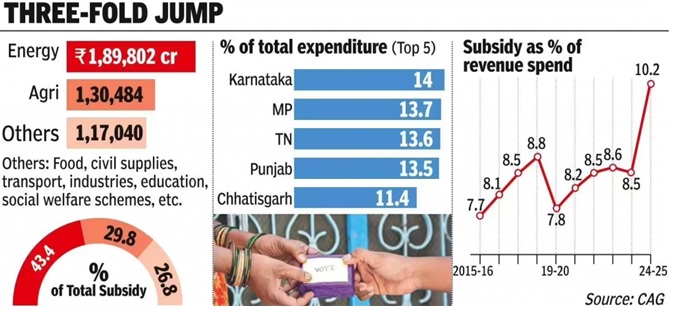
Subsidies account for nearly 9% of total state expenditure, showing their growing importance in state budgets. The share of subsidies in revenue expenditure has also increased to 10.2%, indicating higher recurring financial commitments.
This rise reflects expanding welfare schemes but also reduces flexibility for development spending.
The energy sector remains the largest component, accounting for 43.4% of total subsidies (around ₹1.9 lakh crore). These subsidies are mainly used to support electricity supply for households and farmers and to compensate losses of power distribution companies.
Agriculture is the second-largest sector, receiving ₹1.30 lakh crore in subsidies, including support for irrigation, fertilisers, and farm inputs.
Some states show significantly higher dependency on subsidies, indicating uneven fiscal stress across India. Karnataka recorded the highest subsidy burden at 14.01% of total expenditure, while Rajasthan led in energy subsidy spending at ₹32,572 crore.
Other states such as Madhya Pradesh, Tamil Nadu, Uttar Pradesh, and Punjab also show consistently high subsidy-related expenditure.
State debt has increased sharply from ₹23.92 lakh crore (2015-16) to ₹75.52 lakh crore (2024-25). This reflects a 216% rise over the last decade, largely driven by borrowing to meet revenue expenditure.
Debt levels in many states now exceed 186% of their revenue receipts, raising concerns about long-term fiscal sustainability.
A large portion of state budgets is locked into fixed obligations such as salaries, pensions, and interest payments. Salaries amount to ₹7.71 lakh crore, pensions to ₹5.12 lakh crore, and interest payments to ₹5.7 lakh crore.
These unavoidable expenses significantly reduce the money available for infrastructure and new development projects.
Revenue expenditure now dominates over 83% of total spending, leaving limited space for capital investment. As a result, spending on infrastructure, education, healthcare, and other productive sectors is not growing proportionately.
This creates a structural imbalance between welfare spending and long-term development needs.
The report raises several important concerns regarding state finances :
The CAG suggests several corrective measures for states to ensure fiscal stability :
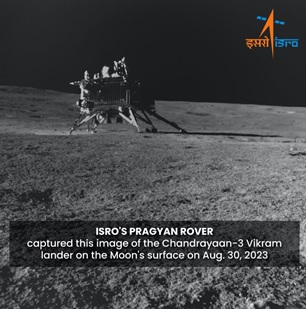
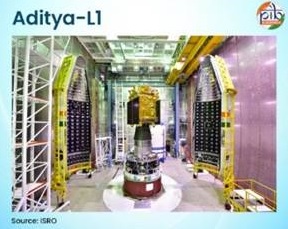
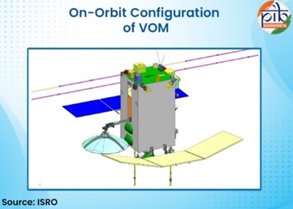
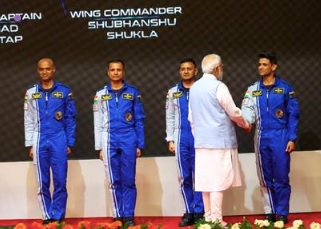
Did You Know ?As part of preparations for Gaganyaan, India participated in the ISRO-NASA supported Axiom-4 mission to the International Space Station in 2025. Group Captain Shubhanshu Shukla travelled aboard the SpaceX Dragon spacecraft launched by Falcon 9 on 25 June 2025. During the mission, he conducted seven microgravity experiments developed by Indian research institutions. The studies examined muscle regeneration, algal growth, crop viability, microbial survivability, cognitive performance, and cyanobacterial behaviour in space. The mission concluded successfully on 15 July 2025 with safe undocking, re-entry, and splashdown. Beyond its scientific outcomes, Axiom-4 provided India with valuable operational experience in astronaut training, human spaceflight procedures, microgravity research, and international collaboration, strengthening the country's readiness for future crewed missions.
|
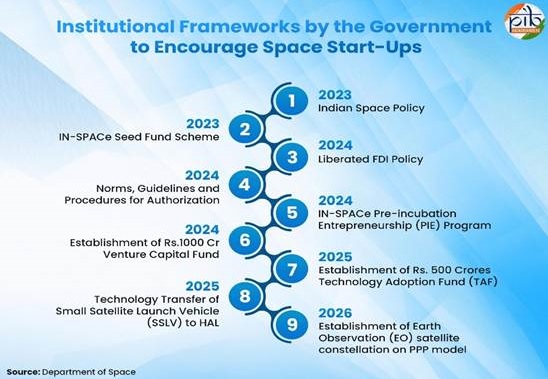
Did You Know?In February 2024, the Government liberalised the Foreign Direct Investment (FDI) policy for the space sector, allowing up to 100% FDI in selected activities. Up to 74% FDI is permitted under the automatic route for satellite manufacturing and operations, satellite data products, and ground/user segment services. Up to 49% FDI is allowed for launch vehicles, related systems, and spaceports, while 100% FDI under the automatic route is permitted for manufacturing satellite and ground-segment components and subsystems. To further boost private participation, the Indian National Space Promotion and Authorisation Centre (IN-SPACe) introduced the Norms, Guidelines and Procedures (NGP) 2024. The framework provides clear authorization, eligibility, and compliance requirements for space activities, bringing greater transparency, predictability, and investor confidence to India's rapidly expanding space ecosystem. |
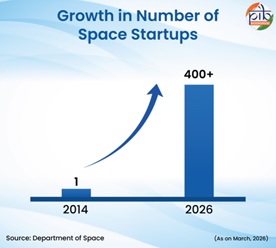
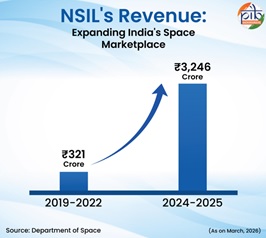
The scale of change is striking. In 2014, India had just one registered space start-up. As on Feb 2026, that number had crossed 400. Investment in Indian space start-ups exceeded $500 million, with nearly $150 million attracted in 2025 alone. Companies such as Pixxel, Dhruva Space, Skyroot Aerospace, Agnikul Cosmos, and Bellatrix Aerospace have emerged as pioneers of a new space era.
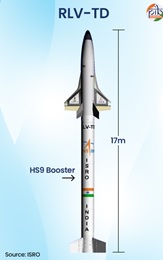
Did You Know ?India is expanding its Space Launch Infrastructure rapidly India's second spaceport is coming up at Kulasekarapattinam, Tamil Nadu. The foundation stone for the Small Satellite Launch Vehicle (SSLV) Complex was laid on 28 February 2024 to support 20–25 orbital launches annually, with the first SSLV launch targeted for FY 2026–27. In January 2025, Third Launch Pad at Sriharikota at a cost of ₹3,984.86 crore approved. The facility will support next-generation launch vehicles, human spaceflight missions, and future lunar exploration. |
Did You Know ?India leads the BIMSTEC Space Programme as part of its “Neighbourhood First” policy. The initiative strengthens regional cooperation through space technology, disaster management, and capacity building. The North Eastern Space Applications Centre (NESAC) conducts specialised training programmes for BIMSTEC countries in space applications and satellite technologies. India has also proposed regional nano-satellites, local ground stations, and shared earth observation data for climate and disaster management. The BIMSTEC Centre for Weather and Climate supports regional forecasting and disaster preparedness. An Expert Group on Space Security Cooperation further strengthens regional resilience and strategic collaboration. |

Did you know?India's space partnership with Russia dates back to 1975, when the Soviet Union launched India's first satellite, Aryabhata. Russia also enabled India's first human spaceflight milestone when Wing Commander Rakesh Sharma travelled to space aboard Soyuz T-11 in 1984. Today, the partnership extends to Gaganyaan, satellite navigation cooperation through GLONASS and NavIC, and future space exploration initiatives, highlighting the enduring credibility and strategic depth of India-Russia space cooperation. |





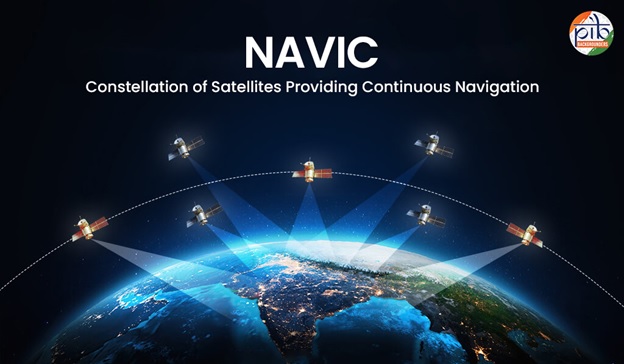
Did You know:In 2025, India signed an agreement with South Africa to establish a NavIC reference station. The initiative will strengthen the performance and reach of India's indigenous satellite navigation system beyond national boundaries. The partnership enhances navigation cooperation and demonstrates growing international confidence in India's space-based positioning and timing capabilities. |
Did You KnowSouth Asia Satellite (GSAT-9) is a 2,230-kg geostationary communication satellite providing coverage over Afghanistan, Bangladesh, Bhutan, Maldives, Nepal and Sri Lanka. It was launched on 5 May 2017 aboard the GSLV-F09 rocket from Sriharikota, as a gift to neighbours in the SAARC region. Built by ISRO and funded entirely by India at a total cost of approximately ₹450 crore, the satellite carries 12 Ku-band transponders, with each participating country receiving access to one transponder. The satellite supports DTH (direct-to-home) broadcasting, telemedicine, tele-education, banking connectivity, weather forecasting and disaster management links across the region. It has a designed mission life of 12 years. Pakistan opted out of the project; as a result, the original name "SAARC Satellite" was changed to "South Asia Satellite." |
Origin and History of ISRO (Indian Space Research Organisation)India’s space research activities began in the early 1960s, at a time when satellite applications were still in their experimental stages worldwide. Over the decades, India has built one of the most successful and cost-effective space programs in the world.
Establishment of INCOSPAR (1962)Recognizing the importance of space research for national development, Dr. Vikram Sarabhai proposed the creation of the Indian National Committee for Space Research (INCOSPAR) in 1962 under the Department of Atomic Energy (DAE).
Formation of ISRO (1969)To expand India's space activities and harness space technology for national development, INCOSPAR was replaced by the Indian Space Research Organisation (ISRO) on 15 August 1969, with its headquarters in Bengaluru. Objective of ISROThe primary objective of ISRO is to develop and apply space technology for various national needs. To achieve this goal, ISRO has established major space systems supporting:
Major ISRO Centres
|
||||||||||||||
ISRO Missions and SatellitesSince its establishment, ISRO has achieved remarkable milestones in space exploration and technology, demonstrating exceptional efficiency and cost-effectiveness. 1. Launch VehiclesLaunch vehicles are rocket-powered systems that carry spacecraft beyond Earth’s atmosphere into orbit or deep space. Operational Launch Vehicles
2. Experimental SatellitesISRO launched several experimental satellites primarily for scientific research, remote sensing, and atmospheric studies. Key Examples
3. Communication SatellitesCommunication satellites use transponders to transmit signals from one location on Earth to another. Major Communication Satellite Systems
The launch of INSAT-1B in 1983 revolutionized India's communication, television broadcasting, and weather services. 4. Earth Observation SatellitesEarth observation involves collecting information about Earth's physical, chemical, and biological systems using remote sensing technologies. Important Earth Observation Satellites
Other Notable Earth Observation Satellites
5. Navigation SatellitesNavigation satellite systems provide accurate positioning, navigation, and timing services. GAGANGPS Aided GEO Augmented Navigation (GAGAN) was developed by ISRO to provide satellite-based navigation services for civil aviation in Indian airspace. NavICNavigation with Indian Constellation (NavIC) is India's independent regional navigation satellite system providing positioning, navigation, and timing services. 6. Small SatellitesSmall satellites generally weigh less than 500 kilograms and are used for Earth imaging, scientific missions, and technology demonstrations. Examples
|
The India-United Kingdom Comprehensive Economic and Trade Agreement (CETA), which is set to come into effect on July 15, is being considered a significant milestone in India's trade diplomacy. This agreement aims to increase trade between the two countries, expand market access, boost Indian exports, facilitate professional mobility, and accelerate the goal of 'Developed India 2047.' It holds a special place among the most comprehensive and ambitious free trade agreements India has signed with a developed economy.
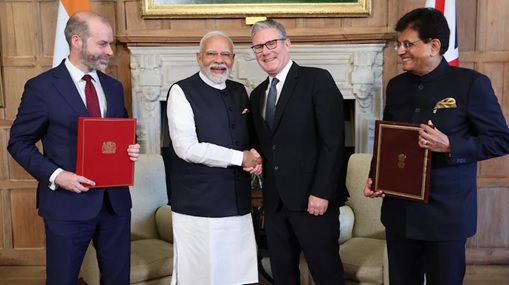
The India-UK CETA is a new-generation trade agreement, not limited to tariff reductions but also encompassing investment facilitation, professional mobility, social security cooperation, and broader dimensions of economic partnership. This agreement will play a significant role in boosting Indian exports, encouraging job creation, attracting investment, and strengthening India's participation in global markets. While ensuring the protection of sensitive domestic sectors, this agreement can prove to be an important step in moving India towards the goal of a 'Developed India 2047'.
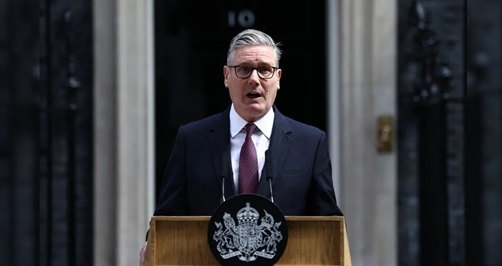
Keir Starmer and several of his cabinet ministers were accused of accepting gifts and perks worth thousands of pounds. This matter became known as "Freebies Gate." This controversy affected his credibility with the public and led to a significant decline in his popularity.
In the current political climate, Andy Burnham is considered a leading contender for the post of Prime Minister. Wes Streeting has reportedly withdrawn his candidacy and endorsed Burnham, further strengthening his position.

|
Q. The Central Consumer Protection Authority (CCPA) was established under which Act ? (A) Consumer Protection Act, 1986 (B) Food Safety and Standards Act, 2006 (C) Consumer Protection Act, 2019 (D) Legal Metrology Act, 2009 |

Our support team will be happy to assist you!

 Contact Us
  New Batch : 9555124124/ 7428085757
  Tech Support : 9555124124/ 7428085757