
- UPSC Exam
- State PCS
- One Day Exam
- Current Affairs
- PT Quiz
- Downlaods
- About Coaching
- Blog
- Videos

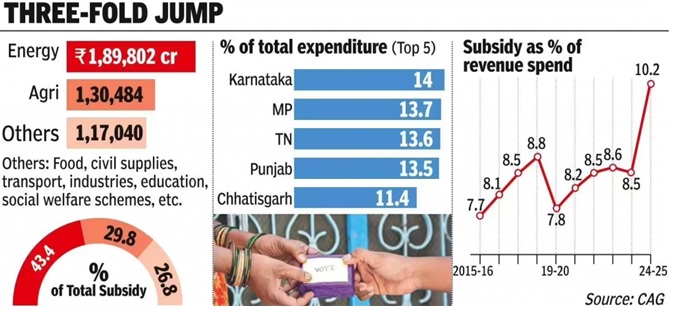
Subsidies account for nearly 9% of total state expenditure, showing their growing importance in state budgets. The share of subsidies in revenue expenditure has also increased to 10.2%, indicating higher recurring financial commitments.
This rise reflects expanding welfare schemes but also reduces flexibility for development spending.
The energy sector remains the largest component, accounting for 43.4% of total subsidies (around ₹1.9 lakh crore). These subsidies are mainly used to support electricity supply for households and farmers and to compensate losses of power distribution companies.
Agriculture is the second-largest sector, receiving ₹1.30 lakh crore in subsidies, including support for irrigation, fertilisers, and farm inputs.
Some states show significantly higher dependency on subsidies, indicating uneven fiscal stress across India. Karnataka recorded the highest subsidy burden at 14.01% of total expenditure, while Rajasthan led in energy subsidy spending at ₹32,572 crore.
Other states such as Madhya Pradesh, Tamil Nadu, Uttar Pradesh, and Punjab also show consistently high subsidy-related expenditure.
State debt has increased sharply from ₹23.92 lakh crore (2015-16) to ₹75.52 lakh crore (2024-25). This reflects a 216% rise over the last decade, largely driven by borrowing to meet revenue expenditure.
Debt levels in many states now exceed 186% of their revenue receipts, raising concerns about long-term fiscal sustainability.
A large portion of state budgets is locked into fixed obligations such as salaries, pensions, and interest payments. Salaries amount to ₹7.71 lakh crore, pensions to ₹5.12 lakh crore, and interest payments to ₹5.7 lakh crore.
These unavoidable expenses significantly reduce the money available for infrastructure and new development projects.
Revenue expenditure now dominates over 83% of total spending, leaving limited space for capital investment. As a result, spending on infrastructure, education, healthcare, and other productive sectors is not growing proportionately.
This creates a structural imbalance between welfare spending and long-term development needs.
The report raises several important concerns regarding state finances :
The CAG suggests several corrective measures for states to ensure fiscal stability :



Our support team will be happy to assist you!

 Contact Us
  New Batch : 9555124124/ 7428085757
  Tech Support : 9555124124/ 7428085757