New
Hindi Medium: (Delhi) - GS Foundation (P+M) : 6th July 2026, 6:00 PM Hindi Medium: (Prayagraj) - GS Foundation (P+M) : 1st June 2026, 5:30 PM English Medium: (Delhi) - GS Foundation (P+M) : 20th July 2026 Hindi Medium: (Delhi) - GS Foundation (P+M) : 6th July 2026, 6:00 PM Hindi Medium: (Prayagraj) - GS Foundation (P+M) : 1st June 2026, 5:30 PM English Medium: (Delhi) - GS Foundation (P+M) : 20th July 2026

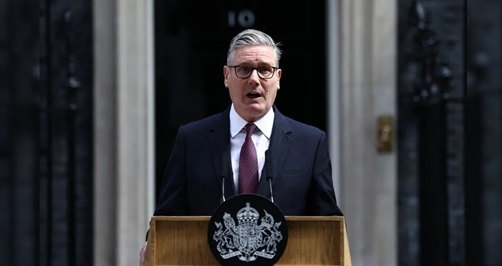
Keir Starmer resigns: What is the constitutional process for changing Prime Minister in the UK?

Why in the news ?

  • British Prime Minister Keir Starmer has formally resigned from his post and as leader of the Labour Party. With his resignation, Britain has lost its seventh Prime Minister in the past decade, which is being seen as a sign of growing political instability in the country.
  • In the 2024 general election, the Labour Party won 412 seats, defeating the Conservative Party, which had been in power for 14 years. However, Starmer was forced to step down only two years after receiving a landslide mandate.

Why did Keir Starmer resign ?

Freebies Gate controversy

  • Keir Starmer and several of his cabinet ministers were accused of accepting gifts and perks worth thousands of pounds. This matter became known as "Freebies Gate." This controversy affected his credibility with the public and led to a significant decline in his popularity.

Unpopular policy decisions

  • Several decisions by the Starmer government caused public discontent. The government cut the winter fuel subsidy for approximately 10 million pensioners. Additionally, approximately 1,700 prisoners were released before the completion of their sentences.
  • Some of the harsh economic measures taken to raise resources for the National Health Service (NHS) were also not well-received by the public.

The Impact of Brexit

  • Keir Starmer's resignation comes just before the tenth anniversary of Britain's exit from the European Union, or Brexit. Britain left the EU following a referendum in 2016.
  • Even a decade later, its economic and political effects are clearly visible. Problems such as slow economic growth, rising government borrowing, rising taxes, inflation, business complexities, and limited success in immigration control have fueled public discontent.
  • Several surveys have shown that a majority of British citizens believe Brexit was a wrong decision.

Poor performance in local elections

  • The Labour Party suffered a serious setback in the local elections held in May 2026. The party lost nearly 1,100 council seats and lost control of more than 30 local councils.
  • The party also performed poorly in the Makerfield by-election. These results strengthened calls for leadership change within the party and ultimately led to Starmer's resignation.

How is the Prime Minister elected in Britain ?

  • The British Parliament consists of two houses, the House of Commons and the House of Lords. The House of Commons is the elected lower house of Parliament, consisting of 650 MPs, while the House of Lords is the upper house, whose members are appointed or hereditary.
  • British citizens elect MPs from their constituencies in general elections. The leader of the political party that wins a majority in the House of Commons is invited by the British monarch, King Charles III, to form a government. This leader then becomes Prime Minister.
  • It is important to understand that in Britain, the five-year term is for Parliament, not for the Prime Minister. Therefore, if the ruling party wishes, it can change its leader and Prime Minister even before the end of Parliament's term.

Why is the Prime Minister called "first among equals"c?

  • In the British parliamentary system, the Prime Minister is not considered an all-powerful ruler. He is called "primus inter pares," meaning "first among equals."
  • This means that the Prime Minister's power is based on the confidence of his party and cabinet. If the support of his party's MPs wanes, the Prime Minister may have to step down and be replaced by another leader.

What is the process for replacing the Prime Minister ?

  • If the position of Labour Party leader becomes vacant or enough party MPs demand a leadership change, the process of selecting a new leader begins.
  • First, the Labour Party's National Executive Committee (NEC) meets and schedules the leadership election. Interested candidates then submit their nominations.
  • Candidates must be current members of the House of Commons and have the necessary support from party organizations or affiliated institutions.
  • Party members then vote through a preferential voting system. Voters rank the candidates in order of their preference. If no candidate receives more than 50 percent of the vote in the first round, the candidate with the lowest number of votes is eliminated and their votes are transferred to other candidates. This process continues until a candidate receives a clear majority.

The Constitutional Process of Transfer of Power

  • After the selection of a new leader, the outgoing Prime Minister formally submits his resignation to the British Monarch at Buckingham Palace. The newly elected leader is then invited to meet with the Monarch.
  • The Monarch invites him to form a government, and upon accepting the invitation, he becomes the new Prime Minister of Britain.

Who Could Be the Next Prime Minister ?

  • In the current political climate, Andy Burnham is considered a leading contender for the post of Prime Minister. Wes Streeting has reportedly withdrawn his candidacy and endorsed Burnham, further strengthening his position.


Conclusion

  • Since the Brexit referendum in 2016, Britain has experienced a period of frequent leadership changes. During this period, leaders such as David Cameron, Theresa May, Boris Johnson, Liz Truss, Rishi Sunak, and Keir Starmer have served as Prime Minister, but none has completed a full term.
  • Keir Starmer's resignation is not just a political event, but also a symbol of the economic challenges in Britain, the long-term effects of Brexit, political polarization, and changing public opinion. This incident demonstrates that while leadership changes in parliamentary democracies are relatively simple, maintaining political stability can be equally difficult.
Have any Query?

Our support team will be happy to assist you!

OR