- UPSC Exam
- State PCS
- One Day Exam
- Current Affairs
- PT Quiz
- Downlaods
- About Coaching
- Blog
- Videos

| Prelims : (Polity & Governance + Economy + CA) Mains : (GS 2 – Governance, Regulatory Bodies; GS 3 – Economy, Corporate Sector) |
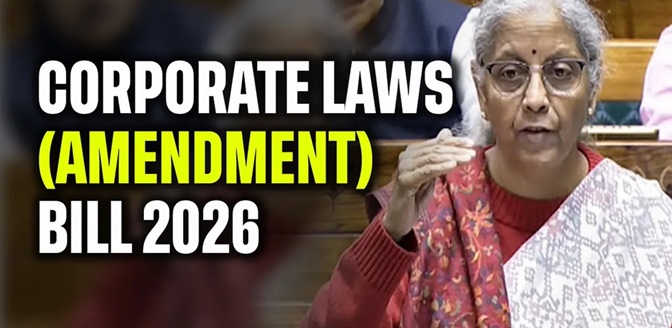
The Corporate Laws (Amendment) Bill, 2026, introduced by the Union Finance Minister in the Lok Sabha, seeks to amend the Companies Act, 2013 and the Limited Liability Partnership Act, 2008.
The Bill has been referred to a 31-member Joint Parliamentary Committee (JPC) for detailed examination, reflecting its significance and the concerns raised regarding regulatory oversight and delegation of powers.
India’s corporate regulatory framework has evolved to :
The 2026 amendment builds on earlier reforms aimed at simplification and decriminalisation.
Impact :
Relaxations :
Significance :
Impact :
FAQs1. What is the Corporate Laws (Amendment) Bill, 2026 ?It is a proposed law to amend corporate regulations to improve ease of doing business and modernise governance. 2. What is meant by decriminalisation in this context ?It refers to converting minor corporate offences from criminal penalties to monetary fines. 3. What changes have been made to CSR provisions ?The applicability threshold has been increased, while mandatory spending remains unchanged. 4. Why is delegation of powers being criticised?Because excessive delegation to executive bodies may reduce parliamentary oversight and accountability. 5. What is the significance of the Bill ?It aims to improve business environment, attract investment, and modernise India’s corporate governance framework. |
| Prelims : (Science & Technology + Health + CA) Mains : (GS 3 – Science & Technology, Biotechnology; GS 2 – Health, Government Initiatives) |
The government has highlighted that India’s largest pregnancy cohort study under the GARBH-INi initiative, involving around 12,000 women, is aimed at developing indigenous, AI-driven solutions to predict and prevent preterm births.
India continues to face significant challenges in :
Among these, preterm birth is a leading cause of :
This necessitated a large-scale, India-specific research initiative.
The GARBH-INi Initiative (Group for Advanced Research in BirtH outcomes – DBT India Initiative) :
Preterm birth refers to babies born before 37 weeks of pregnancy.
FAQs1. What is the GARBH-INi initiative ?It is a DBT-led research programme aimed at understanding and preventing adverse pregnancy outcomes. 2. What is the main focus of the initiative ?Developing AI-based tools to predict and reduce preterm births. 3. Why are preterm births a concern ?They are a leading cause of neonatal mortality and long-term health issues. 4. Which institution leads the initiative ?The Translational Health Science and Technology Institute (THSTI). 5. What is the significance of this initiative ?It enhances maternal healthcare, promotes indigenous research, and supports evidence-based policymaking. |
| Prelims : (Economy + CA) Mains : (GS 3 – Energy, Infrastructure, External Sector) |
India’s Strategic Petroleum Reserves (SPRs) are currently operating at only 64% capacity, holding about 3.37 million tonnes out of a total 5.33 million tonnes, raising concerns over the country’s preparedness against global supply shocks amid ongoing geopolitical tensions.

India is the third-largest consumer of crude oil globally and relies heavily on imports :
This makes India highly vulnerable to :
Managed by Indian Strategic Petroleum Reserve Limited, a subsidiary of the Oil Industry Development Board.
Total Capacity : 5.33 million tonnes
Government-approved additional reserves (2021) :
Status : Pending decisions or incomplete implementation
The ongoing West Asian conflict has disrupted :
FAQs1. What are Strategic Petroleum Reserves ?They are government-maintained crude oil stockpiles used during emergencies. 2. Why are SPRs important for India ?Due to high import dependence, they act as a buffer against supply disruptions. 3. How much oil can India’s SPRs currently cover ?Around 9.5 days at full capacity. 4. What is the IEA benchmark ?Countries should maintain reserves covering at least 90 days of net imports. 5. What is the key concern regarding India’s SPRs ?Low utilisation and insufficient capacity compared to global standards. |
| Prelims : (International Relations + CA) Mains : (GS 2 – International Relations, Indian Diaspora; GS 3 – Security, Energy) |
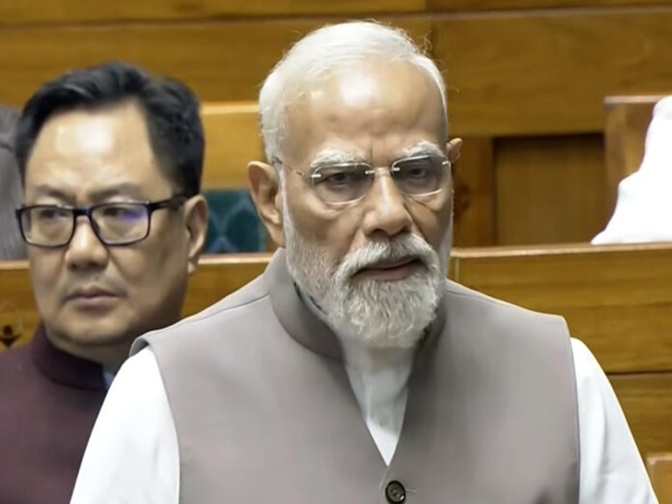
The ongoing conflict in West Asia has raised serious concerns for India due to its large diaspora presence, energy dependence, and maritime interests. The government has intensified evacuation efforts, activated consular mechanisms, and adopted a calibrated diplomatic stance emphasising dialogue and peace.
West Asia (Gulf region) is of critical importance to India due to :
The current conflict has disrupted :
FAQs1. Why is the Gulf region important for India ?Due to its large Indian diaspora, energy imports, and strategic trade routes. 2. What is the Strait of Hormuz’s significance ?It is a key global oil transit chokepoint critical for India’s energy security. 3. What is India’s diplomatic stance on the conflict ?India supports dialogue and diplomacy without taking sides. 4. What is strategic autonomy ?It is India’s policy of maintaining independent foreign policy decisions without aligning with any major power bloc. 5. What are the main concerns for India in this crisis ?Safety of citizens, energy security, economic impact, and geopolitical balancing. |
| Prelims : (Polity & Governance + Constitution + CA) Mains : (GS 2 – Governance, Representation, Women Empowerment) |
The government is considering implementing the Women’s Reservation Act through delimitation based on the 2011 Census, in an effort to fast-track its rollout amid delays in conducting the latest Census.
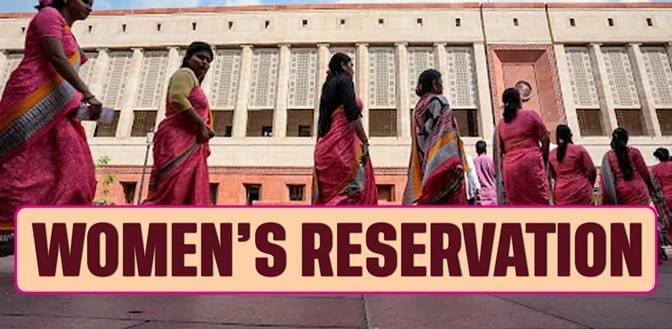
The Act, officially known as the Constitution (106th Amendment) Act, 2023, aims to ensure greater political inclusion.
Delimitation refers to the redrawing of electoral constituency boundaries based on population changes.
FAQs1. What is the Women’s Reservation Act ?It provides 33% reservation for women in Parliament and State Assemblies. 2. Why is delimitation important for its implementation ?Reservation can only be लागू after constituencies are redrawn based on population data. 3. What is the current delay ?The delay in Census has postponed delimitation and thus the implementation of the Act. 4. What is the proposed solution ?Using 2011 Census data to carry out delimitation and fast-track implementation. 5. What is the main challenge ?Balancing timely implementation with fair and updated representation. |

Our support team will be happy to assist you!

 Contact Us
  New Batch : 9555124124/ 7428085757
  Tech Support : 9555124124/ 7428085757