Prelims : (Polity & Governance + Constitution + CA)
Mains : (GS 2 – Governance, Representation, Women Empowerment) |
Why in News?
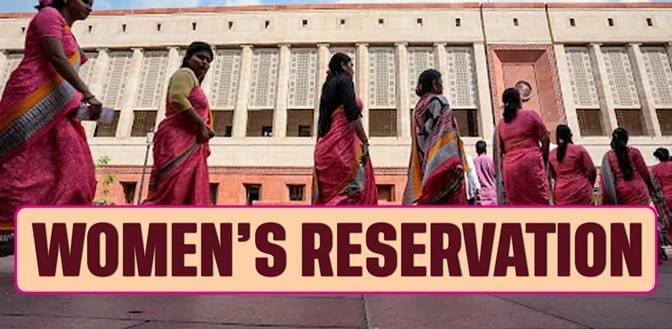
The government is considering implementing the Women’s Reservation Act through delimitation based on the 2011 Census, in an effort to fast-track its rollout amid delays in conducting the latest Census.
Background and Context
Women’s Representation in India
- Women remain underrepresented in :
- Parliament
- State Legislative Assemblies
- Despite constitutional equality, structural barriers persist in :
- Political participation
- Electoral representation
Women’s Reservation Act
The Act, officially known as the Constitution (106th Amendment) Act, 2023, aims to ensure greater political inclusion.
Key Features :
- 33% reservation for women in :
- Lok Sabha
- State Legislative Assemblies
- Includes sub-reservation within :
- Scheduled Castes (SC)
- Scheduled Tribes (ST)
- Implementation is linked to :
- Delimitation exercise based on Census data
What is Delimitation ?
Delimitation refers to the redrawing of electoral constituency boundaries based on population changes.
Constitutional Basis :
- Article 82 → Delimitation for Parliament
- Article 170 → Delimitation for State Assemblies
Objective:
- Ensure :
- Equal representation
- Fair distribution of seats
Existing Framework and Delay
- Delimitation is scheduled after the first Census post-2026
- However :
- The 2021 Census has been delayed
Implication:
- Implementation of Women’s Reservation may be postponed :
Current Policy Proposal
- Use 2011 Census data for delimitation
- Enable earlier implementation of reservation
Rationale :
- Avoid prolonged delay due to :
- Accelerate gender representation reforms
Key Issues and Concerns
1. Legal and Constitutional Questions
- Whether delimitation based on older Census data is :
- Constitutionally valid
- Consistent with existing provisions
2. Federal Concerns
- States with higher population growth may :
3. Representation Imbalance
- Outdated data may not reflect :
- Current demographic realities
4. Political Consensus
- Requires broad agreement among :
Significance of Women’s Reservation
1. Enhancing Political Representation
- Addresses gender imbalance in governance
2. Inclusive Policymaking
- Women’s participation leads to :
- Diverse perspectives
- Socially responsive policies
3. Strengthening Democracy
4. Social Empowerment
- Encourages :
- Leadership roles for women
- Greater societal equality
5. Long-Term Structural Reform
- Institutionalises gender inclusion in politics
Way Forward
- Build political consensus on implementation timeline
- Clarify legal framework for :
- Conduct Census at the earliest
- Ensure transparent and fair delimitation process
- Complement reservation with :
- Capacity-building for women leaders
FAQs
1. What is the Women’s Reservation Act ?
It provides 33% reservation for women in Parliament and State Assemblies.
2. Why is delimitation important for its implementation ?
Reservation can only be लागू after constituencies are redrawn based on population data.
3. What is the current delay ?
The delay in Census has postponed delimitation and thus the implementation of the Act.
4. What is the proposed solution ?
Using 2011 Census data to carry out delimitation and fast-track implementation.
5. What is the main challenge ?
Balancing timely implementation with fair and updated representation.
|






 Contact Us
  New Batch : 9555124124/ 7428085757
  Tech Support : 9555124124/ 7428085757