Why in News?
India observes National Forest Martyrs Day (राष्ट्रीय वन शहीद दिवस) every year on 11 September to honour forest personnel and others who have sacrificed their lives while protecting the country’s forests, wildlife and biodiversity.
Key Facts
|
Observed on
|
11 September every year
|
|
2026 Theme
|
Remembering Martyrs, Protecting Forests
|
|
Purpose
|
To honour forest personnel and others who sacrificed their lives while protecting forests, wildlife and biodiversity
|
|
Historical connection
|
Khejarli Sacrifice
|
|
Khejarli incident
|
1730
|
|
Place
|
Khejarli village, Rajasthan, near Jodhpur
|
|
Community
|
Bishnoi
|
|
Key personality
|
Amrita Devi Bishnoi
|
|
Tree protected
|
Khejri Tree
|
|
Number of people who sacrificed their lives
|
363 Bishnois
|
|
Core idea
|
Community-based forest and biodiversity conservation
|
|
Forester Memorial
|
Forest Research Institute (FRI), Dehradun
|
What is National Forest Martyrs Day?
- A national observance dedicated to remembering the men and women who lost their lives in the line of duty while protecting forests, wildlife and other natural resources.
- India’s forests are protected on the ground by forest officers, forest guards and other frontline personnel. Their work can involve confronting timber smugglers and poachers, controlling forest fires, responding to human-wildlife conflict and protecting ecologically sensitive areas.
- The Ministry of Environment, Forest and Climate Change has specifically recognised these sacrifices through the observance of Forest Martyrs Day.
Why on 11 September?
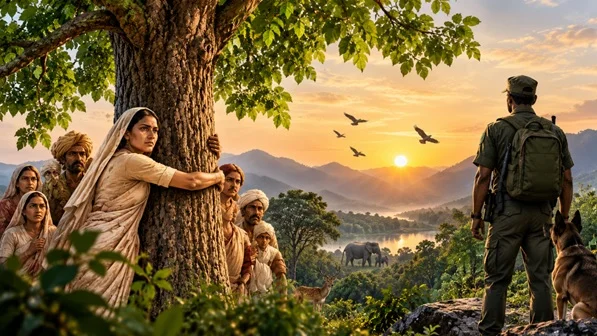
- The choice of 11 September is associated with the historic Khejarli sacrifice of 1730 in present-day Rajasthan. In Khejarli village near Jodhpur, members of the Bishnoi community, led by Amrita Devi Bishnoi, resisted the cutting of Khejri trees.
The Khejarli Sacrifice of 1730
- In 1730, the ruler of the erstwhile Jodhpur State required wood, and men were sent to cut trees in the Khejarli area. The Bishnoi community strongly opposed the cutting of the Khejri (Prosopis cineraria) trees, which have great ecological and cultural importance in Rajasthan.
- Amrita Devi Bishnoi resisted the felling and embraced a tree to protect it. Other members of the community followed her example. Ultimately, 363 Bishnois were killed while protecting the trees, according to Rajasthan government records.
- The sacrifice is often regarded as a historical precursor to later tree-protection movements in India, particularly the Chipko Movement of the 1970s. Rajasthan government material also identifies Khejarli as an inspiration for the later Chipko movement.
- The Government of Rajasthan has continued to commemorate this legacy; for example, the state's forestry records describe the Amrita Devi Park in Jaipur, dedicated to the memory of Amrita Devi and the 363 people.
Why is the Khejri Tree Important?
- The Khejri tree (Prosopis cineraria) is especially important in the arid and semi-arid landscapes of Rajasthan. It is adapted to harsh climatic conditions and is culturally significant to communities in the region. Its protection at Khejarli illustrates how traditional societies understood the importance of vegetation in sustaining fragile desert ecosystems.
Forest Personnel: The Frontline Guardians of Biodiversity
- The Day brings attention to the contemporary role of India's forest personnel. Their responsibilities can include preventing illegal logging, tackling poaching and wildlife crime, responding to forest fires, conducting patrols, managing protected areas, rescuing wildlife and dealing with human-wildlife conflict.
- These duties may expose personnel to attacks by criminals as well as dangerous natural conditions and wildlife encounters. The Environment Ministry has previously highlighted deaths linked to forest fires, smugglers and wildlife attacks while commemorating forest martyrs.
Forester Memorial at Forest Research Institute, Dehradun
- It is to commemorate forest personnel who sacrificed their lives while protecting India's forests and biodiversity. The foundation stone of the memorial pillar was laid on 3 October 2012 near Brandis Road at FRI.
- In 2025, National Forest Martyrs Day was observed at this memorial with floral tributes and a two-minute silence. Officials and trainees from forestry institutions participated and reaffirmed their commitment to conserving natural resources for future generations.
Significance
- Recognition of sacrifice: It honours forest personnel who have lost their lives while protecting India's natural heritage.
- Environmental awareness: It reminds citizens that forests provide ecological services such as biodiversity conservation, soil protection, water regulation and climate regulation.
- Community conservation: The Khejarli story demonstrates the potential of local communities to act as custodians of natural resources.
- Frontline protection: The day highlights the need for better training, safety equipment, institutional support and welfare mechanisms for forest staff.
- Environmental ethics: The sacrifice of the Bishnoi community represents the idea that nature possesses value beyond its immediate commercial use.
Major Challenges Faced by Forest Protectors
- Challenges include illegal logging and timber smuggling, poaching and wildlife trafficking, forest fires, human-wildlife conflict, illegal mining and encroachment, difficult terrain, inadequate equipment in some regions and climate-related ecological stresses.
- The Environment Ministry has previously connected Forest Martyrs Day with the risks posed by smugglers, forest fires, wildlife attacks and illegal resource extraction.
FAQs
When is National Forest Martyrs Day observed in India?
It is observed every year on 11 September.
Why was 11 September chosen for this day?
The date commemorates the historic Khejarli sacrifice of 1730 in Rajasthan.
Who was Amrita Devi Bishnoi?
She was a Bishnoi woman who sacrificed her life while protecting Khejri trees at Khejarli.
Which tree was protected during the Khejarli sacrifice?
The Khejri tree (Prosopis cineraria).
Where did the Khejarli sacrifice take place?
It took place at Khejarli village near Jodhpur in Rajasthan.
|






 Contact Us
  New Batch : 9555124124/ 7428085757
  Tech Support : 9555124124/ 7428085757