| (Prelims: Environmental Ecology, Biodiversity) (Mains, General Studies Paper 3: Conservation, Environmental Pollution and Degradation, Environmental Impact Assessment) |
Recently, India notified the Greenhouse Gas Emission Intensity (GEI) Target Rules, 2025, taking a significant step towards fulfilling its commitments to the Paris Agreement. These rules are the country's first legally binding emission reduction orders for industrial sectors.

This notification was issued ahead of COP-30 in Brazil, where India presented it as part of its robust domestic climate policy to “bridge the gap between voluntary pledges and enforceable emissions accountability.”
| (Prelims: Environmental Ecology, Biodiversity) (Mains, General Studies Paper 3: Conservation, Environmental Pollution and Degradation, Environmental Impact Assessment) |
The World Meteorological Organization (WMO) has confirmed that global atmospheric carbon dioxide has reached a new high, reflecting extreme weather events, rising global temperatures, and destabilizing ecosystems.
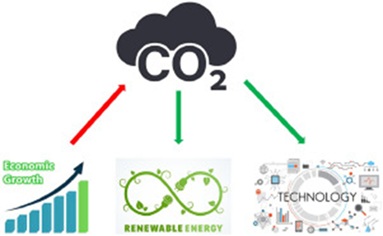
The world stands at a crossroads between technological optimism and economic skepticism. Renewable energy, electric mobility, and low-carbon pathways are no longer future possibilities but present realities. However, without a coordinated global financial framework, equitable technological access, and political courage, the fight against climate change risks stalling midway.
| Prelims: (Geography + CA) Mains: (GS 3 – Disaster Management, Coastal Security, Climate Resilience) |
India is set to have over 100 tsunami-ready villages across its coastline and island territories under the Tsunami Ready Recognition Programme, placing it among the leading countries in the Indian Ocean region in terms of community-based tsunami preparedness.
The 2004 Indian Ocean tsunami highlighted the devastating impact of tsunamis on coastal populations, especially in countries with long coastlines and densely populated shorelines like India. Since then, India has significantly strengthened its early warning systems, institutional mechanisms, and community preparedness through bodies such as the Indian National Centre for Ocean Information Services (INCOIS).
However, experience has shown that early warnings alone are insufficient unless local communities understand risks, evacuation routes, and response protocols. This recognition led to the adoption of community-centric disaster risk reduction frameworks, of which the Tsunami Ready Recognition Programme is a key global initiative.
Standardised Indicators
A Tsunami-Ready village must demonstrate:
FAQsQ1. What is the Tsunami Ready Recognition Programme ? An international initiative by UNESCO-IOC to recognise tsunami-prepared communities. Q2. How many indicators must a community meet to be certified tsunami-ready ? Twelve indicators covering assessment, preparedness, and response. Q3. Who awards the Tsunami Ready certification ? The Intergovernmental Oceanographic Commission of UNESCO. Q4. How long is the certification valid ? Four years, after which it must be renewed. Q5. Why is this programme important for India ? Due to India’s long coastline and vulnerability to tsunamis in the Indian Ocean region. |
| Prelims: (Nuclear Energy + CA) Mains: (GS 3 – Disaster Management, Energy Security, Environmental Safety) |
Nearly 15 years after the Fukushima nuclear disaster, Japan is preparing to restart the Kashiwazaki–Kariwa Nuclear Power Plant, triggering public protests and opposition from Fukushima survivors who warn of unresolved nuclear safety risks. The move is part of Japan’s strategy to reduce dependence on imported fossil fuels and meet rising energy demand while advancing its decarbonisation goals.
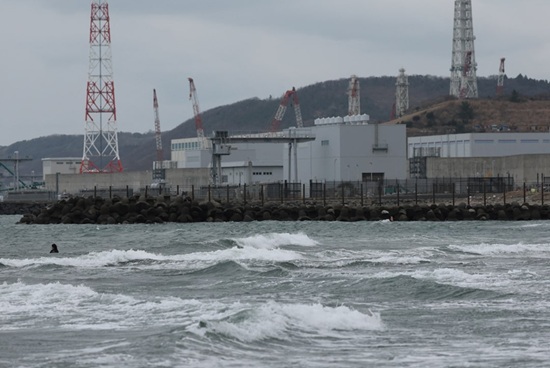
Japan is one of the world’s most energy-import-dependent economies, with 60–70% of electricity generation reliant on imported fossil fuels. Following the 2011 Fukushima disaster, Japan sharply curtailed nuclear power generation, increasing dependence on coal, LNG, and oil.
However, new challenges—such as:
have compelled Japan to reconsider nuclear energy as a stable, low-carbon baseload power source.
FAQsQ1. Why is Japan restarting the Kashiwazaki–Kariwa nuclear plant ? To reduce fossil fuel dependence and meet rising electricity demand while pursuing decarbonisation. Q2. Who operates the Kashiwazaki–Kariwa plant ? Tokyo Electric Power Company (TEPCO). Q3. What caused the Fukushima nuclear disaster ? A massive earthquake and tsunami that disabled reactor cooling systems. Q4. Why is nuclear energy controversial in Japan ? Due to seismic risks, Fukushima’s legacy, and public safety concerns. Q5. How is India expanding its nuclear energy capacity ? Through policy reforms like the SHANTI Act, 2025 and a target of 100 GW by 2047. |
| Prelims: (Security + Governance + CA) Mains: (GS 2 – Governance; GS Paper 3 – Internal Security, Technology in Policing) |
The Union Government has linked the National Intelligence Grid (NATGRID) with the National Population Register (NPR), enabling authorised security and law-enforcement agencies to access family-wise demographic data of nearly 119 crore residents through a secure digital platform.
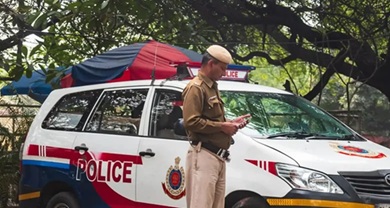
India’s internal security landscape has evolved significantly since the 26/11 Mumbai terror attacks, which exposed serious gaps in inter-agency coordination and intelligence sharing. In response, technology-driven mechanisms were conceptualised to break down information silos across departments.
Simultaneously, the expansion of large population databases for governance purposes has created new possibilities—and concerns—regarding surveillance, privacy, and state power. The linkage of NATGRID with NPR reflects this broader trend of data-centric security governance, raising questions about proportionality and accountability.
FAQsQ1. What is NATGRID ? A secure data-sharing platform for intelligence and law-enforcement agencies in India. Q2. What kind of data does NPR contain ? Demographic and family-wise details of residents in India. Q3. Why was NATGRID linked with NPR ? To enable faster access to verified demographic and relational data for investigations. Q4. What are the main concerns with this linkage ? Privacy risks, potential misuse, and lack of a comprehensive data protection law. Q5. How can these concerns be addressed ? Through strong legal safeguards, oversight, and operational data protection frameworks. |
| Prelims: (Security+ CA) Mains: (GS 2 – Governance; GS 3 – Security, Infrastructure) |
The Union Government has constituted the Bureau of Port Security (BoPS) as a statutory body under the Merchant Shipping Act, 2025, aimed at strengthening port, ship, and maritime security governance across India’s coastline.
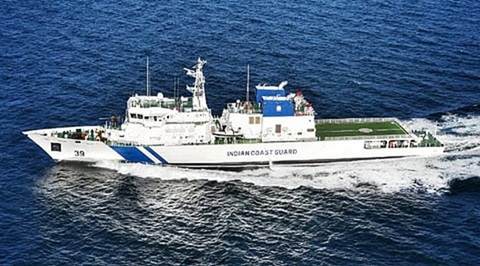
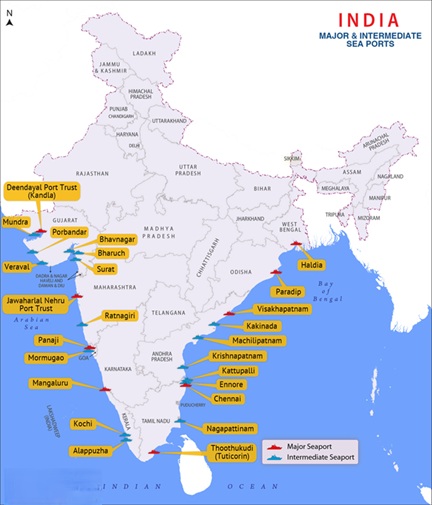
India’s growing integration with global trade has led to rapid expansion of its port infrastructure, coastal shipping, and inland waterways. While this has improved logistics efficiency and economic competitiveness, it has simultaneously increased vulnerabilities related to maritime terrorism, smuggling, cyber threats, and illegal migration.
Past incidents such as the 26/11 Mumbai attacks exposed gaps in coastal and port security coordination, leading to reforms in operational preparedness. However, regulatory oversight remained fragmented, prompting the need for a central statutory authority to ensure uniform security standards across ports.
Earlier, coastal and port security responsibilities were distributed across multiple agencies, including:
Rationale
FAQsQ1. What is the Bureau of Port Security (BoPS) ? A statutory body established under the Merchant Shipping Act, 2025, to regulate port and ship security. Q2. Which ministry oversees BoPS ? The Ministry of Ports, Shipping and Waterways. Q3. Is BoPS an operational agency ? No. It performs regulatory, supervisory, and coordination functions. Q4. What international code does BoPS enforce ? The International Ship and Port Facility Security (ISPS) Code. Q5. Why is BoPS important for India ? It strengthens maritime security amid rapid growth in ports, trade, and digitalisation. |
| Prelims: (Defence Technology + CA) Mains: (GS 3 – Defence, Strategic Capabilities, Technology) |
India recently conducted a successful test of the K-4 submarine-launched ballistic missile (SLBM) from the nuclear-powered submarine INS Arighaat in the Bay of Bengal. The test demonstrated India’s ability to strike targets at a distance of around 3,500 km from underwater platforms, significantly strengthening its sea-based nuclear deterrence.
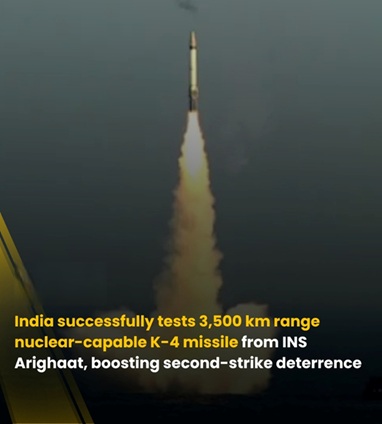
India’s nuclear doctrine is anchored in credible minimum deterrence and a no-first-use policy, which requires a survivable second-strike capability.
To ensure this, India is developing a nuclear triad consisting of:
The Arihant-class nuclear submarines, armed with long-range SLBMs like the K-4, form the most survivable leg of this triad, as submarines can remain concealed underwater for extended periods.
FAQsQ1. What is the K-4 missile ? A nuclear-capable, intermediate-range submarine-launched ballistic missile developed by DRDO. Q2. What is the range of the K-4 missile ? Approximately 3,500 km. Q3. From which platform was the K-4 recently tested ? From the nuclear-powered submarine INS Arighaat. Q4. Why is cold-launch capability important ? It enhances submarine safety by ejecting the missile before engine ignition. Q5. Why is the K-4 missile strategically important for India ? It strengthens India’s second-strike capability and completes the nuclear triad. |

Our support team will be happy to assist you!


 Contact Us
  New Batch : 9555124124/ 7428085757
  Tech Support : 9555124124/ 7428085757