Prelims: (Defence Technology + CA)
Mains: (GS 3 – Defence, Strategic Capabilities, Technology) |
Why in News ?
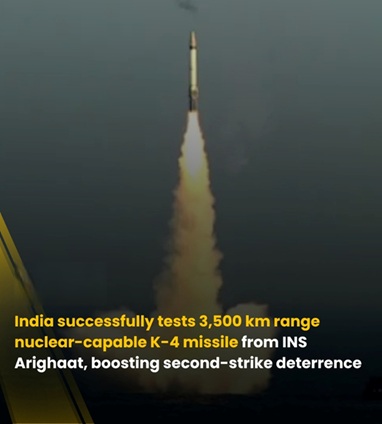
India recently conducted a successful test of the K-4 submarine-launched ballistic missile (SLBM) from the nuclear-powered submarine INS Arighaat in the Bay of Bengal. The test demonstrated India’s ability to strike targets at a distance of around 3,500 km from underwater platforms, significantly strengthening its sea-based nuclear deterrence.
Background & Context
India’s nuclear doctrine is anchored in credible minimum deterrence and a no-first-use policy, which requires a survivable second-strike capability.
To ensure this, India is developing a nuclear triad consisting of:
- Land-based ballistic missiles
- Air-delivered nuclear weapons
- Sea-based nuclear weapons (SLBMs)
The Arihant-class nuclear submarines, armed with long-range SLBMs like the K-4, form the most survivable leg of this triad, as submarines can remain concealed underwater for extended periods.
K-4 Missile: Overview
- Also known as Kalam-4 (K-4)
- A nuclear-capable, intermediate-range SLBM
- Designed primarily for deployment on Arihant-class nuclear submarines
- Each Arihant-class submarine can carry four K-4 missiles
- Indigenously developed by the Defence Research and Development Organisation (DRDO)
Key Features of the K-4 Missile
- Range: Approximately 3,500 km
- Propulsion:
- Two-stage
- Solid-fuel system
- Launch Capability:
- Cold-launch from underwater
- Missile is ejected from the submarine before engine ignition, enhancing platform safety
- Guidance System:
- Advanced inertial navigation system
- Supported by GPS and NavIC (India’s regional navigation satellite system)
- Accuracy:
- High precision due to multi-layered navigation support
- Penetration Capability:
- Equipped with manoeuvring features to evade missile defence systems
Strategic Significance of the Test
- Strengthens India’s sea-based nuclear deterrence
- Enhances the operational credibility of Arihant-class submarines
- Expands India’s strategic reach across key regions
- Demonstrates:
- Technological maturity in SLBM development
- Progress in defence indigenisation under Atmanirbhar Bharat
- Reinforces India’s position as a credible nuclear power with a functional triad
INS Arighaat and India’s SSBN Programme
- INS Arighaat is part of India’s Strategic Forces Command
- Represents the next phase of India’s indigenous SSBN programme
- Designed to:
- Remain submerged for long durations
- Conduct deterrent patrols
- K-4 missiles allow SSBNs to strike targets without approaching hostile coastlines, improving survivability
Comparison with Other Indian SLBMs
- K-15 (Sagarika):
- Range: ~750 km
- Suitable for regional deterrence
- K-4:
- Longer range
- Enables deterrence against distant adversaries
- Reflects a graduated evolution of India’s SLBM capabilities
FAQs
Q1. What is the K-4 missile ?
A nuclear-capable, intermediate-range submarine-launched ballistic missile developed by DRDO.
Q2. What is the range of the K-4 missile ?
Approximately 3,500 km.
Q3. From which platform was the K-4 recently tested ?
From the nuclear-powered submarine INS Arighaat.
Q4. Why is cold-launch capability important ?
It enhances submarine safety by ejecting the missile before engine ignition.
Q5. Why is the K-4 missile strategically important for India ?
It strengthens India’s second-strike capability and completes the nuclear triad.
|






 Contact Us
  New Batch : 9555124124/ 7428085757
  Tech Support : 9555124124/ 7428085757