(Prelims: Environmental Ecology, Biodiversity)
(Mains, General Studies Paper 3: Conservation, Environmental Pollution and Degradation, Environmental Impact Assessment) |
Context
The World Meteorological Organization (WMO) has confirmed that global atmospheric carbon dioxide has reached a new high, reflecting extreme weather events, rising global temperatures, and destabilizing ecosystems.
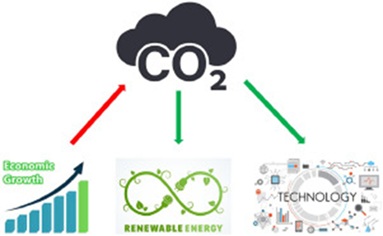
Changing Global Energy Trends
- According to Ember's 'Global Electricity Mid-Year Insights 2025', renewable energy has emerged as the world's leading power source in the first half of 2025, surpassing coal.
- Solar power has doubled in the last three years, largely due to China, which contributed more than half of the global increase. Furthermore, in India, government programs such as the National Solar Mission have rapidly increased installed capacity to over 90 gigawatts.
- However, natural gas-based generation increased by 1.6% as countries turn to fossil fuels to meet the growing energy needs of AI data centers and combat the effects of intense heatwaves.
China and India: Double-Edged Progress
- China is leading solar deployment while also building 95 gigawatts of new coal capacity (CarbonBrief, 2025).
- India is continuing to expand coal capacity to ensure grid stability and energy security while moving ahead with solar and green hydrogen initiatives.
Electric Vehicle (EV) Revolution
- According to an International Energy Agency (IEA) report, 20% of global new car sales will be electric by 2024. China leads the way, with nearly half of its new cars being EVs.
- India is emerging as a strong regional stakeholder with over 3 million EVs registered (Vahan Portal, 2025) and new policies such as FAME-II and the National Electric Mobility Mission Plan are promoting adoption.
- However, geopolitical conflicts are reshaping the landscape:
- China's dominance of rare earth minerals and battery supply chains has forced Western nations to reconsider EV subsidies and delay the deadline for phasing out internal combustion engines (ICEs).
- Export restrictions on lithium and graphite are exacerbating supply chain vulnerabilities that could slow the pace of global electrification.
The Financing Gap: A Real Barrier to Change
- The International Monetary Fund (IMF)'s World Economic Outlook 2025 report highlights the economic imbalances of climate change, stating that for the first time since 2000, the poorest countries are now spending more on debt servicing than on official development assistance.
- This leaves nations most vulnerable to climate impacts facing a fiscal gap for investments in green technologies, trapping them in a cycle of energy poverty and dependency.
- According to the Ministry of Environment, Forests and Climate Change, international climate financing remains well below pledged levels, hampering efforts to meet the Paris Agreement goals.
Conclusion
The world stands at a crossroads between technological optimism and economic skepticism. Renewable energy, electric mobility, and low-carbon pathways are no longer future possibilities but present realities. However, without a coordinated global financial framework, equitable technological access, and political courage, the fight against climate change risks stalling midway.






 Contact Us
  New Batch : 9555124124/ 7428085757
  Tech Support : 9555124124/ 7428085757