- UPSC Exam
- State PCS
- One Day Exam
- Current Affairs
- PT Quiz
- Downlaods
- About Coaching
- Blog
- Videos

| Prelims: Sixth Schedule, uranium resources, tribal areas, Autonomous District Councils, mineral resources. Mains – GS Paper III: Nuclear energy, mineral resources, environmental conservation and sustainable development. Keywords: Meghalaya Uranium Mining 2026, Meghalaya Assembly Uranium Resolution, Uranium Deposits in Meghalaya, Domiasiat Uranium Deposit, Sixth Schedule Meghalaya, Uranium Mining India, Meghalaya Tribal Land Rights |
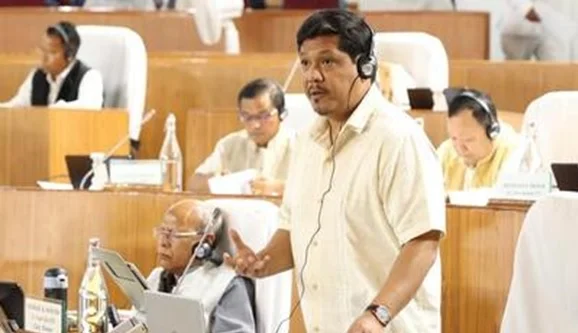
The Meghalaya Legislative Assembly has unanimously passed a resolution opposing uranium mining and the establishment of any uranium ore-processing facility anywhere in the state.
Meghalaya opposes uranium mining mainly because of:
Prelims Practice Question1. Which State Assembly recently passed a unanimous resolution against uranium mining? Mains Practice QuestionExplain the significance of the Sixth Schedule of the Constitution in the management of land and natural resources in Meghalaya. |
1. What has the Meghalaya Assembly decided on uranium mining?It has unanimously passed a resolution opposing uranium mining and uranium ore-processing plants in the state. 2. Who moved the resolution?The resolution was moved by Meghalaya Chief Minister Conrad K. Sangma. 3. Where are uranium deposits mainly found in Meghalaya?They are mainly found in the West Khasi Hills region. 4. What are the major uranium-bearing areas in Meghalaya?Important areas include Domiasiat, Wahkijn and Lostoin. 5. Why is Meghalaya opposing uranium mining?Major concerns include environmental damage, potential health risks, tribal land rights and impacts on local livelihoods. |
| Prelims: BRICS, New Development Bank, BRICS Membership, International Organisations Mains: GS Paper II – International Relations, Global Groupings, India and Global South, Multilateral Institutions Keywords: BRICS, BRICS Summit 2026, India BRICS Chairship, Global South, New Development Bank, Multipolar World Order, Global Governance Reform, Strategic Autonomy, Emerging Economies, Multilateralism |
India is set to host the 18th BRICS Summit in New Delhi on 12–13 September 2026, under its BRICS Chairship for 2026.
BRICS is an intergovernmental grouping of major emerging economies that seeks to strengthen cooperation in areas such as global governance, trade, finance, development, technology, security and people-to-people relations.
The grouping originated as BRIC, comprising:
The term BRIC gained prominence in the early 2000s, while political cooperation among the four countries began taking institutional shape in 2006. The first BRIC Summit was held in Yekaterinburg, Russia, in 2009. South Africa subsequently joined the grouping, and BRIC became BRICS. Over the following years, BRICS developed into an important platform for emerging economies and countries of the Global South.
India assumed the BRICS Chairship on 1 January 2026.
India has previously chaired BRICS in: 2012 → 2016 → 2021 → 2026
Therefore, 2026 represents another important phase in India’s engagement with the grouping. India’s Chairship is particularly significant because it coincides with the 20th anniversary of BRICS cooperation, tracing its origins to the first BRIC-level political engagement in 2006.
The theme of India’s 2026 BRICS Chairship is: “Building for Resilience, Innovation, Cooperation and Sustainability”
The theme can be understood through four major pillars:
Despite its growing global profile, BRICS faces several internal and external challenges.
The New Delhi Summit will be important for several reasons.
Prelims MCQsQ1. The first BRIC Summit was held in which of the following countries? A. Brazil Mains QuestionQ. “The expansion of BRICS reflects the growing influence of the Global South, but it also increases the challenge of maintaining internal cohesion.” Discuss in the context of India’s BRICS Chairship in 2026. |
What is BRICS?BRICS is an intergovernmental grouping of major emerging economies created to promote cooperation in economic, political, financial and other areas. When was BRICS formed?BRIC political cooperation began in 2006, while the first leaders’ summit was held in 2009. Where was the first BRIC Summit held?The first BRIC Summit was held in Yekaterinburg, Russia, in 2009. When did South Africa join BRICS?South Africa joined the grouping after the original BRIC framework was established, transforming BRIC into BRICS. Which country holds the BRICS Chairship in 2026?India holds the BRICS Chairship in 2026. What is the theme of India’s BRICS Chairship 2026?The theme is “Building for Resilience, Innovation, Cooperation and Sustainability.” |
| Prelims: Current Affairs + International Relations Mains: Paper GS-II International Relations → India and its neighbourhood / Important International Groupings & Agreements |
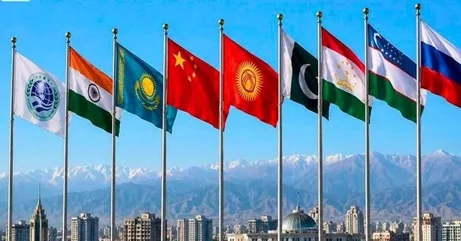
The Shanghai Cooperation Organisation (SCO) Summit 2026 will be an important milestone for the organisation as it celebrates 25 years of its establishment. The summit will be hosted by Kyrgyzstan in Bishkek, from August 31 to September 1, 2026.
|
Particular |
Details |
|
Event |
SCO Summit 2026 |
|
25th Anniversary |
Yes |
|
Dates |
August 31- September 1, 2026 |
|
Venue |
Bishkek, Kyrgyzstan |
|
Host Country |
Kyrgyzstan |
|
Official Theme |
“25 Years of the SCO: Together Towards Sustainable Peace, Development and Prosperity” |
|
Full Members |
10 |
|
Major Focus Areas |
Security, counter-terrorism, trade, connectivity, energy and development |
Prelims QuestionQ.With reference to the Shanghai Cooperation Organisation (SCO), consider the following statements:
Which of the statements given above is/are correct?
Mains QuestionQ. “The Shanghai Cooperation Organisation has evolved from a regional security grouping into a broader platform for economic and strategic cooperation.” Discuss. |
Q1: Where is the SCO Summit 2026?Bishkek, Kyrgyzstan. Q2: What is the theme?"25 years of the SCO: Together Towards Sustainable Peace, Development and Prosperity." Q3: How many members are there?10 members. Q4: Who are the 10 members?India, China, Russia, Pakistan, Kazakhstan, Kyrgyzstan, Tajikistan, Uzbekistan, Iran, Belarus. Q5: What is the significance of this summit?It marks the 25th anniversary of the SCO. |
|
Prelims: National Shipping Board (NSB), Sagar Samvad, Maritime India Vision 2030, Maritime Amrit Kaal Vision 2047, Merchant Shipping Act, 2025, Indian Merchant Fleet, Blue Economy |
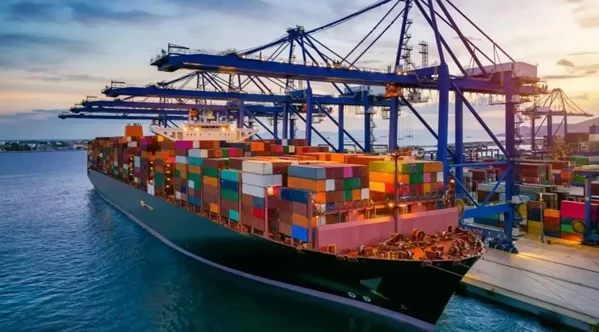
A stronger Indian merchant fleet can:
The National Shipping Board’s discussions proposed five major areas for strengthening India's merchant fleet:
A large merchant fleet is important not only from an economic perspective but also from a strategic perspective.
India’s dependence on foreign shipping can create vulnerabilities during:
Therefore, increasing Indian-owned and Indian-flagged tonnage can contribute to strategic autonomy and economic security. The proposed addition of 100 ships over five years is intended to contribute to India’s long-term ambition of becoming one of the world’s leading ship-owning nations.
The objective is to strengthen India’s position as a major global maritime power.
Despite significant potential, India’s shipping sector faces several challenges:
UPSC Prelims MCQQ. Consider the following statements regarding the National Shipping Board (NSB):
Which of the statements given above are correct? (a) 1, 2 and 3 only (b) 1 and 4 only (c) 2 and 3 only (d) 1, 2, 3 and 4 Mains QuestionQ.1 India’s dependence on foreign shipping lines has significant economic and strategic implications. Discuss the measures required to strengthen India’s merchant shipping sector and achieve maritime self-reliance by 2047. |
Q.1 What is Sagar Samvad?Answer :-Sagar Samvad is a maritime dialogue platform organised by the National Shipping Board to bring together policymakers, industry stakeholders, experts and maritime professionals. Q.2 Where was the first Sagar Samvad held?Answer :-The inaugural Sagar Samvad was held in New Delhi. Q.3 What is the five-pillar roadmap proposed for Indian shipping?Answer :-It focuses on fiscal reform, assured cargo support, competitive financing, regulatory streamlining and Ease of Doing Business. Q.4 Why are Indian-flagged ships considered less competitive?Answer :-They were highlighted as being around 16–20% costlier due to factors such as taxation, maintenance costs, freight-related costs and higher domestic capital costs. Q.5 What is Maritime India Vision 2030?Answer :-It is India’s roadmap for transforming and modernising the maritime sector by improving ports, shipping, logistics, shipbuilding, employment and sustainability. Q.6 What is Maritime Amrit Kaal Vision 2047?Answer :-It is India’s long-term maritime development vision aimed at building a globally competitive, sustainable and self-reliant maritime sector by 2047. Q.7 Why is a strong merchant fleet important for India?Answer :-A strong merchant fleet can reduce dependence on foreign shipping lines, strengthen supply-chain resilience, support economic security, save foreign exchange and enhance India’s strategic autonomy. |

Our support team will be happy to assist you!

 Contact Us
  New Batch : 9555124124/ 7428085757
  Tech Support : 9555124124/ 7428085757