Prelims: Sixth Schedule, uranium resources, tribal areas, Autonomous District Councils, mineral resources.
Mains – GS Paper III: Nuclear energy, mineral resources, environmental conservation and sustainable development.
Keywords: Meghalaya Uranium Mining 2026, Meghalaya Assembly Uranium Resolution, Uranium Deposits in Meghalaya, Domiasiat Uranium Deposit, Sixth Schedule Meghalaya, Uranium Mining India, Meghalaya Tribal Land Rights |
Why in News?
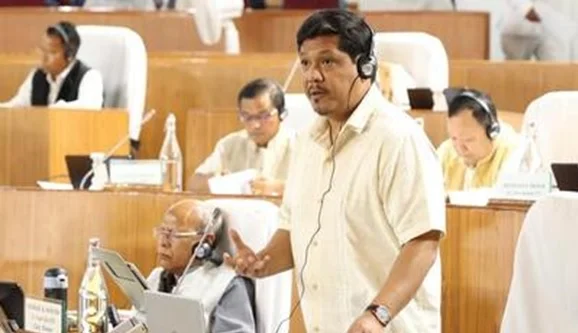
The Meghalaya Legislative Assembly has unanimously passed a resolution opposing uranium mining and the establishment of any uranium ore-processing facility anywhere in the state.
Key points
- The resolution was moved by Chief Minister Conrad K. Sangma and supported by all 60 MLAs.
- The state government will inform the Central Government about its decision and has asked it to respect the concerns of Meghalaya’s local and tribal communities.
What Does the Resolution Say?
- The resolution clearly opposes:
- Uranium mining anywhere in Meghalaya.
- Setting up any uranium ore-processing plant in the state.
- Any decision that ignores the land rights and concerns of local communities.
- Chief Minister Conrad K. Sangma called it a historic decision and said Meghalaya has clearly expressed its opposition to uranium mining.
Where are Uranium Deposits Found in Meghalaya?
- Uranium deposits are mainly found in the West Khasi Hills region of Meghalaya.
- Major uranium-bearing areas include:
- Domiasiat – a major uranium-bearing area.
- Wahkijn – known for uranium deposits.
- Lostoin – another uranium-bearing area.
- The Domiasiat deposit was identified in the 1980s. Later exploration and drilling faced strong opposition from local communities due to environmental and health concerns.
Why Does Meghalaya Oppose Uranium Mining?
Meghalaya opposes uranium mining mainly because of:
- Environmental Risk: Mining may affect forests, soil, water and biodiversity.
- Health Concerns: Uranium and mining waste may create health and radiation-related risks.
- Land Rights: Much of the land belongs to individuals, clans and local communities.
- Tribal Rights: Local and tribal communities want their traditional rights over land and resources protected.
- Livelihood Impact: Mining may affect agriculture, forests, water resources and local livelihoods.
Sixth Schedule and Meghalaya
- Meghalaya is covered under the Sixth Schedule of the Constitution, which protects the interests of tribal communities.
- The Sixth Schedule provides for Autonomous District Councils (ADCs) in Assam, Meghalaya, Tripura and Mizoram.
- ADCs have powers over certain local matters, including land management and local administration.
- Meghalaya has a strong system of traditional and community land ownership.
- Therefore, the state argues that tribal and customary land rights must be considered before taking decisions on mining projects.
Supreme Court Judgment and Mineral Rights
- In 2019, the Supreme Court gave an important judgment in State of Meghalaya v. All Dimasa Students Union.
- The Court recognised the mineral rights of private and community landowners in Meghalaya.
- This means minerals under such land do not automatically belong to the State Government.
- However, any mining activity must follow mining, environmental and other applicable laws.
- The judgment strengthened traditional and community land rights in Meghalaya.
Decades of Opposition to Uranium Mining
- Opposition to uranium mining in Meghalaya has continued for several decades.
- Uranium deposits in Domiasiat were identified in the 1980s.
- By the 1990s, uranium mining had become a major public and political issue.
- The Khasi Students’ Union (KSU), local communities and traditional institutions strongly opposed mining.
- Spelity Lyngdoh Langrin, a local landowner, became a prominent symbol of the movement after refusing an offer linked to uranium mining on her land.
- In 2008, then Chief Minister Donkupar Roy said uranium mining would not be allowed without the support of local people.
- Since then, opposition to uranium mining has remained strong in Meghalaya.
Opposition Also Supports Resolution
- Leader of the Opposition Mukul Sangma supported the resolution.
- He said uranium mining should not be treated as a political party issue.
- He called for continued talks with the Central Government.
- He also stressed the need to protect Meghalaya’s traditional land rights.
- He highlighted renewable and alternative energy sources as other options
Why is Uranium Important for India?
- Uranium is an important mineral used as fuel for nuclear power generation.
- It is important for India’s nuclear energy programme and energy security.
- Nuclear power can provide large-scale, low-carbon electricity.
- However, uranium mining must balance energy needs with environmental protection, tribal rights and local community concerns.
Significance of the Resolution
- Shows unanimous political support against uranium mining in Meghalaya.
- Strengthens the voice of tribal and local communities.
- Highlights the importance of traditional land rights.
- Raises concerns about environmental and health risks of mining.
- Highlights the need to balance energy security with environmental protection and community rights.
- Important for UPSC topics such as Sixth Schedule, tribal rights, federalism, mineral resources and energy security.
Conclusion
- Meghalaya’s resolution reflects strong concerns over environmental protection, health and traditional land rights.
- While uranium is important for India’s nuclear energy and energy security, its mining must balance national needs with environmental protection, tribal rights and the interests of local communities.
Prelims Practice Question
1. Which State Assembly recently passed a unanimous resolution against uranium mining?
(A) Assam
(B) Meghalaya
(C) Mizoram
(D) Nagaland
Mains Practice Question
Explain the significance of the Sixth Schedule of the Constitution in the management of land and natural resources in Meghalaya.
|
FAQs
1. What has the Meghalaya Assembly decided on uranium mining?
It has unanimously passed a resolution opposing uranium mining and uranium ore-processing plants in the state.
2. Who moved the resolution?
The resolution was moved by Meghalaya Chief Minister Conrad K. Sangma.
3. Where are uranium deposits mainly found in Meghalaya?
They are mainly found in the West Khasi Hills region.
4. What are the major uranium-bearing areas in Meghalaya?
Important areas include Domiasiat, Wahkijn and Lostoin.
5. Why is Meghalaya opposing uranium mining?
Major concerns include environmental damage, potential health risks, tribal land rights and impacts on local livelihoods.
|






 Contact Us
  New Batch : 9555124124/ 7428085757
  Tech Support : 9555124124/ 7428085757