- UPSC Exam
- State PCS
- One Day Exam
- Current Affairs
- PT Quiz
- Downlaods
- About Coaching
- Blog
- Videos

| Prelims: (Cybersecurity + CA) Mains: (GS 2 – Governance; GS 3 – Cybersecurity, Law & Order; GS 4 – Ethics) |
India has recorded a sharp escalation in cyber-enabled financial crimes during 2024–25, particularly a new form of intimidation-based fraud popularly termed as the “digital arrest” scam. Multiple incidents involving losses of several crores, prolonged psychological confinement of victims via video calls, and impersonation of senior law-enforcement or judicial officials have raised serious concerns. Courts and central agencies have taken cognisance of the growing threat, highlighting cyber fraud as not merely an economic crime but a challenge to internal security and public trust.
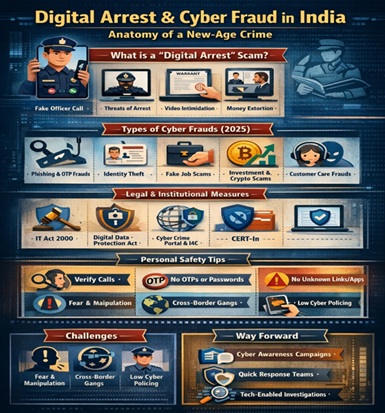
India’s digital transformation—driven by UPI payments, Aadhaar-based services, online banking, remote working, and smartphone penetration—has dramatically expanded access to services and financial inclusion. However, this rapid digitisation has also created new vulnerabilities.
Cybercrime in India has evolved in three phases:
The “digital arrest” scam represents a qualitative shift, where fear of the state and legal institutions is deliberately exploited using digital tools, fake documents, and prolonged psychological pressure.
A digital arrest scam refers to a cyber fraud technique where criminals impersonate:
They falsely accuse victims of grave offences such as money laundering, terror financing, drug trafficking, or cybercrime, and claim that immediate arrest is warranted unless the victim complies with instructions.
Crucial Fact: There is no legal provision in India for arrest, detention, interrogation, or trial via phone call or video conferencing initiated by enforcement agencies.
FAQsQ1. Is digital arrest legally valid in India ? No. Indian law does not recognise arrest or investigation through phone or video calls. Q2. Why are digital arrest scams particularly dangerous ? They exploit fear, authority, and lack of legal awareness, leading to high-value fraud and psychological harm. Q3. What should a person do if targeted ? Disconnect immediately, verify independently, inform family and bank, and report to cyber authorities. Q4. How does cyber fraud affect internal security ? It erodes public trust, funds organised crime, and exploits digital infrastructure. Q5. What is the long-term solution ? Cyber literacy, strong institutions, coordinated enforcement, and responsible digital behaviour. |
| Prelims: (International Relations + Education + CA) Mains: (GS 1 – Indian Culture, Society; GS 2 – International Relations, Governance, Education Policy, Youth Empowerment) |
The results of the Prime Minister’s Scheme for Mentoring Young Authors (PM-YUVA 3.0) have been declared, with 43 young authors selected through an All-India contest. The scheme aims to mentor talented youth writers and promote original writing on India’s civilisational, cultural, and contemporary themes.

India has a rich literary and intellectual tradition, but young writers often face challenges such as lack of mentorship, limited publishing opportunities, and inadequate exposure to professional literary ecosystems. Recognising the need to nurture young creative talent, the Government of India launched the PM-YUVA (Young, Upcoming and Versatile Authors) Scheme as part of a broader effort to promote reading, writing, and knowledge creation.
PM-YUVA aligns with the objectives of the National Education Policy (NEP) 2020, which emphasises creativity, critical thinking, Indian Knowledge Systems, and multidisciplinary learning. The third edition, PM-YUVA 3.0, continues this vision by providing structured mentorship and national-level recognition to young authors.
The Prime Minister’s Scheme for Mentoring Young Authors (PM-YUVA 3.0) is a government initiative aimed at nurturing writers below 30 years of age by offering mentorship, training, and publishing opportunities.
Selected young authors are encouraged to write on the following themes:
These themes aim to blend historical understanding with contemporary narratives and future-oriented thinking.
FAQsQ1. What is PM-YUVA 3.0 ? It is a government scheme to mentor young authors below 30 years and promote original writing on Indian themes. Q2. Who implements the PM-YUVA scheme ? The National Book Trust (NBT), India, under the Ministry of Education. Q3. What themes are covered under PM-YUVA 3.0 ? Indian Diaspora, Indian Knowledge System, and Makers of Modern India (1950–2025). Q4. What benefits do selected authors receive ? Six months of mentorship, scholarship, publication by NBT, 10% royalty, and exposure at literary platforms. Q5. How does PM-YUVA align with NEP 2020 ? It promotes creativity, knowledge creation, Indian perspectives, and multidisciplinary learning. |
| Prelims: (Crude Oil Imports + CA) Mains: (GS 2 – International Relations; GS 3 – Security, Economy) |
India’s crude oil sourcing pattern has undergone a significant transformation over the past decade. Once heavily dependent on West Asian suppliers, India has increasingly diversified its oil import basket—most notably with Russia emerging as the largest supplier since 2022. This shift reflects India’s pragmatic energy diplomacy, balancing geopolitical risks, sanctions regimes, and economic imperatives such as cost control and inflation management.

Energy security has remained a central pillar of India’s economic and strategic planning. As the world’s third-largest oil consumer and importer, India depends on imports for over 85% of its crude oil needs. Historically, this dependence exposed India to geopolitical instability in West Asia, price volatility, and supply disruptions.
Over time, India recalibrated its oil strategy from supplier concentration to diversified sourcing, prioritising flexibility, affordability, and resilience over rigid geopolitical alignments. This transition has accelerated amid global disruptions—sanctions on Iran, the Russia–Ukraine war, and shifting energy geopolitics.
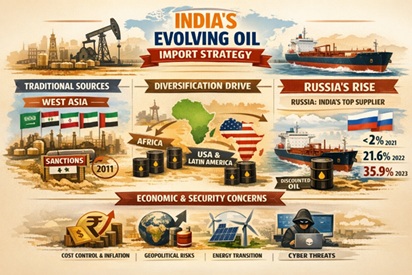
African suppliers (Nigeria and Angola) formed a secondary source, contributing roughly one-fifth of total imports.
This phase underscored how geopolitics can override economic logic, compelling India to rework its energy sourcing strategy.
India increasingly turned to:
Current import profile:
Today, around one-third of India’s crude imports come from Russia.
FAQsQ1. Why has India diversified its oil import basket ? To reduce geopolitical risks, manage price volatility, and enhance energy security. Q2. Why did Russian oil become attractive to India ? Due to deep discounts, refinery compatibility, and economic prudence amid global sanctions. Q3. Has West Asia lost relevance for India ? No. It remains a key supplier, though its dominance has reduced. Q5. What is India’s long-term solution to oil dependence ? Diversification, strategic reserves, and a gradual shift to renewable energy. |
| Prelims: (Environment + CA) Mains: (GS 3 – Environment, Biodiversity, Climate Change; GS 2 – Judiciary, Governance) |
The Supreme Court of India recently delivered a landmark judgment to strengthen conservation of the Great Indian Bustard (GIB) by addressing bird fatalities caused by collisions with overhead power lines linked to renewable energy projects. Acting on expert committee recommendations, the Court demarcated priority conservation areas and laid down mechanisms to manage or reroute power lines in these zones.
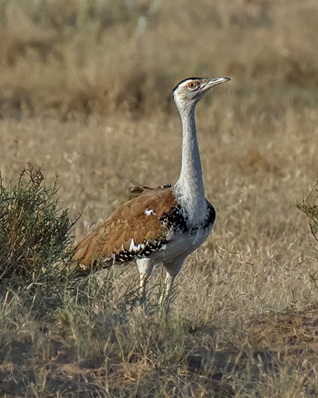
The Great Indian Bustard, once widespread across India’s grasslands, is now among the most critically endangered bird species in the world, with an estimated population of fewer than 150 individuals. Rajasthan and Gujarat host its last viable habitats.
Rapid expansion of renewable energy infrastructure—particularly wind and solar projects—has led to a dense network of overhead transmission lines across these landscapes. Due to poor frontal vision and a heavy body, GIBs are unable to detect thin overhead wires, leading to frequent fatal collisions.
The case highlights a broader policy dilemma: balancing India’s climate commitments and clean energy transition with the urgent need to prevent irreversible biodiversity loss.
The Court approved a package of measures across three core pillars:
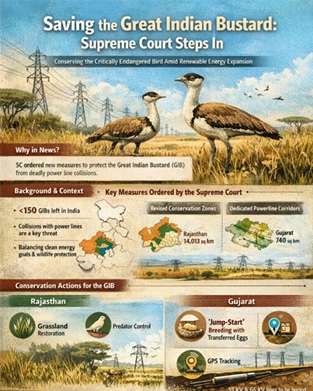
Contestation: Petitioners opposed the exclusion of 657 sq km of eastern Rasla–Degray Oran, citing its importance as a wintering and migratory corridor.
The Court endorsed a mix of general and State-specific conservation measures, supplementing the ongoing Project GIB.
The Supreme Court’s judgment represents a nuanced attempt to reconcile environmental protection with developmental imperatives. By adopting science-based, location-specific safeguards, the ruling sets a precedent for integrating biodiversity conservation into India’s renewable energy transition.
FAQsQ1. Why is the Great Indian Bustard critically endangered ? Due to habitat loss, fragmentation, low reproductive rates, and fatal collisions with overhead power lines. Q2. Why are power lines especially dangerous for the GIB ? The bird’s poor frontal vision and heavy body make it unable to detect and avoid thin overhead wires. Q3. Did the Supreme Court ban renewable energy projects ? No. The Court adopted a balanced approach, allowing renewable projects with strict safeguards in priority areas. Q4. What are dedicated powerline corridors ? Designated routes to carry transmission lines away from critical GIB habitats, reducing collision risk. Q5. What is the ‘jump-start’ breeding method ? A conservation technique where fertile eggs are transferred to enable natural incubation and chick-rearing in the wild. |
| Prelims: (International Relations + CA) Mains: (GS 2 – International Relations, Foreign Policy; GS 3 – Economy, Security) |
More than six years after opting out of the Regional Comprehensive Economic Partnership (RCEP) in 2019, India has effectively secured most economic benefits of the grouping without formally joining it. The conclusion of the India–New Zealand Free Trade Agreement (FTA) marks a key milestone, as India now has FTAs with all RCEP members except China, reflecting a calibrated strategy balancing market access, strategic autonomy, and economic security.
Mega trade agreements like RCEP aim to deepen regional integration through tariff liberalisation and harmonised rules. However, for developing economies such as India, such arrangements can also constrain domestic policy space and expose vulnerable sectors to import surges.
India’s decision to stay out of RCEP in 2019 marked a departure from blanket trade liberalisation towards a selective, bilateral, and risk-calibrated trade approach. Since then, India has progressively negotiated FTAs tailored to its economic sensitivities while avoiding systemic exposure to Chinese manufacturing dominance.
The Prime Minister stated that RCEP, in its existing form, failed to reflect agreed guiding principles and did not address India’s “outstanding issues and concerns”.
Issue: AITIGA contributed to a sharp rise in India’s trade deficit with ASEAN.
Status: Renegotiation of AITIGA underway, though progress remains limited.
Rebalance FTAs with stronger safeguards and reciprocity-based market access.
Domestic Competitiveness
Align trade strategy with Make in India and Atmanirbhar Bharat initiatives.
Geopolitical Pressures
Adopt strategic plurilateralism—engage selectively without compromising autonomy.
Global Supply Chain Realignments
Leverage FTAs to enhance supply chain resilience and diversification.
FAQsQ1. What is meant by ‘RCEP minus China’ ? A strategy where India secures FTAs with RCEP members except China, avoiding full exposure to Chinese imports. Q2. Why did India stay out of RCEP ? Due to concerns over trade deficits, manufacturing competitiveness, weak safeguards, and China’s dominance. Q3. How does the India–New Zealand FTA fit this strategy ? It completes India’s bilateral trade coverage of RCEP members while preserving strategic autonomy. Q4. Is India completely closed to trade with China ? No. Trade continues under limited frameworks like APTA, without a comprehensive FTA. Q5. Why is this strategy important for India’s long-term growth ? It balances global integration with economic resilience, policy flexibility, and national security. |
| Prelims: (Cyber Security + Digital Economy + CA) Mains: (GS Paper 2 – Governance, Digital Public Infrastructure; GS 3 – Internal Security, Cyber Security, Science & Technology) |
According to Check Point Software Technologies’ “State of Cyber Security in India 2025” report, Indian organisations faced an average of 2,011 cyberattacks per week in 2025, significantly higher than the global average. The report highlights cloud misconfigurations, infostealer malware, ransomware, and AI-enabled frauds as key drivers behind India’s rapidly escalating cyber threat landscape.
India’s rapid digital transformation—driven by UPI-based payments, cloud adoption, e-governance platforms, and data-driven public services—has significantly expanded its digital attack surface. While this transformation has enhanced efficiency and inclusion, it has also made India a high-value target for cybercriminals.
Over the last three years, cyber incidents in India have more than doubled, reflecting a mismatch between the pace of digitisation and the maturity of cyber security practices. The 2025 report underscores that cyber risks are no longer confined to financial theft alone but now threaten national security, data sovereignty, and public trust in digital systems.
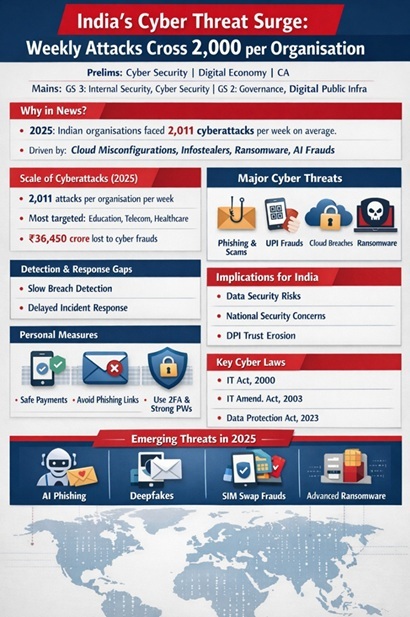
This pattern reflects attackers’ focus on data-rich, service-critical, and digitally dependent sectors.
These losses are closely linked to the expansion of digital payments and remote digital interactions.
FAQsQ1. Why is India facing a surge in cyberattacks in 2025 ? Due to rapid digital adoption, expanded cloud usage, and increasing use of real-time digital payments. Q2. Which sector is most targeted by cyberattacks ? The education sector, followed by telecom, healthcare, finance, and government bodies. Q3. What are infostealer malwares ? Malware designed to steal credentials, banking details, and sensitive user data from infected devices. Q4. Why are cloud misconfigurations dangerous ? They expose sensitive data due to weak access controls and lack of encryption. Q5. What new cyber threats are emerging in 2025 ? AI-enabled phishing, deepfake scams, SIM swap frauds, and advanced ransomware techniques. |
| UPSC Mains GS–III | Economy |
Digitalization has emerged as a key driver of India’s structural economic transformation. The rapid spread of digital technologies is not only enhancing productivity and efficiency but is also playing a decisive role in governance, financial inclusion, and employment generation. It is estimated that by 2030, the digital economy will contribute around 20% of India’s Gross Value Added (GVA).
UPI (Unified Payments Interface)
UPI is a real-time digital payment system in India that allows instant money transfers by linking bank accounts through a mobile app. It was developed by the National Payments Corporation of India (NPCI).
India’s electronics manufacturing sector has emerged as a high-growth strategic sector.
Today, India is no longer just an import-dependent consumer; rather—
Semiconductors are the backbone of the modern digital economy:
Without semiconductors, the vision of Digital India, Industry 4.0, and Atmanirbhar Bharat (Self-Reliant India) cannot be realized.
This provides India with Strategic Autonomy.
Indigenous semiconductors mean control over technology, not mere consumption.
Healthcare
Logistics and Transportation
Defence and Security
The semiconductor industry strengthens Comprehensive National Power.
Through these, India:
Production Linked Incentive (PLI) Scheme
The PLI scheme has been the most significant policy for expanding electronics manufacturing in India. Its objective is not limited to assembly, but to promote value addition and export-oriented production.
Key Features
Impact and Achievements
Objectives
Strategic Importance
Significance
Functions
Significance
The objective of the Semicon India Programme is to develop an end-to-end semiconductor value chain in India—from design to fabrication, packaging, and display manufacturing. The programme is implemented under the India Semiconductor Mission.
Key Features
Significance
Covered Technologies
Incentive Structure
Significance
Covered Areas
Incentives
Strategic Importance
This scheme focuses on strengthening India’s chip design capabilities, enabling leadership not only in manufacturing but also in intellectual property (IP) creation.
Benefits
Significance

Our support team will be happy to assist you!

 Contact Us
  New Batch : 9555124124/ 7428085757
  Tech Support : 9555124124/ 7428085757