Prelims: (Environment + CA)
Mains: (GS 3 – Environment, Biodiversity, Climate Change; GS 2 – Judiciary, Governance) |
Why in News ?
The Supreme Court of India recently delivered a landmark judgment to strengthen conservation of the Great Indian Bustard (GIB) by addressing bird fatalities caused by collisions with overhead power lines linked to renewable energy projects. Acting on expert committee recommendations, the Court demarcated priority conservation areas and laid down mechanisms to manage or reroute power lines in these zones.
Background & Context
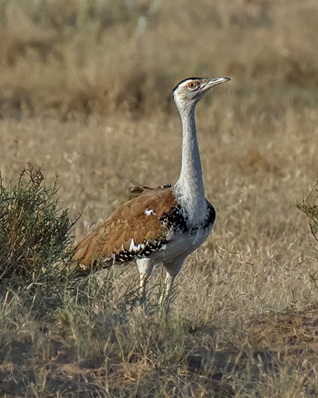
The Great Indian Bustard, once widespread across India’s grasslands, is now among the most critically endangered bird species in the world, with an estimated population of fewer than 150 individuals. Rajasthan and Gujarat host its last viable habitats.
Rapid expansion of renewable energy infrastructure—particularly wind and solar projects—has led to a dense network of overhead transmission lines across these landscapes. Due to poor frontal vision and a heavy body, GIBs are unable to detect thin overhead wires, leading to frequent fatal collisions.
The case highlights a broader policy dilemma: balancing India’s climate commitments and clean energy transition with the urgent need to prevent irreversible biodiversity loss.
What the Supreme Court Was Examining
- A retired bureaucrat and environmentalist approached the Supreme Court seeking urgent protection for the GIB.
- The petition highlighted rising mortality due to collisions with overhead power lines in Rajasthan and Gujarat.
- Scientific evidence showed that GIBs are especially vulnerable due to:
- Poor frontal vision
- Low manoeuvrability during flight
Key Supreme Court Directions (2021–2024)
2021 Interim Directions
- Ban on new overhead power lines across ~99,000 sq km of GIB habitat.
- Assessment of feasibility of undergrounding high-voltage transmission lines.
- Mandatory installation of bird flight diverters on existing lines.
March 2024 Modification
- Withdrawal of the blanket ban on overhead power lines.
- Modification followed concerns raised by:
- Ministry of Power
- Ministry of New and Renewable Energy (MNRE)
- Ministry of Environment, Forest and Climate Change (MoEFCC)
- Authorities flagged feasibility constraints, high costs, and adverse impacts on renewable energy expansion.
Balancing Conservation and Clean Energy
- The Court acknowledged the need to balance:
- India’s renewable energy and climate commitments, and
- Protection of a critically endangered species
- Held that undergrounding alone is insufficient as a universal solution.
- Constituted an expert committee comprising wildlife scientists and power-sector specialists.
Basis of the Final Judgment
- The Court’s final ruling was guided by expert committee recommendations.
- Adopted a targeted, zone-based approach rather than blanket prohibitions.
- Sought to ensure biodiversity protection while accommodating India’s clean energy goals.
Measures Ordered by the Supreme Court
The Court approved a package of measures across three core pillars:
- Redrawing priority conservation zones
- Voltage-based mitigation of power lines
- Creation of dedicated powerline corridors
Revised Priority Conservation Areas
Rajasthan
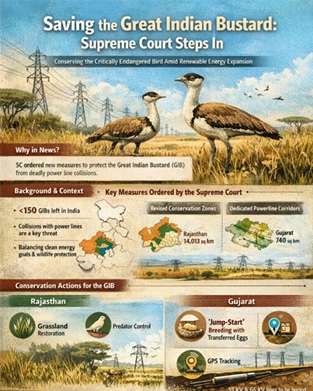
- Priority areas expanded from 13,163 sq km to 14,013 sq km.
- Identified by the Rajasthan Forest Department and the Wildlife Institute of India (WII).
Gujarat
- Priority areas increased from 500 sq km to 740 sq km.
Key Critical Sites Identified
- Desert National Park
- Salkha–Kuchri
- Sanu–Mokla–Parewar
- Pokhran Field Firing Range (PFFR) and buffer areas
- Dholiya
- Khetolai
- Chacha
Contestation: Petitioners opposed the exclusion of 657 sq km of eastern Rasla–Degray Oran, citing its importance as a wintering and migratory corridor.
Dedicated Powerline Corridors
Rajasthan
- New corridors up to 5 km wide, located at least 5 km south of Desert National Park.
- Designed to carry rerouted overhead lines away from core habitats.
Gujarat
- Dedicated corridors of 1–2 km width in coastal Kutch to evacuate power from wind and solar projects.
Route Optimisation Mandate
- Where multiple renewable pooling stations feed into a single grid station, routes must be converged into a common corridor wherever feasible.
Project Restrictions in Priority Areas
- No new overhead power lines within priority areas (except ≤11 kV lines).
- No new wind turbines permitted.
- No new solar parks or plants above 2 MW, and no expansion of existing solar parks.
Voltage-Based Mitigation: Undergrounding & Timelines
Rajasthan
- Immediate undergrounding of 80 km of 33 kV lines (out of 104 km identified).
- All undergrounding or rerouting to commence immediately and be completed by 2028.
Gujarat
- Immediate undergrounding of:
- 79.2 km of 33 kV lines
- 64.9 km of 66 kV lines
- Additional 250 km of critical lines (identified by WII) to be buried within two years.
Bird Flight Diverters: Evidence-Based Approach
- The Court refrained from issuing blanket directions on bird diverters.
- Directed the expert committee to:
- Assess their effectiveness scientifically
- Submit findings to the Union Government for future policy decisions
Conservation Measures Directed by the Supreme Court
The Court endorsed a mix of general and State-specific conservation measures, supplementing the ongoing Project GIB.
Measures for Rajasthan
Grassland Restoration
- Priority on restoration, conservation, and consolidation of grassland ecosystems—the GIB’s primary habitat.
In-situ Habitat Management
- Securing breeding and foraging enclosures
- Predator management, including control of:
- Free-ranging dogs
- Reptiles that prey on eggs
- Food and water resource management
- Community engagement to reduce human–wildlife conflict
Measures for Gujarat
‘Jump-Start’ Breeding in the Wild
- Adoption of a ‘jump-start’ breeding technique:
- Fertile eggs transferred from Rajasthan
- Infertile egg swapped to allow natural incubation
- Enables females to raise chicks in the wild.
Technology-Enabled Monitoring
- GPS tagging of birds to:
- Track movement patterns
- Support breeding and post-release monitoring
The Road Ahead: Coexistence of Energy and Ecology
The Supreme Court’s judgment represents a nuanced attempt to reconcile environmental protection with developmental imperatives. By adopting science-based, location-specific safeguards, the ruling sets a precedent for integrating biodiversity conservation into India’s renewable energy transition.
FAQs
Q1. Why is the Great Indian Bustard critically endangered ?
Due to habitat loss, fragmentation, low reproductive rates, and fatal collisions with overhead power lines.
Q2. Why are power lines especially dangerous for the GIB ?
The bird’s poor frontal vision and heavy body make it unable to detect and avoid thin overhead wires.
Q3. Did the Supreme Court ban renewable energy projects ?
No. The Court adopted a balanced approach, allowing renewable projects with strict safeguards in priority areas.
Q4. What are dedicated powerline corridors ?
Designated routes to carry transmission lines away from critical GIB habitats, reducing collision risk.
Q5. What is the ‘jump-start’ breeding method ?
A conservation technique where fertile eggs are transferred to enable natural incubation and chick-rearing in the wild.
|






 Contact Us
  New Batch : 9555124124/ 7428085757
  Tech Support : 9555124124/ 7428085757