| (Prelims: Important Personalities) |
Why in News
On December 6, 2025, India observed the 70th death anniversary (Mahaparinirvan Diwas) of Dr. Bhimrao Ramji Ambedkar.
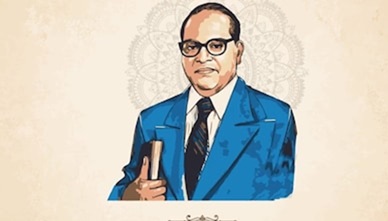
Dr. Bhimrao Ramji Ambedkar: Biography
- Dr. Ambedkar (1891–1956) was a great jurist, economist, social reformer, and the chief architect of the Indian Constitution.
- He fought throughout his life against casteism, untouchability, injustice, and social inequality.
- His contribution to the creation of modern India's democratic and egalitarian structure is unparalleled.
Early Life and Education
- Born: April 14, 1891, in Mahu (Madhya Pradesh), into the Mahar community.
- Faced social discrimination since childhood.
- After his primary education, he received the opportunity to study abroad through a scholarship from the Baroda State.
- He pursued advanced studies in the United States and Britain and became one of the world's leading scholars.
- His early research, such as "How Castes Formed" and "The Problem of the Rupee," earned him global recognition.
Contribution to the Freedom Movement and Social Reform
Social Movements Against Untouchability
- Mahad Satyagraha (1927): A historic movement for the right of Dalits to draw water from public sources.
- This was the first major organized movement for Dalit rights in India.
Temple Entry Movement
- Kala Ram Temple Satyagraha (1930): A major struggle for religious equality and the right to worship.
- This movement gave a new direction to the debate on social equality.
Demand for Political Representation
- At the Round Table Conference (1930–1932), he made the political problems of Dalit society a topic of international discussion.
- He presented the demand for separate electorates in a just manner.
Poona Pact (1932)
- An agreement between Mahatma Gandhi and Ambedkar.
- The provision of reserved seats in legislatures was decided in place of separate electorates.
- The foundation of the modern reservation system was laid by this agreement.
Protector of Labor Rights
- As the Labor Member of the Viceroy's Council from 1942 to 1946, his efforts led to important reforms such as the 8-hour workday, maternity benefits, paid leave, a labor dispute resolution system, and a labor welfare fund.
Creating the Indian Constitution
As Chairman of the Drafting Committee of the Constituent Assembly, he played a decisive role in the formulation of fundamental rights, a framework of equality, liberty, justice, and fraternity, a federal system, an independent judiciary, and protections for Scheduled Castes, Scheduled Tribes, and the underprivileged.
Contributions to Economic Thought
- Inventor of Monetary Policy: His studies on the stability of the rupee later formed the foundation for the formation of the Reserve Bank of India.
- Financial Decentralization: His research on provincial finance laid the foundation for central-state financial relations.
- Water and Energy Resources Planning: He promoted institutions such as multipurpose river projects, the Damodar Valley Project, and the Central Water Commission.
- The system of employment exchange centers was a result of his efforts.
- He expressed deep concern about the disproportionate burden of price rise (inflation) on the poor.
Important organizations associated with him
- Bahishkrit Hitakarini Sabha (1923)
- Independent Labour Party (1936)
- Scheduled Caste Federation (1942)
- Democratic Party (1956, formed after him)
Major works
- Annihilation of Caste
- The Problem of the Rupee
- Who were the Shudras
- Buddha and His Dhamma
- Essays on the Untouchables and Untouchability
- Buddha or Karl Marx
- Major papers: Mooknayak, Bahishkrit Bharat, Janata, Samata
Late life
- His health began to deteriorate from 1954, but he remained active in writing and parliamentary work.
- "Buddha and His Dhamma" is his last and most important philosophical treatise.
- On October 14, 1956, he embraced Buddhist ordination in Nagpur, along with five hundred thousand followers.
- His final message was, "Political democracy cannot be sustainable unless it is founded on social democracy."
- He attained Mahaparinirvana on December 6, 1956, in Delhi.
- His memorial, Chaityabhoomi, Mumbai, remains a sacred site for millions of followers even today.
- He was awarded the Bharat Ratna in 1990.
Conclusion
Dr. Ambedkar was not only the architect of the Constitution, but also the moral, social, economic, and democratic pillar of modern India. His message still reminds us that true progress lies in ensuring respect, equal opportunity, dignity, and justice for every individual. Even 70 years later, his ideology continues to influence both India's direction and future.





 Contact Us
  New Batch : 9555124124/ 7428085757
  Tech Support : 9555124124/ 7428085757