Prelims: Science & Technology → Defence Technology / Defence Systems
Mains: GS Paper III → Science & Technology → Defence Technology, Indigenisation & Self-Reliance
Important Keywords: DRDO | MCPS | ADRDE | Defence Indigenisation | Atmanirbhar Bharat | High-Altitude Military Capabilityb |
Why in News?
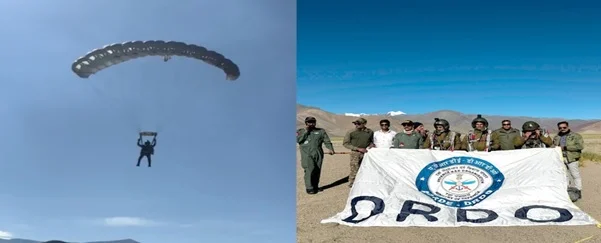
- The Defence Research and Development Organisation (DRDO) successfully tested the indigenous Military Combat Parachute System (MCPS) at an altitude of 22,000 feet at the Nyoma-Mudh drop zone in Ladakh.
- The test was conducted in extreme conditions, with temperatures around -15°C.
What is the Military Combat Parachute System (MCPS)?
The Military Combat Parachute System (MCPS) is an indigenous parachute system developed for military airborne operations, especially high-altitude missions.
- It has been designed and developed by the Aerial Delivery Research and Development Establishment (ADRDE), a DRDO laboratory.
- It enables military personnel to perform safe parachute jumps from high altitudes.
- It is designed for specialised and tactical military operations.
- The system aims to provide a reliable parachuting capability in challenging operational conditions.
How Was the Test Conducted?
DRDO test jumpers jumped from an altitude of 22,000 feet AMSL (Above Mean Sea Level.)
- The temperature during the jump was around -15°C.
- The MCPS parachute was deployed at 20,000 feet.
- The jumpers made a safe landing at 13,700 feet.
- The test demonstrated the MCPS's ability to operate in extreme high-altitude and cold-weather conditions.
Indigenous Equipment Used in the Test
Along with the MCPS, the test jumpers used several supporting systems,
including:
- Indigenous para computer
- Oxygen system
- Specialised jumpsuits
The use of these systems together is important for military personnel operating at extreme altitudes, where low oxygen levels and freezing temperatures create additional challenges.
Who Conducted the Test Jump?
The ADRDE test team included:
- Wing Commander Rahul Jha – Chief Test Jumper
- Master Warrant Officer R. J. Singh, VM(G)
- Master Warrant Officer Vivek Tiwari
The team successfully completed the high-altitude jump using the MCPS and its supporting systems.
What is ADRDE?
The Aerial Delivery Research and Development Establishment (ADRDE) is a specialised laboratory of DRDO.
- It is located in Agra, Uttar Pradesh.
- It develops parachutes and aerial delivery systems for the Indian Armed Forces.
- Its systems support the safe aerial delivery of military personnel, equipment and supplies.
- ADRDE designed and developed the indigenous Military Combat Parachute System (MCPS).
Why is the MCPS Test Important?
- High-Altitude Capability: The successful 22,000-feet jump proves that MCPS can operate at very high altitudes.
- Extreme Conditions: The system performed successfully at around -15°C, demonstrating its reliability in harsh conditions.
- Indigenous Defence Capability: MCPS strengthens India’s capability to develop specialised military equipment domestically.
- Self-Reliance: It supports Atmanirbhar Bharat and helps reduce dependence on imported defence systems.
Significance for the Indian Armed Forces
- Military operations in high-altitude areas are difficult because of extreme cold, low oxygen levels and challenging terrain.
- The MCPS can strengthen the Armed Forces' capability to carry out specialised airborne operations in such environments.
MCPS and Atmanirbhar Bharat
The development of MCPS is part of India's wider effort to promote self-reliance in defence manufacturing.
Indigenous systems such as MCPS can:
- Reduce dependence on imported defence equipment
- Strengthen domestic defence research and development
- Provide equipment suited to India's operational requirements
- Improve India's capability in specialised military technologies
About DRDO
The Defence Research and Development Organisation (DRDO) is India’s main defence research and development organisation.
- Established: 1958
- Works under: Ministry of Defence, Government of India
- Headquarters: New Delhi
- Main Role: Development of indigenous defence technologies and systems
- Major Areas: Missiles, aircraft systems, electronics, combat vehicles, naval systems, armaments and advanced materials
- Objective: To strengthen India’s defence capabilities and technological self-reliance.
Conclusion
The successful test of MCPS at 22,000 feet in Ladakh is a major step in strengthening India’s high-altitude military capabilities. It also supports India’s goal of self-reliance in defence technology by promoting indigenous and reliable military systems.
Prelims Practice Question
Military Combat Parachute System (MCPS) has been developed by which organisation?
A. HAL
B. ADRDE
C. BEL
D. ISRO
Mains Practice Questions
How can indigenous development of specialised military systems such as MCPS contribute to India's goal of Atmanirbhar Bharat in defence? Discuss.
|
FAQs
1. What is MCPS?
MCPS stands for Military Combat Parachute System, an indigenous parachute system developed for military airborne operations.
2. Who developed MCPS?
It was designed and developed by ADRDE, a laboratory of DRDO.
3. Where was MCPS recently tested?
It was tested at the Nyoma-Mudh drop zone in Ladakh.
4. At what altitude was the MCPS test jump conducted?
The test jump was conducted from 22,000 feet AMSL.
5. At what altitude was the parachute deployed?
The MCPS parachute was deployed at 20,000 feet.
|






 Contact Us
  New Batch : 9555124124/ 7428085757
  Tech Support : 9555124124/ 7428085757