Prelims: (Social Issues + CA)
Mains: (GS 1 - Social Issues, Women & Child Development; GS 2 - Government Policies & Interventions, Welfare Schemes, Social Justice) |
Why in News ?
The Union government has launched a 100-day nationwide awareness drive to mark one year of the Bal Vivah Mukt Bharat Abhiyan, reaffirming India’s commitment to eliminate child marriage by 2030, in line with the Sustainable Development Goals (SDGs).
Despite notable declines over the past decade, progress has slowed and remains uneven across States and socio-economic groups, raising concerns about India’s ability to meet the UN target on time.
Background & Context
Child marriage is a deeply rooted social practice linked to poverty, gender inequality, low educational attainment, and entrenched social norms. While India has made substantial gains through legal reforms and welfare interventions, the persistence of early marriage among marginalised communities underscores the limits of law-centric approaches.
The renewed policy focus reflects recognition that ending child marriage is not only a social justice imperative but also a prerequisite for achieving broader development goals.
Global Push to End Child Marriage: Targets and Slow Progress
- Ending child marriage is central to SDG 5 (Gender Equality), with Target 5.3 aiming to eliminate child, early, and forced marriages.
- Progress is measured by the proportion of women aged 20–24 married before 18.
- UNICEF estimates that in 2023, around 64 crore women globally were married as children, with India accounting for nearly one-third.
- Experts warn that failure to end child marriage will derail at least nine SDGs, including those on health, education, poverty reduction, and economic growth.
- At current rates, global progress must accelerate 20-fold to meet the 2030 deadline.
Child Marriage in India: Progress, Plateaus, and Inequalities
Sharp Decline, Slowing Momentum
- Child marriage declined from 47.4% (NFHS-3, 2005–06) to 26.8% (NFHS-4, 2015–16).
- However, progress slowed thereafter, falling marginally to 23.3% (NFHS-5, 2019–21).
Wide Regional Variations
- Highest prevalence: West Bengal (42%), Bihar (40%), Tripura (39%).
- Lowest prevalence: Lakshadweep, Jammu & Kashmir, Ladakh, Himachal Pradesh, Goa, and Nagaland.
Education and Income Divide
- Nearly 50% of girls with no schooling marry before 18, compared to only 4% among those with higher education.
- 40% of girls from the poorest households marry early, versus 8% from the richest quintile.
- Education emerges as the single most effective protective factor against early marriage.
Tackling Child Marriage in India: Laws, Campaigns, and Social Change
Legal Framework
- The Prevention of Child Marriage Act (PCMA), 2006 significantly reduced prevalence.
- The POCSO Act, 2012 strengthened protection by criminalising sexual activity with minors.
- However, enforcement gaps and social acceptance limit legal deterrence.
Bal Vivah Mukt Bharat Abhiyan
- Over 54,900 Child Marriage Prevention Officers appointed nationwide.
- In one year:
- 1,520 child marriages prevented through persuasion or administrative action.
- 198 cases required police or child welfare intervention.
- Community engagement includes:
- Faith leaders
- Youth volunteers
- Grassroots networks to encourage reporting and norm change.
Girls’ Empowerment and Welfare Schemes
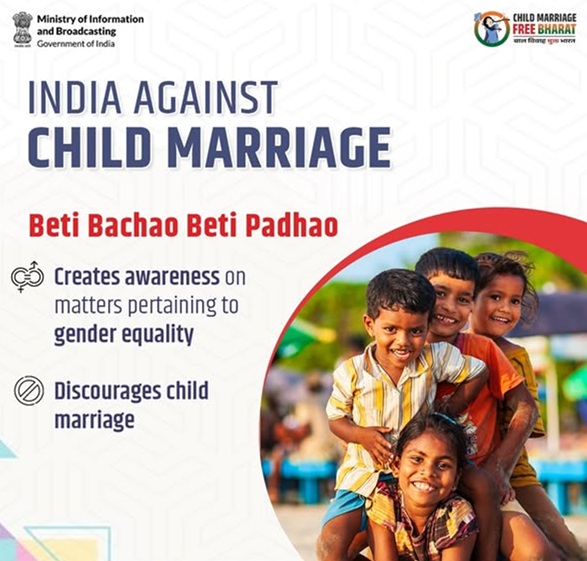
- Beti Bachao Beti Padhao aims to improve child sex ratio and girls’ education, though outcomes vary.
- Supporting measures include:
- Scholarships and financial incentives
- Improved school sanitation
- Free bicycles and transport support to reduce dropout rates.
State-Level Incentives: Mixed Outcomes
- West Bengal’s Kanyashree scheme provides annual support (13–18 years) and a lump sum for delaying marriage and pursuing education.
- Critics point out contradictions with schemes like Rupashree, which provide marriage-linked cash assistance, potentially normalising early marriage once the legal age is reached.
Debate on Raising the Legal Age of Marriage for Women
- The Centre has proposed raising the minimum age of marriage for women from 18 to 21, aligning it with men.
- Objectives include:
- Higher education and skill development
- Improved maternal and child health
- Greater economic independence
- Critics argue that:
- Without social reform, it could criminalise communities.
- 61% of women aged 20–24 were married before turning 21, indicating a large compliance gap.
- The debate underscores the need for social change alongside legal reform.
Way Forward
- Shift from punitive approaches to education-led and empowerment-centric strategies.
- Strengthen:
- Secondary education retention for girls
- Economic security for families
- Community-based monitoring and reporting
- Ensure policy coherence between welfare incentives and child marriage prevention goals.
- Foster cooperative federalism, tailoring interventions to State-specific realities.
FAQs
Q1. What is India’s target year to eliminate child marriage ?
India aims to end child marriage by 2030, in line with SDG 5.3.
Q2. Which law primarily governs child marriage in India ?
The Prevention of Child Marriage Act, 2006.
Q3. Why is girls’ education crucial in preventing child marriage ?
Higher education delays marriage, improves agency, and enhances economic prospects.
Q4. Why is raising the marriage age controversial ?
Critics fear criminalisation without social reform and weak enforcement capacity.
|







 Contact Us
  New Batch : 9555124124/ 7428085757
  Tech Support : 9555124124/ 7428085757