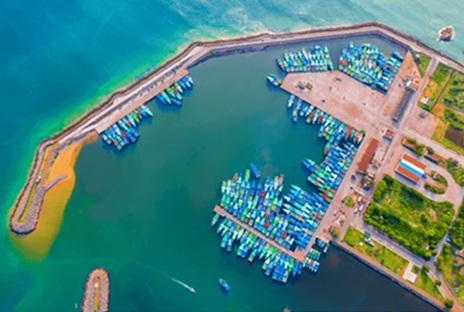
Recently, the Department of Fisheries, Ministry of Fisheries, Animal Husbandry and Dairying, Government of India, approved the proposal for the development of a Smart and Integrated Fishing Harbour at Mayabunder in the Andaman and Nicobar Islands.
The project will be implemented at an estimated cost of approximately ₹199.24 crore with 100% central financial assistance under the Pradhan Mantri Matsya Sampada Yojana (PMMSY).
About the Smart and Integrated Fishing Harbour Project
This Smart Fishing Harbour will be developed in line with the Blue Port initiative, providing safe landing and berthing facilities equipped with the latest technologies and IoT-enabled systems.
The project aims to promote sustainable fisheries management, increase fish handling capacity, and strengthen operational safety.
Additionally, it will incorporate energy-efficient systems, digital traceability, and environmentally friendly processes. This will not only increase efficiency in the fisheries sector but also help control illegal, unreported, and unregulated (IUU) fishing.
This initiative will help India progress towards the Sustainable Development Goals (SDGs).
Boosting Employment and the Fisheries Value Chain
The development of a smart and integrated fishing harbor will provide safe landing and berthing facilities for approximately 430 fishing vessels.
This will ensure the landing of approximately 9,900 tons of fish per year.
This project is expected to create new employment opportunities in the fisheries value chain and strengthen the income and livelihoods of the fishing community.
Fisheries Potential of the Andaman and Nicobar Islands
The Andaman and Nicobar Islands have an Exclusive Economic Zone (EEZ) of approximately 600,000 square kilometers, which offers vast marine resources.
It is estimated that the island has a stock of 60,000 metric tons of tuna and tuna-like species, including approximately 24,000 metric tons of yellowfin tuna and 2,000 metric tons of skipjack tuna.
Investment and Value Chain Development Efforts
To encourage investment in the fisheries sector and develop the value chain, the Fisheries Department organized an investor conference on "Investment Opportunities in the Fisheries and Aquaculture Sector of the Andaman and Nicobar Islands" on November 14, 2024, at Swaraj Dweep.
Investors with expertise in tuna fishing technologies, seaweed production, and related infrastructure participated in the conference. Additionally, a tuna cluster has been notified in the islands under the PMMSY, aimed at strengthening infrastructure development, training, investor partnerships, and global competitiveness.
PMMSY in the Andaman and Nicobar Islands Strengthening the Fisheries Sector
Fisheries infrastructure and livelihood support systems have been significantly strengthened in the Andaman and Nicobar Islands under the Pradhan Mantri Matsya Sampada Yojana (PMMSY).
An investment of approximately ₹5,573.02 lakh has been made so far, enabling the development of a holistic and integrated fisheries ecosystem from production to marketing.
These efforts have equally strengthened fish production, post-harvest management, value addition, transportation, and fishermen's welfare.
Expansion of Infrastructure and Production Capacity
Assistance provided under the PMMSY has led to significant progress in various sectors of fisheries, including hatchery development, open sea cage farming, ornamental fisheries, value-added enterprises, cold-chain logistics, fish transportation, and community support systems.
The major achievements of the scheme include the establishment of five freshwater finfish hatcheries, seven small-scale ornamental fish farming units, new brackishwater ponds covering an area of 23.2 hectares, and freshwater ponds covering an area of 17.9 hectares.
Additionally, fish feed production units, insulated vehicles, refrigerated transportation systems, fish kiosks, and bio-toilets for mechanized fishing vessels have also been established.
Fishermen Welfare and Livelihood Support
Livelihood and nutritional support has been provided to 1,000 traditional fishing families.
280 Sagar Mitras have been deployed under the IT-enabled service delivery system, improving communication and access to services between the fishing community and the administration.
The cold chain has been modernized and expanded through new and upgraded cold-chain facilities with a capacity of 10–20 tonnes, which have helped maintain the quality of fish products and reduce wastage.
Improving the Value Chain, Safety, and Traceability
PMMSY initiatives have strengthened the entire value chain from production to market through ice plants, cold storage, insulated vehicles, e-rickshaws equipped with ice boxes, and fish value addition units.
Additionally, the installation of 300 communication and tracking devices on fishing vessels has significantly improved maritime safety and monitoring capabilities.
Progress of India's Fisheries Sector
India's fisheries sector has witnessed remarkable progress in recent years. Public investment of over ₹39,000 crore has laid a strong foundation in production, infrastructure, technology, fisher welfare, and value addition. As a result, fish production is projected to increase from 9.6 million tonnes in 2013–14 to approximately 19.775 million tonnes in 2024–25.
Similarly, seafood exports have also doubled in value to ₹62,408 crore, with over 350 products being exported to approximately 130 countries.






 Contact Us
  New Batch : 9555124124/ 7428085757
  Tech Support : 9555124124/ 7428085757