
- UPSC Exam
- State PCS
- One Day Exam
- Current Affairs
- PT Quiz
- Downlaods
- About Coaching
- Blog
- Videos

| Prelims : (Science & Technology + CA) Mains : (GS-3 – Science & Technology, Infrastructure, Digital Economy) |
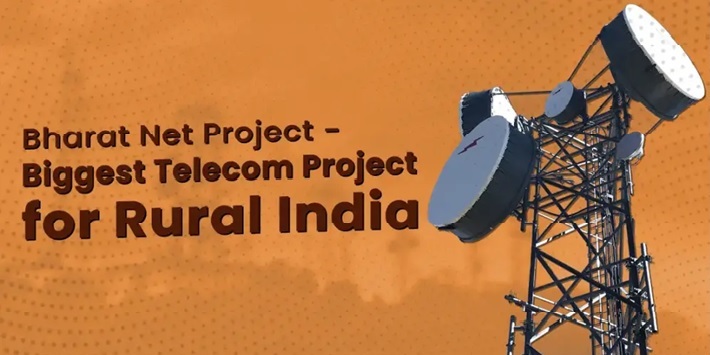
The Government of India recently stated that under the BharatNet Project, the country has expanded its optical fibre network, 5G services, and digital public infrastructure to more than 2.15 lakh Gram Panchayats.
The initiative represents one of the world’s largest rural broadband connectivity programmes and aims to bridge the digital divide between urban and rural regions. The project is implemented by Bharat Broadband Network Limited under the supervision of the Ministry of Communications.
Access to high-speed internet has become a crucial component of socio-economic development. Digital connectivity enables citizens to access services related to governance, education, healthcare, financial inclusion, and commerce.
However, rural areas in India historically suffered from limited internet access due to :
To address this gap, the Government launched the Digital India Programme in 2015, aiming to transform India into a digitally empowered society and knowledge economy.
The BharatNet Project forms a critical component of this broader digital transformation strategy.
The BharatNet Project is a flagship initiative of the Government of India designed to provide broadband connectivity to all Gram Panchayats across the country through a high-speed optical fibre network.
It is considered the largest rural broadband connectivity programme in the world, connecting villages with high-speed internet infrastructure.
The project seeks to create a robust digital backbone for rural India, enabling citizens to access government services and digital platforms.
The primary objectives of the project include :
The network functions as a wholesale infrastructure platform, allowing various service providers to deliver internet and digital services to rural populations.
The BharatNet infrastructure allows multiple stakeholders to use the broadband network.
These include :
Through this network, various services can be delivered to rural areas such as :
Thus, the project creates a digital ecosystem that supports rural development and economic inclusion.
The BharatNet programme has been implemented in multiple phases to gradually expand digital infrastructure across the country.
The first phase focused on connecting 1 lakh Gram Panchayats by laying optical fibre cables using existing telecom infrastructure.
Key highlights :
This phase established the initial backbone for rural broadband connectivity.
The second phase expanded the network to an additional 1.5 lakh Gram Panchayats.
Key features include :
This phase significantly expanded rural broadband access across the country.
The third phase focuses on modernising and strengthening the network infrastructure.
Key goals include :
This phase aims to transform BharatNet into a high-capacity digital infrastructure capable of supporting next-generation digital services.
The BharatNet Project is funded primarily through the Digital Bharat Nidhi, which replaced the earlier Universal Service Obligation Fund.
The fund supports the expansion of telecom infrastructure in areas where commercial telecom investments are not viable.
It is financed through a levy collected from telecom operators and is used to promote connectivity in underserved regions.
The project is executed by Bharat Broadband Network Limited, a Special Purpose Vehicle established by the Government of India.
The organisation is responsible for :
BharatNet aims to provide rural communities with access to high-speed internet, thereby reducing disparities between urban and rural regions.
The project supports the delivery of digital government services such as :
This enhances transparency and efficiency in public administration.
Improved connectivity enables rural entrepreneurs, farmers, and small businesses to access digital marketplaces, financial services, and information networks.
The BharatNet network supports India’s expanding digital ecosystem, including platforms related to digital payments, digital identity, and online public services.
With the integration of 5G technology, BharatNet will support advanced digital services such as smart agriculture, remote healthcare, and digital education.
Despite its progress, the project faces several challenges :
Addressing these challenges is crucial for achieving universal digital connectivity.
FAQs1. What is the BharatNet Project ? The BharatNet Project is a Government of India initiative aimed at providing high-speed broadband connectivity to all Gram Panchayats in the country. 2. Which organisation implements BharatNet ? The project is implemented by Bharat Broadband Network Limited, a Special Purpose Vehicle established by the government. 3. How is the BharatNet Project funded ? It is funded primarily through the Digital Bharat Nidhi, which replaced the earlier Universal Service Obligation Fund. 4. How many Gram Panchayats have been connected under BharatNet ? According to recent government updates, the project has expanded digital infrastructure to more than 2.15 lakh Gram Panchayats. 5. Why is BharatNet important for rural India ? BharatNet enables rural communities to access digital services such as e-governance, telemedicine, online education, and digital financial services, thereby promoting inclusive development and bridging the digital divide. |



Our support team will be happy to assist you!

 Contact Us
  New Batch : 9555124124/ 7428085757
  Tech Support : 9555124124/ 7428085757