Prelims: World Economic Forum, Global Gender Gap Index, its four dimensions, India's rank and leading countries.
Mains: GS Paper II: Women-related issues, welfare schemes, social justice, representation of women and vulnerable sections.
GS Paper III: Inclusive growth, employment, human capital and economic participation. |
Why in news?
India has retained the 131st position out of 145 economies in the Global Gender Gap Index 2026, released by the World Economic Forum (WEF) on September 16, 2026.
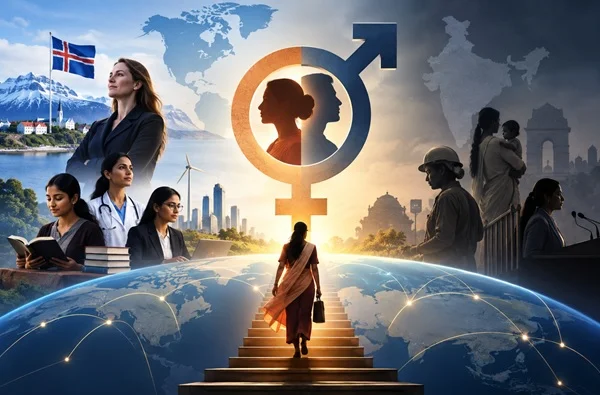
Key Facts
|
Report
|
Global Gender Gap Report 2026
|
|
Released by
|
World Economic Forum (WEF)
|
|
Index launched
|
2006
|
|
2026 edition
|
20th edition
|
|
Economies covered
|
145
|
|
India's rank
|
131st
|
|
India's overall parity
|
64.5%
|
|
Global parity
|
69.2%
|
|
Rank
|
Iceland followed by Finland, Norway
|
|
Iceland's score
|
93%
|
|
Lowest ranked
|
Chad
|
|
Estimated time to global parity
|
120 years
|
|
Four dimensions
|
Economic Participation and Opportunity, Educational Attainment, Health and Survival, and Political Empowerment
|
What is the Global Gender Gap Index?
- The Global Gender Gap Index is published annually by the World Economic Forum (WEF) to measure gender-based disparities across countries.
- The index was first introduced in 2006, making the 2026 report its 20th edition. The 2026 edition covers 145 economies.
Four Dimensions of the Global Gender Gap Index
- Economic Participation and Opportunity: It measures gender gaps in areas such as labour-force participation, wage equality for similar work, estimated earned income, representation in senior and managerial positions and professional-technical employment.
- Educational Attainment: It evaluates gender parity in literacy, primary education, secondary education and tertiary education.
- Health and Survival: It assesses sex ratio at birth and healthy life expectancy.
- Political Empowerment: It measures representation of women and men in parliament, ministerial positions and head-of-state positions over a rolling 50-year period.
India's Performance in Global Gender Gap Index 2026
- India retained its 131st rank, while its overall gender parity score improved slightly to 64.5%.
- India recorded a gender parity score of 41.2% in Economic Participation and Opportunity. This represents an improvement of 0.5 percentage points over the previous edition. However, it remains 3.5 percentage points below India's best result of 44.6% recorded in 2013.
- Gender parity among professional and technical workers increased from 26.6% in 2006 to 49.9% in 2026. However, parity in labour-force participation stands at only 44.1%, indicating that women's participation in economic activity remains an important area of concern.
- Representation among legislators, senior officials and managers has improved over the past two decades but remains comparatively low, with parity at 13.1%.
- India recorded a 96.6% gender parity score in Educational Attainment. India has achieved full parity in secondary and tertiary enrolment and remains close to parity in primary education.
- Adult literacy parity declined slightly to 82.5% in 2026. Despite this decline, the long-term trend remains positive: adult literacy parity has increased substantially from 65.2% in 2006.
Global Gender Gap Index 2026
- Iceland continues to lead the world, ranking first with 93% gender parity. It has held the top position since the 2009 edition and remains the only economy in the index to have closed more than 90% of its gender gap.
- The leading economies are Iceland (93.0%), Finland (87.2%), Norway (85.7%), Namibia (84.5%) and United Kingdom (84.2%). At the other end of the index are Chad (145th), Iran (144th) and Pakistan (143rd).
Why Does India Continue to Rank Low?
- India's relatively low overall ranking reflects an uneven pattern of progress: High Educational Parity and Lower Economic Conversion.
- India has achieved near parity in education, but educational gains have not translated proportionately into economic participation and leadership positions.
Labour-Force Participation Gap
- Limited Representation in Leadership: Women remain underrepresented among legislators, senior officials, managers and ministers.
- Political Representation: Although Political Empowerment is India's highest-ranked subindex, women's representation in Parliament and ministerial positions remains far from parity.
- Persistent Health and Demographic Challenges: India has achieved high overall parity in Health and Survival, but the sex-ratio-at-birth indicator continues to require attention.
Why Gender Parity Matters for India
- Improving gender parity is not merely a social objective; it has important implications for India's economic and developmental trajectory.
- Greater participation of women in the workforce can expand the productive labour pool, increase household incomes and support economic growth.
- Similarly, greater representation of women in political and corporate decision-making can broaden participation in governance and leadership.
Key Challenges for India
- Low economic participation and employment opportunities for women
- Gender disparities in wages and income
- Unequal burden of unpaid care and domestic work
- Gaps in political representation
- Differences in literacy outcomes
- Persistent concerns related to sex ratio at birth
Prelims MCQ
Q. With reference to the Global Gender Gap Index 2026, consider the following statements:
- It is released by the World Economic Forum (WEF).
- India ranked 131st in the 2026 Index.
- Iceland secured the first position.
- The Index measures gender gaps across four major dimensions.
Which of the statements given above are correct?
A. 1 and 2 only
B. 1, 2 and 3 only
C. 2, 3 and 4 only
D. 1, 2, 3 and 4
Mains Practice Question
Q. Despite achieving near gender parity in education, India continues to face significant gaps in women's economic and political participation. Discuss.
|
FAQs
Who releases the Global Gender Gap Index?
The World Economic Forum (WEF).
What is India's rank in the Global Gender Gap Index 2026?
India ranks 131st out of 145 economies.
Which country topped the 2026 Index?
Iceland, with about 93% gender parity.
What is India's overall gender parity score?
India has closed approximately 64.5% of its gender gap.
When was the Global Gender Gap Index introduced?
It was introduced in 2006.
|






 Contact Us
  New Batch : 9555124124/ 7428085757
  Tech Support : 9555124124/ 7428085757