Why in the news ?
At the Hamburg Sustainability Conference (HSC) 2026, held in Hamburg, Germany, on June 29-30, 2026, world leaders, senior UN officials, policymakers, and private sector representatives expressed serious concern about growing geopolitical conflicts, the energy crisis, the lack of development finance, and weakening multilateralism. The key message of the conference was that development is today's greatest strategic force (hard power) and clean energy has become the foundation of real security for the future.
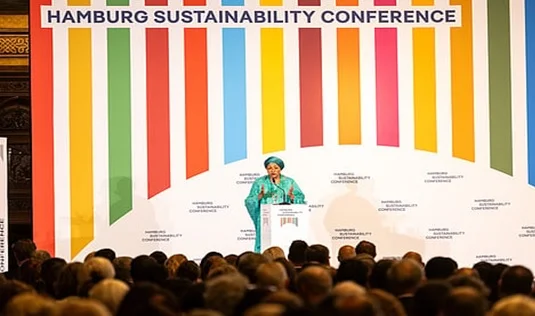
What is the Hamburg Sustainability Conference 2026 ?
- The Hamburg Sustainability Conference 2026 was held in Hamburg, Germany, on 29–30 June 2026. This year's theme was "The Power of Cooperation: Advancing Progress Together."
- Approximately 1,600 delegates from 115 countries participated in the conference. These included ministers from 22 countries, top officials from 13 international organizations, and over 280 private sector representatives.
- The conference was jointly organized by the United Nations Development Programme (UNDP), the German Federal Ministry for Economic Cooperation and Development (BMZ), the Michael Otto Foundation, and the Hamburg City Administration.
What was the main message of the conference ?
- All speakers at the conference agreed that the solution to the challenges facing the world today lies not in weakening global cooperation but in making it more effective.
- Speakers said that to address problems such as conflict, energy crises, and lack of development finance, it is necessary to redefine multilateralism in accordance with the new times.
Why was development called the new "hard power" ?
- Alexander de Croo, Administrator of the United Nations Development Programme (UNDP), stated that development is not only a means to economic growth, but also the most effective means to global peace and stability. He explained that countries that achieve inclusive and balanced development are less likely to experience conflict, civil war, and political instability.
- He stated that "Development is Hard Power," meaning that development itself has become a strategic force today.
Why is clean energy considered a cornerstone of national security ?
- Alexander de Croo stated that renewable energy is no longer solely a matter of climate change. In the current global climate, it has become a crucial pillar of national security and economic stability.
- He explained that clean energy sources, such as solar and wind, are cheaper, less volatile, and relatively more vulnerable to geopolitical crises than fossil fuels. He emphasized that energy transition and energy security cannot be separated from each other.
What concerns were raised about fossil fuel subsidies ?
- According to data presented at the conference, ongoing conflicts in West Asia could lead to global fossil fuel subsidies reaching US$1.1 trillion in 2026, approximately US$410 billion more than in 2025.
- Experts believe this could slow the transition to clean energy, increase the economic burden on developing countries, and deepen instability in the global energy market.
What did the German President warn about ?
- German President Frank-Walter Steinmeier stated that the decades-old rules-based international order is facing a serious crisis. He stated that some powerful countries are openly violating international rules to serve their own interests.
- Citing the example of the Strait of Hormuz, he said that if vital sea routes are disrupted, it impacts the entire world's economy, trade, and supply chains. Therefore, safe sea routes are essential for global economic development.
What did UN Deputy Secretary-General Amina J. Mohammed say ?
-
UN Deputy Secretary-General Amina J. Mohammed said that the development gains made over the past several decades are now under serious threat. She said that the ongoing war in West Asia has disrupted maritime trade, affected energy supplies, increased global inflation, and weakened vital supply chains.
The world is going through a period of unprecedented contradictions.
- Alexander de Croo said that while the world is experiencing unprecedented economic prosperity and technological innovation, it is also facing increasing conflict, economic uncertainty, and global instability.
- He said that for the first time since World War II, the world is facing so many crises simultaneously.
Which new global alliances will be announced at the conference ?
- More than 15 new global alliances are expected to be announced or make significant progress during the conference.
- These alliances aim to strengthen global cooperation in areas such as clean energy, Responsible AI, child malnutrition, skills development, sustainable development, and green investment.
New initiative to end child malnutrition
-
During the conference, the German Federal Ministry for Economic Cooperation and Development (BMZ), UNICEF, and the United Nations World Food Programme (WFP) are expected to announce a joint global initiative aimed at ending child malnutrition by 2030.
North-South Development Commission
- The North-South Development Commission was launched on June 30, 2026, as the summit's key event.
- The Commission will be co-chaired by former German Chancellor Olaf Scholz and former Costa Rican President Laura Chinchilla.
- The Commission will have approximately 20 members, most of whom will be from countries in the Global South.
- The Commission aims to develop new cooperation models consistent with a multipolar world order, increase the participation of the Global South, and foster new partnerships in the areas of development finance, climate change, and international trade.
Conclusion
The Hamburg Sustainability Conference 2026 sent a clear message that the solutions to current global challenges-such as war, energy crises, climate change, economic instability, and weakening multilateralism-lie not in isolation or protectionism, but in stronger international cooperation, inclusive growth, a clean energy-based economy, and effective global governance. The conference also underlined that the true power of the future will lie not solely in military capability, but in inclusive growth, energy self-sufficiency, climate-friendly policies, and strengthened multilateral cooperation.






 Contact Us
  New Batch : 9555124124/ 7428085757
  Tech Support : 9555124124/ 7428085757