Prelims : Environment +CA
Mains : GS Paper 3 – Conservation, Environmental Pollution & Degradation, Government Policies & Interventions |
Why in News ?
- India has amended the Plastic Waste Management Rules, 2016 in 2026, easing compliance norms for companies.
- The amendment allows carry-forward of recycling deficits, while retaining targets under the Extended Producer Responsibility (EPR) framework.
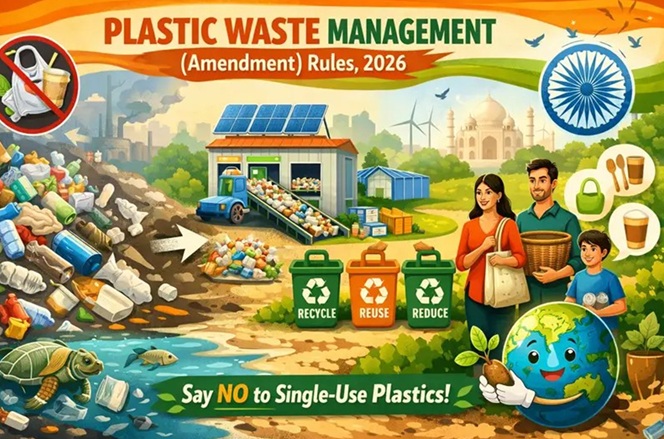
About Plastic Waste Management Rules, 2016 (Amended 2026)
- These rules regulate plastic waste generation, collection, recycling, and disposal in India.
- The 2026 amendment focuses on flexibility in compliance, while continuing long-term sustainability goals.
Key Features of the 2026 Amendment
1. Compliance Provisions
- No immediate penalties for failing recycling targets in FY 2025–26
- Deficits can be carried forward for 3 years (from 2026–27)
- Condition : At least 1/3rd of the deficit must be cleared annually
2. Recycling Targets (Under EPR Framework)
- Continues phased targets introduced in 2022 for Producers, Importers, Brand Owners (PIBOs)
Category-wise Targets :
- Category I (Rigid Plastics) :
- 30% (2025–26) → 60% (2028–29)
- Category II (Flexible Plastics) :
- Category III (Multi-layered Plastics) :
3. Reuse Targets
- Introduced for rigid plastic packaging :
- Small containers (0.9–4.9 L): 10%
- Large water packaging: 70%
- Large non-water packaging: 10%
- Targets to increase gradually over time
4. Tradable Certificate System
- Companies can meet targets by buying credits from over-performing firms
- Pros :
- Flexibility
- Cost reduction
- Concerns :
- Allows avoidance of actual recycling
- Over 6 lakh fake certificates detected (2023)
5. Exemptions
- Exemptions where use of recycled plastic is restricted, e.g.:
- Food packaging (regulated by FSSAI)
- Limits applicability in food & beverage sector
6. Implementation Mechanism
- Centralised EPR Portal for :
- Tracking
- Reporting
- Compliance
- Oversight by Central Pollution Control Board (CPCB)
- Mandate :
- 100% collection & processing of plastic by 2024–25
7. Ground Reality
- Over 20.7 million tonnes recycled since 2022
- Annual plastic waste generation: ~4.13 million tonnes (2022–23)
- Issues :
- Reliance on self-reporting
- Lack of independent verification
Plastic Categories (Based on Recyclability)
- Category I (Rigid Plastics) :
- Examples : HDPE, PET containers
- Easiest to recycle
- Category II (Flexible Plastics) :
- Examples : Carry bags, wrappers
- Moderately difficult
- Category III (Multi-layered Plastics) :
- Examples : Tetra Pak, foil wrappers
- Hardest to recycle
Key Concepts: Extended Producer Responsibility (EPR)
- EPR makes producers responsible for :
- Collection
- Recycling
- Safe disposal of plastic
- Ensures :
- Polluter Pays Principle
- Circular economy approach
Key Terms (Amendment 2026)
1. End-of-Life Disposal
- Includes :
- Waste-to-energy
- Co-processing (cement/steel)
- Waste-to-oil
- Road construction
- Excludes recycling into new plastic
2. Recycling
- Expanded definition :
- Conversion into new products
- Includes energy generation
3. Plastic Waste Processors
- Now includes :
- Recyclers
- Waste-to-energy operators
- Co-processors
4. Registered Environment Auditor
- Defined under Environment Audit Rules, 2025
- Role :
- Verify EPR compliance
- Check recycled content
5. Reuse
- Using plastic again without structural change
6. Seller (New Term)
- Includes :
- Raw material suppliers (resins, pellets)
- Expands accountability across entire value chain
Significance of the Amendment
1. Flexibility for Industry
- Reduces compliance burden
- Prevents abrupt penalties
2. Strengthening Circular Economy
- Encourages :
- Recycling
- Reuse
- Resource efficiency
3. Improved Regulatory Coverage
- Inclusion of :
- Expands scope of responsibility
4. Institutional Monitoring
- Centralised digital tracking improves :
- Transparency
- Accountability
Challenges
1. Weak Enforcement
- Heavy reliance on self-reporting
- Lack of robust verification system
2. Misuse of Tradable Certificates
- Fake certificates undermine system integrity
3. Exemptions Diluting Impact
- Food packaging exemptions reduce coverage
4. Gap Between Targets and Reality
- High plastic waste generation persists
Related Developments
- Ban on Single-Use Plastics (2022)
- Strengthening of EPR framework (2022 onwards)
- Push towards Aatmanirbhar Bharat in waste management technologies
Way Forward
- Strengthen third-party verification mechanisms
- Regulate and audit tradable certificate system
- Reduce exemptions and promote safe recycled materials
- Enhance waste segregation at source
- Invest in advanced recycling technologies
Practice Questions
Prelims :
Q. Which of the following best describes Extended Producer Responsibility (EPR) ?
(a) Government responsibility for waste management
(b) Consumer responsibility for recycling
(c) Producer responsibility for lifecycle of products
(d) Local body responsibility for waste disposal
Mains :
“Critically examine the effectiveness of the Extended Producer Responsibility (EPR) framework in managing plastic waste in India.”
FAQs
Q1. What is the key change in the 2026 amendment ?
Carry-forward of recycling deficits for 3 years with phased compliance.
Q2. What is EPR ?
A policy making producers responsible for plastic waste management.
Q3. What are plastic categories ?
Rigid, flexible, and multi-layered plastics based on recyclability.
Q4. What is the issue with tradable certificates ?
Risk of fake credits and avoidance of actual recycling.
Q5. What is India’s plastic waste scenario ?
High generation with improving but incomplete recycling coverage.
|






 Contact Us
  New Batch : 9555124124/ 7428085757
  Tech Support : 9555124124/ 7428085757