Why in news?
Hyderabad Liberation Day is observed on 17 September to commemorate the integration of the erstwhile princely State of Hyderabad with the Indian Union in 1948.
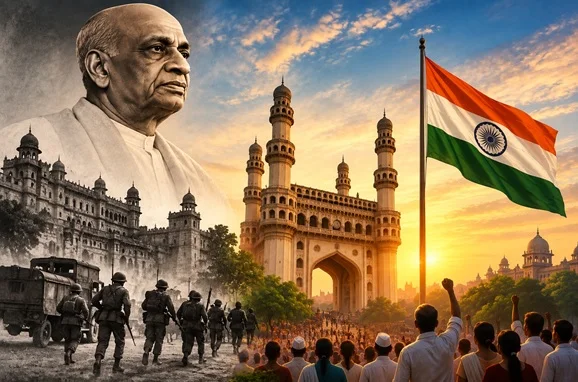
Key Facts
|
17 September 1948
|
Hyderabad's integration with India
|
|
Operation Polo
|
Hyderabad Police Action
|
|
Nizam
|
Mir Osman Ali Khan
|
|
Home Minister
|
Sardar Vallabhbhai Patel
|
|
Former Hyderabad State
|
Telangana + Marathwada + parts of present-day Karnataka
|
|
Standstill Agreement
|
Hyderabad and Government of India before Operation Polo
|
What was the Princely State of Hyderabad?
- At the time of India's independence in 1947, Hyderabad was one of the largest princely states in India. It was ruled by Nizam Mir Osman Ali Khan, the seventh Nizam of Hyderabad.
- The Hyderabad State was much larger than the present-day city of Hyderabad or Telangana. It broadly included present-day Telangana, the Marathwada region of Maharashtra and parts of present-day Karnataka, particularly the Kalyana Karnataka region.
What happened after India's Independence?
- India became independent from British rule on 15 August 1947. With the end of British paramountcy, princely states had to determine their future relationship with the newly independent dominions.
- While most princely states joined India, the Nizam of Hyderabad initially sought to maintain Hyderabad's separate status.
- To temporarily maintain the existing arrangements, Hyderabad and the Government of India entered into a Standstill Agreement in November 1947.
- However, the political and security situation inside Hyderabad continued to deteriorate. Communal violence, political tensions and the activities of the Razakars, associated with the Majlis-e-Ittehadul Muslimeen, became major concerns. Government accounts also record popular movements within Hyderabad demanding integration with the Indian Union.
Who were the Razakars?
- The Razakars were a paramilitary volunteer force associated with the Majlis-e-Ittehadul Muslimeen (MIM) and were led prominently by Qasim Razvi during the final years of the Hyderabad State.
- Their activities became an important element of the political and communal instability preceding India's military intervention.
Role of Sardar Vallabhbhai Patel
- Vallabhbhai Patel played a central role in the political integration of India's princely states. As India's first Home Minister, Patel considered Hyderabad's integration important for India's territorial and political consolidation.
- After negotiations failed to produce a lasting settlement and the security situation deteriorated, the Government of India decided to undertake what it officially termed a "Police Action" against Hyderabad.
Operation Polo
The military action for Hyderabad's integration was code-named Operation Polo.
|
Also known as
|
Police Action
|
|
Started
|
13 September 1948
|
|
Ended
|
17 September 1948
|
|
Objective
|
To bring Hyderabad State under the authority of the Indian Union
|
|
Outcome
|
Hyderabad State was integrated into India
|
Why is 17 September important?
- 17 September is commemorated as Hyderabad Liberation Day by the Government of India. Maharashtra and Karnataka have also officially observed the date in connection with the liberation of the regions of the former Hyderabad State that now fall within those states.
- The Government of India began an official year-long commemoration of Hyderabad Liberation Day from 17 September 2022 to 17 September 2023, intended to remember those who participated in the struggle and Hyderabad's integration into India.
People's Movements in Hyderabad State
- Government records highlight figures and movements associated with resistance in the region, including Ramji Gond, Komaram Bheem and Turrebaz Khan, while the period around independence saw increasing popular mobilisation demanding political change and integration with India.
- The Telangana region also witnessed an important peasant movement against feudal structures and landlords during the 1940s, adding another dimension to the social and political turmoil of the period.
What happened after Operation Polo?
- Following the surrender of Hyderabad's forces, the princely state was incorporated into the Indian Union. The Nizam continued for a period in a constitutional position as Rajpramukh of Hyderabad State.
- Later, the political map of the region changed significantly with linguistic reorganisation. In 1956, Hyderabad State was reorganised and its territories were distributed primarily among Andhra Pradesh, Bombay State and Mysore State.
- Today, territories of the former princely state lie mainly within Telangana, Maharashtra and Karnataka.
Why is Hyderabad Liberation Day Significant?
- Political Integration of India: The event represents an important stage in the consolidation of hundreds of princely states into independent India.
- Role of Sardar Patel: It highlights Patel's central role in the integration of princely states and the creation of a politically unified Indian Union.
- Regional History: The history is important for Telangana as well as the Marathwada and Kalyana Karnataka regions.
- People's Movements: The occasion also recalls the diverse groups and individuals who participated in political and social struggles in the erstwhile Hyderabad State.
FAQs
When is Hyderabad Liberation Day observed?
It is observed every year on 17 September.
Why is Hyderabad Liberation Day celebrated?
It commemorates the integration of Hyderabad State into the Indian Union in 1948.
What was Operation Polo?
It was the Indian government's military action in Hyderabad in September 1948, officially described as a “Police Action.”
When did Operation Polo take place?
It took place from 13 to 17 September 1948.
Who was the Nizam of Hyderabad in 1948?
Mir Osman Ali Khan, the seventh Nizam of Hyderabad.
|





 Contact Us
  New Batch : 9555124124/ 7428085757
  Tech Support : 9555124124/ 7428085757