|
Prelims: Dronathon-2026, Indian Air Force, Pokhran Field Firing Range, Unmanned Aircraft Systems (UAS), Swarm Technology, Autonomous Operations, Electronic Warfare, Counter-Unmanned Aircraft Systems (CUAS), Vayu UTtaM, IAF UAS Roadmap, Atmanirbharta in Defence.
Mains: GS Paper III- Science & Technology, Internal Security and Defence & Self-Reliance
Keywords: IAF Dronathon 2026, Indian Air Force, Pokhran Field Firing Range, Drone Technology, Unmanned Aircraft Systems, UAS, UAV, Swarm Technology, Autonomous Drones, Electronic Warfare, Counter-Drone Systems, CUAS, Vayu UTtaM, Unmanned Traffic Management System, IAF UAS Roadmap, Defence Technology, Atmanirbharta in Defence, Indigenous Drone Technology, Defence Start-ups, MSMEs, Future Warfare, Airspace Management.
|
Why in News?
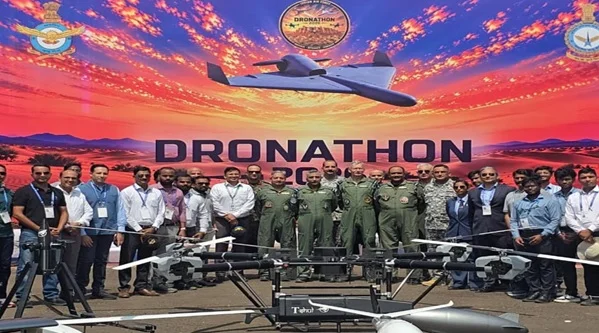
The Indian Air Force (IAF) has launched its first Dronathon-2026 at the Pokhran Field Firing Range in Jaisalmer, Rajasthan. The three-day event is being held from September 14 to 16, 2026, with participation from more than 20 defence companies, start-ups, MSMEs, DPSUs and innovators.
The event aims to test advanced unmanned systems under realistic operational conditions and strengthen cooperation between the IAF and India’s growing unmanned systems industry.
Important Points
- Dronathon-2026 is the first initiative of its kind by the IAF.
- It focuses on testing advanced unmanned systems in challenging operational environments.
- Key technologies include surveillance, reconnaissance, autonomous operations, swarm technology, electronic warfare and Counter-Unmanned Aircraft Systems (CUAS).
- The IAF is assessing systems for reliability, adaptability and operational effectiveness.
- The IAF UAS Roadmap was released to provide industry with clarity on the Air Force’s future unmanned aircraft requirements.
- Vayu UTtaM, an indigenous multi-mode Unmanned Traffic Management System, was demonstrated during the event.
- Vayu UTtaM can detect and track military and civilian unmanned aircraft systems.
- The initiative promotes Atmanirbharta in Defence and strengthens India’s domestic drone ecosystem.
- The event covers the wider ecosystem, including sensors, propulsion, payloads, communications, autonomy and countermeasures.
What is IAF Dronathon 2026?
- Dronathon-2026 is an initiative of the Indian Air Force to engage directly with the Indian unmanned systems industry and assess emerging drone technologies in challenging operational environments.
- The event focuses on moving beyond simple technology demonstrations and evaluating whether these systems can effectively meet the operational requirements of the armed forces.
Key Technologies Being Tested
The demonstrations at Dronathon-2026 cover several important unmanned technologies, including:
- Surveillance and reconnaissance systems
- Autonomous unmanned operations
- Swarm drone technologies
- Electronic warfare capabilities
- Counter-Unmanned Aircraft Systems (CUAS)
- Advanced sensors and payloads
- Communication and propulsion systems
- Drone countermeasures
- Airspace management technologies
These technologies can provide military commanders with additional options to improve the reach, persistence, responsiveness and flexibility of air operations.
Focus on Operational Effectiveness
A major objective of Dronathon-2026 is to assess the real-world operational effectiveness of unmanned systems.
Participating technologies are being evaluated on the basis of:
- Reliability during operations
- Performance in contested environments
- Ability to adapt to changing operational requirements
- Effectiveness against emerging threats
- Operational suitability for future military missions
This approach can help the IAF identify technologies that can move from the development stage towards actual operational deployment.
IAF UAS Roadmap Released
- During the event, Vice Chief of the Air Staff Air Marshal Ashutosh Dixit released the ‘IAF UAS Roadmap’.
- UAS stands for Unmanned Aircraft Systems.
- The roadmap is intended to provide greater clarity to Indian industry about the IAF’s future requirements and capability priorities in the unmanned systems sector.
- It can help defence companies, start-ups, academic institutions and research organisations align their research and innovation efforts with the future needs of the Indian Air Force.
‘Vayu UTtaM’ Demonstrated at Pokhran
- The IAF also demonstrated ‘Vayu UTtaM’, an indigenously developed multi-mode Unmanned Traffic Management System.
- During the real-time demonstration at Pokhran, the system detected and tracked both military and civilian unmanned aircraft systems.
- The system is designed to help manage increasingly crowded airspace and identify and respond to unauthorised or rogue drones.
Applications of Vayu UTtaM
The technology can have applications in areas such as:
- Military airspace management
- Airspace safety
- Protection of critical infrastructure
- Civil aviation
- Public safety
Boost to Atmanirbhar Bharat in Drone Technology
- Dronathon-2026 highlights the IAF’s focus on Atmanirbharta in defence, particularly in the unmanned systems sector.
- The initiative is not limited to drone platforms. It covers the wider unmanned systems ecosystem, including:
- Propulsion systems, sensors, payloads, communications, autonomous systems, electronic warfare, countermeasures and airspace management.
- Greater domestic capability in these areas can reduce dependence on foreign technologies and strengthen India’s defence technology ecosystem.
Why is Dronathon-2026 Important?
The increasing use of unmanned systems is changing modern warfare. Drones can perform surveillance, reconnaissance and other missions while reducing risks to human personnel.
Dronathon-2026 provides an opportunity for the IAF to:
- Test emerging technologies under realistic conditions
- Identify operationally useful drone capabilities
- Strengthen cooperation with Indian defence companies and start-ups
- Promote indigenous research and development
- Improve preparedness against emerging drone threats
- Accelerate the development of next-generation unmanned systems
Challenges
- Technical Reliability: Ensuring that drones work reliably in real-world and combat situations.
- Electronic Warfare: Jamming, spoofing and cyberattacks can affect drone communication and navigation.
- Autonomous Operations: Developing drones that can make safe and accurate decisions without continuous human control.
- Swarm Coordination: Controlling and coordinating a large number of drones at the same time.
- Counter-Drone Systems: Developing effective systems to detect and neutralise rapidly evolving drone threats.
- Airspace Management: Safely managing both military and civilian drones in increasingly crowded airspace.
- Critical Components: Reducing dependence on foreign technology for sensors, chips and communication systems.
- Rapid Technological Changes: Regularly upgrading drone systems to keep pace with new technologies.
- Human-Machine Coordination: Ensuring safe and effective coordination between manned aircraft and unmanned systems.
Way Forward
- India needs to develop a strong domestic ecosystem for unmanned systems by encouraging collaboration among the armed forces, defence industry, start-ups, academia and research institutions.
- Regular field trials such as Dronathon can help convert innovative technologies into reliable operational capabilities. Greater investment in autonomy, artificial intelligence, electronic warfare, counter-drone systems and secure communications will also be important for strengthening India’s future air power.
Conclusion
IAF Dronathon-2026 represents an important step towards integrating advanced unmanned technologies into India’s future air operations. By testing systems under realistic conditions and providing industry with a clear roadmap, the initiative can support innovation, operational preparedness and Atmanirbharta in defence technology
Prelims Practice Question
Q1. With reference to IAF Dronathon-2026, consider the following statements:
- It is an initiative of the Indian Air Force to evaluate unmanned systems under realistic operational conditions.
- It includes technologies such as swarm systems, electronic warfare and Counter-Unmanned Aircraft Systems.
- The event aims to promote indigenous capabilities in unmanned systems.
Which of the statements given above is/are correct?
A. 1 only
B. 1 and 2 only
C. 2 and 3 only
D. 1, 2 and 3
Mains Practice Question
Q. Unmanned systems are emerging as an important component of modern warfare and national security. Discuss the opportunities and challenges associated with the growing use of drone technology in India.
|
FAQs
1. What is IAF Dronathon-2026?
IAF Dronathon-2026 is an Indian Air Force initiative to test and evaluate advanced unmanned systems under realistic operational conditions.
2. Where is Dronathon-2026 being held?
The event is being held at the Pokhran Field Firing Range in Jaisalmer, Rajasthan.
3. What technologies are being tested?
The event covers surveillance, reconnaissance, autonomous operations, swarm technology, electronic warfare and Counter-Unmanned Aircraft Systems (CUAS).
4. What is Vayu UTtaM?
Vayu UTtaM is an indigenous multi-mode Unmanned Traffic Management System designed to detect and track military and civilian unmanned aircraft systems.
5. How does Dronathon-2026 support Atmanirbharta?
It encourages the development of indigenous capabilities in drone platforms, sensors, propulsion, communications, autonomy, electronic warfare and counter-drone systems.
|






 Contact Us
  New Batch : 9555124124/ 7428085757
  Tech Support : 9555124124/ 7428085757