Prelims: Environment & Ecology, Biodiversity, Fisheries, Indian Geography, Current Affairs
Mains: GS Paper II: India-Bangladesh Relations
GS Paper III: Fisheries, Blue Economy, Biodiversity, Food Processing & River Conservation |
Why in news?
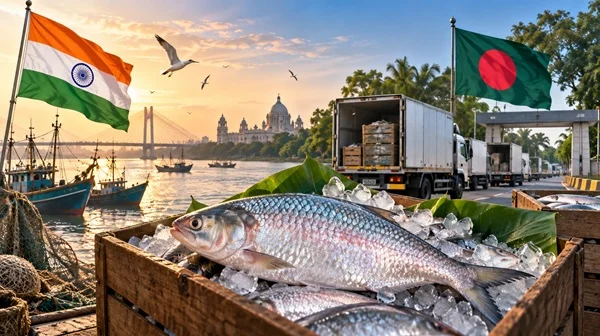
A striking reversal has emerged in the traditional Hilsa (Ilish) trade between India and Bangladesh. India, which is better known for importing the prized fish from Bangladesh particularly to meet festive demand in West Bengal has begun exporting substantial quantities of Hilsa to its eastern neighbour.
Key Facts
|
Fish
|
Hilsa/Ilish
|
|
Scientific name
|
Tenualosa ilisha
|
|
Family
|
Clupeidae
|
|
Nature
|
Anadromous migratory fish
|
|
Migration
|
Marine/estuarine waters → freshwater rivers for breeding
|
|
Important Indian river system
|
Ganga-Bhagirathi-Hooghly
|
|
Barrier discussed in Ganga context
|
Farakka Barrage
|
|
Farakka Barrage commissioned
|
1975
|
|
Major Indian research institute
|
ICAR-CIFRI
|
|
Conservation programme
|
National Mission for Clean Ganga
|
|
Major 2026 Indian export source
|
Gujarat
|
|
2026 trade development
|
India exporting Hilsa to Bangladesh
|
|
Reported exports
|
Around 500 tonnes in about two months
|
|
Additional expected exports
|
Around 150–200 tonnes
|
|
Special demand factor
|
High roe content of Gujarat Hilsa
|
|
Important Bangladeshi markets mentioned
|
Chattogram and Sylhet
|
What exactly has changed?
- The traditional Hilsa trade pattern was Bangladesh to India.
- In 2026, the flow has emerged in the opposite direction India to Bangladesh.
- According to traders, around 500 tonnes had already been exported over roughly two months, with further consignments planned.
Where is India's exported Hilsa coming from?
- Hilsa is popularly associated in India with West Bengal and the Ganga-Bhagirathi-Hooghly system, but the species also occurs along India's western coast.
- The 2026 reports indicate that much of the exported catch is being sourced from the Bharuch region of Gujarat.
- Scientific studies of Indian Hilsa have examined populations from locations including Gujarat, Odisha, Andhra Pradesh and West Bengal, reflecting the species' distribution across different coastal and riverine environments.
Why does Bangladesh want Gujarat Hilsa?
- A particularly interesting factor behind the demand is roe. Traders have reported that Gujarat Hilsa often contains substantial quantities of roe.
- Such roe-filled Hilsa reportedly has relatively limited preference in some Indian markets but enjoys strong demand among buyers in parts of Bangladesh, especially Chattogram and Sylhet.
- This has effectively converted a market characteristic that can reduce preference in one place into a commercial advantage in another.
Gujarat Hilsa → High Roe Content → Demand in Bangladesh
- Reports indicate that roe is being separated for processing and can enter further value-added trade, while some of the imported fish may also be processed into salted or dried Hilsa.
Why is Hilsa So Special?
- Hilsa is one of South Asia's most culturally significant and commercially valuable fish species.
- Common Names: Hilsa, Ilish, Indian Shad
- Hilsa is particularly important in the Bay of Bengal region and is strongly associated with the river systems of eastern South Asia.
- In India, it has immense cultural significance, especially in West Bengal.
Hilsa is an Anadromous Fish
- An anadromous fish generally spends much of its life in marine or estuarine waters but migrates into freshwater rivers for reproduction.
- Hilsa therefore depends on the ecological health of not just one habitat but an interconnected system involving.
- Its migratory character is also why river connectivity and barriers such as barrages can become important for Hilsa conservation.
Hilsa and the Ganga
- Historically, Hilsa migrated from the Bay of Bengal through the Ganga river system and could travel considerable distances upstream.
- However, the construction and commissioning of the Farakka Barrage in 1975 significantly affected this migration route.
- According to ICAR, Hilsa subsequently became virtually absent from many middle and upper stretches of the Ganga.
- This makes the species an important example of how large river infrastructure can interact with the migration patterns of aquatic species.
A Major Development in 2026: Hilsa Returns to Upper Ganga
- In August 2026, the Government reported that Hilsa had been recorded near Tanda Khurd village in Chandauli district, Uttar Pradesh, after being virtually absent from upstream reaches for decades.
- Historically, Hilsa had migrated through the Ganga system towards Varanasi, Prayagraj and beyond. Its renewed appearance upstream has therefore been presented by fisheries authorities as an encouraging development in river restoration and aquatic biodiversity conservation.
Role of ICAR-CIFRI in Hilsa Conservation
- The Indian Cuncil of Agriculture Research-Central Inland Fisheries Research Institute (ICAR-CIFRI) has been involved in scientific efforts to restore Hilsa populations in the Ganga.
- Under the National Mission for Clean Ganga (NMCG), ICAR-CIFRI has been implementing a Hilsa conservation programme since 2020.
- In June 2026, ICAR-CIFRI conducted a Hilsa Ranching Programme at Farakka aimed at supporting restoration of Hilsa populations in the Ganga stretch between Farakka and Prayagraj.
What is Fish Ranching?
- Fish ranching involves releasing fish or suitable life stages into natural water bodies with the objective of strengthening or restoring natural stocks.
- In the case of Hilsa, scientific interventions can support declining populations while broader measures improve river habitat and migration conditions.
Why is Hilsa Conservation difficult?
- Hilsa conservation is complicated because the fish crosses multiple ecological zones during its life cycle.
- Its survival depends on the health of:
Marine waters - Estuaries - River channels - spawning habitats
Major Threats to Hilsa
- Catching Juvenile Hilsa: Research on the Hooghly-Bhagirathi system has identified juvenile fishing as a serious fisheries-management issue. Catching fish before they reach suitable maturity can result in both ecological and economic losses.
- Barriers to Migration: As Hilsa is migratory, maintaining river connectivity is particularly important. The history of Hilsa in the upper Ganga demonstrates this challenge.
- River Pollution: Industrial discharge, untreated sewage, plastics and other pollutants can degrade aquatic habitats. Improved water quality is therefore directly relevant to fisheries conservation.
- Climate Change: Climate change can alter sea temperature, river discharge, monsoon patterns, salinity and coastal ecosystems. These changes can potentially affect the timing and distribution of migratory fish populations.
Hilsa as an Indicator of River Health
- The presence or absence of migratory species can provide useful information about the functioning of river ecosystems.
- For Hilsa, successful migration requires reasonably connected aquatic habitats extending from coastal and estuarine areas into freshwater systems.
Economic Importance of Hilsa
- Hilsa supports a large fisheries value chain involving Fishers, Landing centres, Wholesalers, Cold-chain operators, Transporters, Retailers, Restaurants and Consumers.
India-Bangladesh Dimension
- Hilsa is deeply embedded in Bengali cuisine on both sides of the border.
- For consumers in West Bengal, Bangladeshi Hilsa has traditionally held particular appeal, especially around the festive season.
- As a result, decisions regarding Hilsa exports from Bangladesh to India often attract considerable public attention.
Is Bangladesh still exporting Hilsa to India?
- Bangladesh had permitted 1,200 tonnes of Hilsa exports to India ahead of the festive season in the previous year, according to contemporary reports.
- Therefore, the present development should not be described as the permanent end of Bangladesh's Hilsa exports to India.
Ecological Economics
- Hilsa demonstrates the close connection between natural ecosystems and economic activity.
- If fish stocks decline because of overfishing, pollution, habitat destruction and migration barriers then fishermen, processors, traders and consumers are all affected.
- Thus, biodiversity conservation can also be viewed as an economic investment in natural capital.
Why is this important for India's Blue Economy?
- India's Blue Economy involves the sustainable use of ocean and coastal resources for economic growth, livelihoods and ecosystem health.
- The Hilsa case touches several Blue Economy components:
Marine fisheries, Coastal livelihoods, Food processing, Exports, Biodiversity conservation and Scientific management.
Prelims MCQ
Q. With reference to Hilsa (Tenualosa ilisha), consider the following statements:
- Hilsa is an anadromous fish.
- It migrates from marine/estuarine waters to freshwater rivers for spawning.
- In India, it is associated with the Ganga-Bhagirathi-Hooghly river system.
- It belongs to the family Clupeidae.
Which of the statements given above are correct?
A. 1 and 2 only
B. 1, 2 and 3 only
C. 2, 3 and 4 only
D. 1, 2, 3 and 4
Mains Practice Question
Q. The recent reversal in India-Bangladesh Hilsa trade highlights the interconnection between ecology, livelihoods and international trade.” Discuss.
|
FAQs
What is the scientific name of Hilsa?
Tenualosa ilisha.
What type of fish is Hilsa?
An anadromous migratory fish.
Which sea is strongly associated with Hilsa in South Asia?
The Bay of Bengal.
Which mission supports Hilsa restoration in the Ganga?
The National Mission for Clean Ganga (NMCG).
Why is Hilsa important to India’s Blue Economy?
It supports fisheries, livelihoods, processing and trade.
|






 Contact Us
  New Batch : 9555124124/ 7428085757
  Tech Support : 9555124124/ 7428085757