Prelims: VAHAK-6, SABAL 20, ALAKH UAV, Multi-UAV Mothership, Drone Swarm, GPS-Denied Operations, ISR, Loitering Munition, Electronic Warfare, BEL
Mains: GS Paper III: Defence Technology, Indigenisation of Defence, Border Security, Emerging Technologies, And Electronic Warfare |
Why in News?
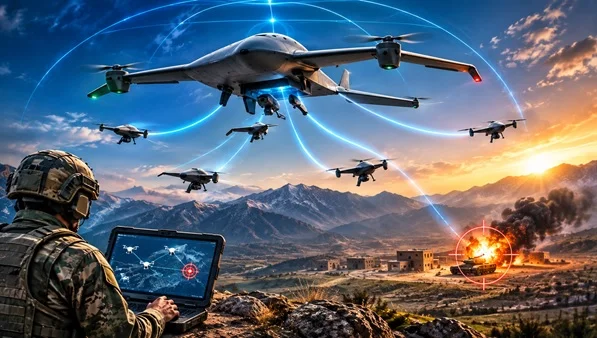
India has unveiled an indigenous multi-UAV mothership system called VAHAK-6, designed to carry and deploy multiple smaller drones in mid-air for surveillance, reconnaissance and strike missions.
Key Facts
|
Feature
|
Details
|
|
System
|
VAHAK-6
|
|
Type
|
Multi-UAV Mothership System
|
|
Developer
|
EndureAir Systems
|
|
Collaboration
|
Bharat Electronics Limited (BEL)
|
|
Mothership
|
SABAL 20
|
|
Drone Capacity
|
Up to 6 ALAKH UAVs
|
|
Deployment
|
Mid-air
|
|
ALAKH Roles
|
Surveillance, reconnaissance and kamikaze/strike
|
|
Operational Concept
|
Search, Detect and Destroy
|
|
Key Capability
|
Operations in EW-challenged and GPS-denied environments
|
|
Swarm Capability
|
Up to six UAVs
|
|
ALAKH
|
Micro-UAV platform with GPS-free navigation
|
|
Primary Relevance
|
ISR, distributed operations and precision strike support
|
What is VAHAK-6?
- VAHAK-6 is a two-tier unmanned aerial system. Instead of requiring each small drone to fly all the way from a ground base to the target area, the larger SABAL 20 mothership carries them closer to the mission zone and releases them in the air. This can extend the effective reach of smaller UAVs while conserving their onboard endurance for the actual mission.
How Does VAHAK-6 Work?
- A typical mission begins with SABAL 20 taking off from a forward base while carrying smaller ALAKH UAVs. During transit, the mothership itself can contribute to aerial surveillance and situational awareness. Once it reaches closer to the operational area, it releases the smaller drones in mid-air.
- The ALAKH fleet can then be configured for different tasks such as surveillance, reconnaissance, target observation, or kamikaze/strike missions.
SABAL 20: The Mothership
It serves two important roles:
- Carrier: It transports the smaller ALAKH drones towards the operational area.
- Airborne Command Node: It supports coordination and situational awareness during the mission.
What is ALAKH?
- It is a compact micro-UAV family developed by EndureAir Systems. The company describes ALAKH as a lightweight UAV designed for close-range surveillance and difficult operating environments. It supports GPS-free navigation, indoor reconnaissance, live FPV streaming and ISR missions.
- ALAKH is particularly suited to confined or difficult-to-access locations. It can operate through spaces as small as a 2 ft × 2 ft window and can support payload drops of up to 400 grams.
- EndureAir, working with IIT Kanpur, had already delivered ALAKH nano-UAVs to the Indian Army by 2023 for ISR and counter-insurgency/counter-terrorism requirements.
Surveillance and Strike Roles
- The key strength of VAHAK-6 is that the six-drone payload does not necessarily have to consist of identical UAVs performing the same task. This means one set of drones can search and observe an area while another strike-configured UAV can engage a designated target when commanded.
What is a Loitering Munition?
- It is an unmanned weapon that can travel to a designated area, remain airborne while searching or waiting for a target, and then strike once an appropriate target has been identified and engagement is authorised. They are commonly called kamikaze drones because the weapon itself is consumed during the strike.
What is a Drone Mothership?
- It is a larger airborne platform that carries, deploys and potentially coordinates multiple smaller unmanned systems. Small drones are useful because they are small, agile, difficult to detect, and relatively low cost. But their small size usually limits range, endurance and payload. A mothership can carry them closer to the mission area before deployment.
What is Drone Swarming?
- It involves multiple UAVs operating together in a coordinated manner. VAHAK-6 can deploy a swarm of up to six UAVs, supporting coordinated as well as distributed operations. This creates a distributed network of aerial sensors and mission systems.
- However, swarming should not automatically be interpreted as fully autonomous lethal decision-making. The available information does not establish that VAHAK-6 independently selects and attacks targets without human command.
GPS-Free Operations: Why Are They Important?
- Modern military drones frequently rely on satellite-based navigation systems. During conflict, however, an adversary may use GPS jamming to interfere with navigation signals. This creates a GPS-denied environment.
- A UAV capable of continuing operations without reliable GPS is therefore more resilient in an electronic-warfare environment. VAHAK-6 is specifically presented as supporting operations in EW-challenged and GPS-denied environments.
What is Electronic Warfare?
- Electronic Warfare (EW) involves the use of electromagnetic energy to exploit, disrupt, deny or protect electronic systems and communications.
- For UAV systems, two particularly important threats are:
Jamming: Blocking or degrading a signal.
Spoofing: Feeding misleading navigation or other electronic information to a system.
ISR and VAHAK-6
- ISR: Intelligence, Surveillance and Reconnaissance. It involves gathering information about an operational environment, monitoring activities and identifying objects or potential targets.
- ALAKH supports day/night ISR using First-Person View (FPV) and electro-optical/infrared sensors, according to its manufacturer.
- Combining such small surveillance drones with a larger mothership could allow forces to observe a wider area while keeping personnel farther from high-risk locations.
Potential for Military Operations
- Border Surveillance: Small UAVs can monitor difficult terrain and provide live information without exposing personnel.
- High-Altitude Operations: India's mountainous borders make lightweight UAVs particularly relevant. ALAKH has been designed for deployment in challenging and high-altitude environments; Endure Air currently lists launch capability up to 4,000m AMSL.
- Counter-Infiltration Operations: Micro-UAVs could help monitor terrain, structures or other areas that are difficult for larger aircraft to observe closely.
- Urban Warfare: ALAKH's small size and indoor-reconnaissance capability make the platform relevant to confined-space operations.
- Target Acquisition: Surveillance UAVs can help locate and observe potential targets before any engagement decision.
- Electronic-Warfare Environment: GPS-independent capabilities become particularly valuable when satellite navigation is degraded or unavailable.
Why is VAHAK-6 important for the Indian Army?
- Extended Reach: The mothership carries micro-UAVs closer to their mission area, allowing the smaller aircraft to preserve endurance for the mission itself.
- Reduced Risk to Soldiers: Drones can enter dangerous areas before personnel, improving situational awareness while reducing direct exposure.
- Multi-Mission Capability: A single carrier can deploy UAVs configured for surveillance, reconnaissance or strike roles.
- Faster Sensor-to-Shooter Chain: Integrating surveillance and strike assets can potentially shorten the time between detecting a target and responding to it.
- Distributed Operations: Multiple small drones can spread across an operational area rather than relying on a single large platform.
- Resilience against GPS Jamming: GPS-free navigation and operation in GPS-denied environments address a major challenge of modern electronic warfare.
Strategic Significance
- Mass: Instead of depending entirely on a small number of expensive platforms, militaries can deploy multiple smaller unmanned systems.
- Distribution: Sensors and strike capabilities can be dispersed across several drones.
- Resilience: GPS-independent and EW-resistant capabilities help unmanned systems operate in increasingly contested electromagnetic environments.
Challenges and Limitations
- A swarm depends on reliable communication, coordination and command-and-control. Enemy electronic warfare can attempt to disrupt data links even when GPS-independent navigation is available.
- Small UAVs also face constraints involving endurance, payload capacity and weather conditions.
- Another major challenge is counter-drone technology. Modern militaries increasingly employ electronic jammers, directed-energy systems, air-defence guns and other counter-UAS measures.
Prelims MCQ
Q1. VAHAK-6, recently seen in the news, is best described as:
A. Anti-drone missile system
B. Multi-UAV mothership system
C. Unmanned submarine
D. Electronic warfare radar
Mains Practice Question
Q. Examine the role of indigenous unmanned aerial systems in strengthening India’s defence preparedness and technological self-reliance.
|
FAQs
What is VAHAK-6?
An indigenous multi-UAV mothership system.
Who developed VAHAK-6?
EndureAir Systems, in collaboration with BEL.
What drones does it carry?
Specialised ALAKH micro-UAVs.
What is its main operational concept?
Search, Detect and Destroy (SDD).
What is drone swarming?
Multiple drones working together in a coordinated mission.
|






 Contact Us
  New Batch : 9555124124/ 7428085757
  Tech Support : 9555124124/ 7428085757