New
GS Foundation (P+M) - Delhi : 19th Jan. 2026, 11:30 AM Republic Day offer UPTO 75% + 10% Off, Valid Till : 28th Jan., 2026 GS Foundation (P+M) - Prayagraj : 09th Jan. 2026, 11:00 AM Republic Day offer UPTO 75% + 10% Off, Valid Till : 28th Jan., 2026 GS Foundation (P+M) - Delhi : 19th Jan. 2026, 11:30 AM GS Foundation (P+M) - Prayagraj : 09th Jan. 2026, 11:00 AM

India–EU Free Trade Pact: A Landmark in a Fragmenting Global Trade Landscape

Prelims: (International Relations + CA)
Mains: (GS 2 – International Relations; GS 3 – Economy, Trade, Globalisation)

Why in News ?

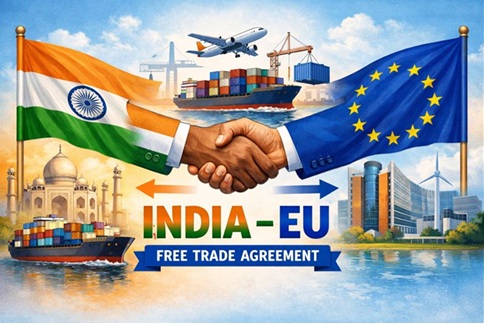
At the India–EU Leaders’ Summit, Prime Minister of India, European Council President António Luís Santos da Costa, and European Commission President Ursula von der Leyen announced the successful conclusion of negotiations of the India–EU Free Trade Agreement (FTA).

The agreement marks a major breakthrough in the India–EU Strategic Partnership, especially at a time marked by global trade uncertainty, tariff wars, de-risking strategies, and supply chain disruptions.
Significance of the India–EU FTA

  • Scale and global weight: India and the EU together account for around 25% of global GDP and over one-third of global trade, making this one of the world’s most consequential bilateral trade agreements.
  • Trade partnership depth: The EU is India’s second-largest export destination after the United States.
  • Strategic complementarity: The agreement complements India’s recent FTAs with the United Kingdom and the European Free Trade Association (EFTA), strengthening India’s trade diversification strategy.
  • Geopolitical relevance: Concluded amid rising protectionism, fragmentation of supply chains, and great-power competition, the FTA signals a shared commitment to open, rules-based, and multilateral trade.

Key Components and Takeaways of the Agreement

1. Trusted Strategic Partnership

  • Anchored in shared democratic values, rule of law, and human rights.
  • Strengthened by people-to-people ties, including:
  • Around 1.7 million Indian diaspora in the EU.
  • Over 1.21 lakh Indian students enrolled in EU universities.
  • Enhances India’s soft power diplomacy and long-term strategic trust.

2. Economic Complementarity, Scale, and Diversity

  • India (world’s 4th-largest economy) and the EU (world’s 2nd-largest economy) are complementary rather than competitive.
  • Market integration opens unprecedented opportunities in:
    • Manufacturing
    • Services
    • Investment
    • Technology cooperation.

3. Trade Diversification, Supply Chain Resilience, and De-Risking

  • Reduces excessive dependence on China-centric supply chains.
  • Strengthens resilience amid:
    • US–China trade tensions
    • Weaponisation of trade and technology
    • Geopolitical disruptions to logistics and production networks.

4. Commercially Meaningful “Win–Win” Deal

  • For India:
    • Major tariff gains in labour-intensive sectors such as:
      • Textiles and clothing
      • Gems and jewellery
      • Leather and footwear
    • These sectors previously faced high EU tariffs, making the FTA economically transformative.
  • For the EU:
    • Improved access to a large, fast-growing Indian market with relatively higher tariffs.
    • Provides EU firms a competitive edge over countries without an India–EU FTA.

5. Safeguarding Sensitive Agriculture and Food Security

  • Core agricultural sectors such as dairy, cereals, meat, and select fruits and vegetables are excluded.
  • Addresses concerns of Indian farmers, a key political and electoral constituency.
  • Ensures food security and rural livelihood protection while opening other sectors.

6. Calibrated Opening of the Automobile Sector

  • EU automakers granted access mainly in higher price segments.
  • Encourages:
    • Make in India
    • Technology transfer
  • Future exports from India.
  • Consumers benefit from:
    • Better technology
    • Increased competition
    • Higher safety and environmental standards.

7. Carbon Border Adjustment Mechanism (CBAM) and Green Protectionism

  • Despite CBAM being a sensitive and complex EU regulation, the FTA provides:
    • Most-favoured treatment
    • A dedicated technical dialogue mechanism
    • EU support for India’s green and climate transition.
  • Enables India to safeguard competitiveness while aligning with climate commitments.

8. Services as the Future Growth Driver

  • Services expected to dominate future bilateral trade growth.
  • Key gains for India include:
    • Certainty of market access
    • Non-discriminatory treatment
    • Boost to digitally delivered services
    • Easier mobility of professionals
    • Coordination on social security
    • Greater penetration of Indian talent and students in the EU.

9. A “Living Agreement” with Review Mechanisms

  • Designed as a dynamic, evolving framework.
  • Includes:
    • Periodic review clauses
    • Consultation mechanisms for emerging technologies and regulations.
  • Relies on mutual trust and strong institutional stewardship for long-term relevance.

10. Signal to Global Business and the United States

  • Projects India as a reliable supporter of open, fair, stable, and rule-based trade.
  • Sends a strong message amid:
    • Tariff wars
    • Unilateral trade actions
    • Rising protectionism, including from major economies such as the US.
  • Reinforces India’s commitment to multilateralism and trade certainty.

Challenges and Way Forward

  • Managing adjustment costs:
    • Particularly in sensitive domestic sectors.
    • Requires targeted support, skilling, and industrial upgrading.
  • Aligning regulatory standards and compliance mechanisms:
    • Effective implementation will need capacity-building support for regulators and businesses.
  • Addressing CBAM-related competitiveness concerns:
    • Use review mechanisms to adapt to technological change and climate transition pathways.
  • Ensuring gains for MSMEs and small farmers:
    • Strengthening domestic competitiveness through structural reforms, credit access, and export facilitation.

FAQs

1. Why is the India–EU FTA considered strategically important ?

Because India and the EU together account for about 25% of global GDP and over one-third of global trade, making this agreement globally consequential.

2. Which sectors benefit the most from the FTA ?

India gains significantly in labour-intensive sectors such as textiles, gems and jewellery, leather, and footwear, while the EU gains access to India’s large and fast-growing market.

3. How does the FTA address climate and sustainability concerns ?

It includes provisions on the EU’s Carbon Border Adjustment Mechanism (CBAM), technical dialogue, and EU support for India’s climate transition.

4. What does a “living agreement” mean in this context ?

It means the FTA includes review clauses and consultation mechanisms to adapt to emerging technologies, regulations, and evolving global conditions.

5. How does the FTA strengthen India’s global economic position ?

It enhances trade diversification, supply chain resilience, services exports, and India’s role as a supporter of open, rule-based global trade.

Have any Query?

Our support team will be happy to assist you!

OR