Prelims: (International Relations + CA)
Mains: (GS 2 - International Relations, International Treaties & Agreements) |
Why in News ?
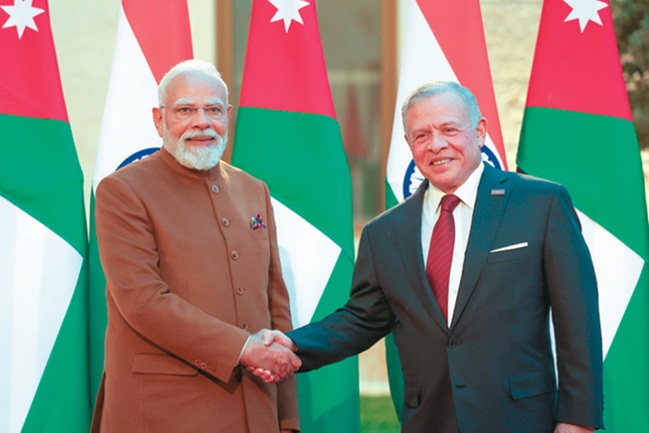
The Prime Minister of India paid his first full-fledged bilateral visit to Jordan in 2025, holding wide-ranging talks with King Abdullah II. The visit coincided with the 75th anniversary of India–Jordan diplomatic relations, signalling an intent to upgrade traditionally warm ties into a future-oriented strategic partnership.
Background and Context
India and Jordan have shared cordial relations since 1950, marked by political trust, limited but stable trade, and cooperation in multilateral forums. However, the relationship remained relatively under-leveraged compared to India’s deeper engagements with Gulf states.
Amid a volatile West Asia, weakening multilateralism, and India’s growing strategic footprint in the region, Jordan’s role as a moderate, stabilising Arab monarchy has gained renewed importance. The 2025 visit sought to recalibrate ties beyond symbolism towards trade, digital cooperation, defence, and regional connectivity.
Key Outcomes of the Visit
MoUs and Institutional Agreements
Five major agreements were concluded:
- Technical Cooperation in New & Renewable Energy
- Cooperation in Water Resources Management & Development
- Twinning Agreement between Petra and Ellora
- Renewal of Cultural Exchange Programme (2025–2029)
- Letter of Intent on sharing population-scale digital solutions for digital transformation
Trade and Economic Ambitions
- Target to raise bilateral trade to USD 5 billion in five years
- India is already Jordan’s 3rd largest trading partner
Political and Security Convergence
- Joint condemnation of terrorism
- Shared commitment to regional peace, stability, and moderation
Strategic Significance of Jordan for India’s West Asia Policy
Geopolitical Bridge
- Jordan is a pro-West, constitutional monarchy with a peace treaty with Israel
- Enables India to balance ties with Israel, Arab states, and Iran without sectarian entanglement
Counter-Terrorism Cooperation
- Collaboration through the Aqaba Process (2015)
- Defence MoU (2018) and participation in SOFEX
- Strong military-to-military and special forces engagement
Multilateral and Diplomatic Support
- Jordan’s influence within the Organisation of Islamic Cooperation (OIC) often helps moderate anti-India narratives
- Balanced stance on Kashmir-related issues
Regional Stability and Connectivity
- Custodianship of holy sites in Jerusalem gives Jordan leverage in de-escalation
- Strategic role in the India–Middle East–Europe Economic Corridor (IMEC)
- Emergence as an overland logistics hub during Red Sea disruptions
Jordan: Key Facts
- Location: West Asia; borders Syria, Iraq, Saudi Arabia, Israel, and the West Bank
- Geography: Predominantly desert; fertile Jordan River Valley
- Population: Largely Arab, with a large Palestinian refugee population
- Capital: Amman
- Maritime Access: Port of Aqaba (Red Sea)
- Political History:
- British Mandate (Transjordan) → Independence in 1946
- Peace Treaty with Israel (Wadi Araba, 1994)
Pillars of India–Jordan Relations
Diplomatic Engagement
- Relations established in 1950
- Regular high-level interactions at UNGA and bilateral platforms
Trade and Economic Cooperation
- Bilateral trade: USD 2.875 billion (FY 2023–24)
- Jordan India Fertiliser Company (JIFCO) ensures India’s access to phosphates and potash
- Over 15 Indian-owned garment units in Jordan (≈ USD 500 million investment)
Defence and Security
- Defence Cooperation MoU (2018)
- Growing focus on counter-terrorism and special operations
Science, Technology and Digital Cooperation
- India–Jordan IT Centre of Excellence at Al-Hussein Technical University
- Supercomputer PARAM Shavak supports training in AI, cybersecurity, and big data
People-to-People Ties
- ~17,500 Indians in Jordan (healthcare, IT, education)
- Strong cultural resonance through Bollywood and festivals
Challenges in the Partnership
- Narrow Trade Basket: Dominated by fertilisers, cereals, and petroleum products
- Economic Constraints in Jordan: High unemployment and public debt limit expansion
- Geopolitical Sensitivities: Israel–Palestine tensions constrain policy flexibility
- Connectivity Gaps: Limited direct flights restrict tourism and business flows
Way Forward
- Diversify Trade: Focus on MSMEs, startups, value chains, and services
- Digital Partnership: Share India’s DPI and UPI experience
- Green & Water Cooperation: Solar energy, green hydrogen, desalination, irrigation
- Regional Gateway Role: Use Jordan as a hub for humanitarian aid and reconstruction
- Improve Connectivity: More direct flights and digital collaboration platforms
FAQs
Q1. Why is Jordan important for India in West Asia ?
Jordan acts as a diplomatic bridge, counter-terrorism partner, and stabilising force in a volatile region.
Q2. What were the key outcomes of the 2025 visit ?
MoUs in energy, water, culture, digital solutions, and an ambitious trade target of USD 5 billion.
Q3. How does IMEC enhance Jordan’s relevance for India ?
It positions Jordan as a key logistics and connectivity node linking India to Europe.
Q4. What limits India–Jordan trade growth ?
A narrow trade base, Jordan’s economic stress, and limited connectivity.
Q5. What is the future potential of the partnership ?
High in areas like digital public infrastructure, renewables, water security, defence, and regional stabilisation.
|






 Contact Us
  New Batch : 9555124124/ 7428085757
  Tech Support : 9555124124/ 7428085757