Why in the news ?
- The Union Home Ministry has announced that from January 1, 2027, investigations and judicial proceedings under new criminal laws will be fully recorded digitally. To this end, the nationwide implementation of the Interoperable Criminal Justice System (ICJS) is in its final stages.
- This initiative is a significant step towards transforming India's criminal justice system from a paper-based system to a digital, transparent, and integrated system.
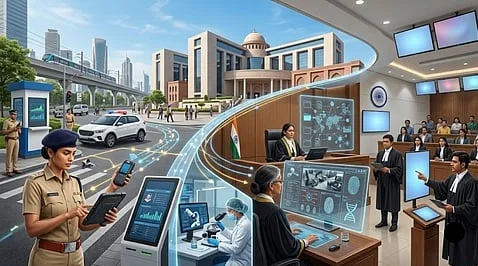
What is the Interoperable Criminal Justice System (ICJS) ?
- The Interoperable Criminal Justice System (ICJS) is a national digital platform of the Government of India, which aims to connect all key institutions involved in the criminal justice system through a common digital network.
- The following institutions are being integrated under this system :
- Police
- Courts
- Prisons
- Forensic Science Laboratories
- Prosecution
- Through this platform, the entire process from filing an FIR to investigation, charge sheet, trial, and final judgment will be conducted digitally.
- The entire data of the system is being stored securely on the Government of India's cloud platform, MeghRaj.
Why has the importance of the ICJS increased after the new criminal codes ?
- Three new criminal laws, effective July 1, 2024, have given greater importance to digital processes and forensic investigations.
- These three laws are :
- The Indian Justice Code (Bharatiya Nyaya Sanhita - BNS) – replaced the Indian Penal Code (IPC).
- The Indian Civil Security Code (BNSS) – replaced the Code of Criminal Procedure (CrPC).
- The Indian Evidence Act (BSS) – replaced the Indian Evidence Act.
- The effective implementation of these laws requires digital records, electronic evidence, and prompt coordination between various agencies.
What will happen by January 1, 2027 ?
- According to the Union Home Ministry, from January 1, 2027, the investigation and judicial process will become completely digital.
- Under this, the entire investigation process will be conducted digitally, digital records of court proceedings will be created, secure management of electronic evidence will be ensured, and real-time information will be shared between police, courts, prisons, prosecution, and forensic institutions.
Digital transmission of FIRs remains a major challenge
- Although implementation of the ICJS is progressing rapidly, current data suggests that the system is not yet fully effective.
- According to the National Crime Records Bureau (NCRB),
- Only 46% of FIRs reach courts digitally.
- This means that in more than half of cases, the digital data flow from police to court is still incomplete.
- This situation indicates that much work remains to be done to fully implement the digital justice system.
Status of cases registered under new laws
- After the implementation of the new criminal law –
- 74.66 lakh FIRs were registered under the Indian Penal Code (BNSS).
- 63,572 zero FIRs were registered under the BNSS.
What is a Zero FIR ?
- A Zero FIR is a complaint that can be filed at any police station, regardless of jurisdiction.
- It is then forwarded to the relevant police station.
- Of these, approximately 13,000 cases were transferred to different districts within the same state.
- The Home Ministry has clarified that no police officer can refuse to register a Zero FIR.
CCTNS: The Backbone of Digital FIRs
- FIR registration across the country is being done through the Crime and Criminal Tracking Network & Systems (CCTNS).
- Its key features :
- Connects approximately 16,000 police stations.
- FIRs can be registered in 23 Indian languages.
- Translation of Zero FIRs into various languages is possible through the Bhashini app.
- This will facilitate the transfer of cases between states.
State Progress
- Haryana, Goa, Assam, Punjab, and Chandigarh have implemented all key parameters for digitizing the criminal justice system so far.
- Additionally, 23 states and union territories, including Delhi, are performing better than the national average.
- Internet connectivity remains a major barrier in some northeastern states.
Rapid Expansion of Forensic Infrastructure
- New laws mandate forensic examination of the crime scene for crimes punishable by seven years or more.
- For this reason, forensic facilities are being expanded.
- Key Achievements
- Forensic laboratories in 2023 – 129
- Increase to 154 in 2025
- 25 new laboratories established in two years.
- More than 700 mobile forensic units deployed.
Increasing number of forensic cases
|
Year
|
Cases Received
|
Cases Pending
|
|
2023
|
844,589
|
464,879
|
|
2025
|
1,111,798
|
390,786
|
Progress in Implementation of New Criminal Codes
- National Implementation Score of New Criminal Codes –
- January 2025 - 46.47%
- June 2026 - 70.06%
Other achievements
- Chargesheet filing compliance within 60 days increased from 51% to 67%
- Chargesheet compliance within 90 days increased from 40% to 61%
- 46.5 lakh digital evidence (Sakshya IDs) were generated.
- 56.74 lakh e-summons were issued.
How big is the National Police Database ?
- As of May 31, 2026, the National Police Database will contain :
- 376.8 million police records
- 99 million FIRs
- 76.4 million chargesheets.
- This database has become the country's largest digital criminal record repository for police and investigative agencies.
Key Challenges
Although the ICJS is progressing rapidly, several significant challenges remain :
- Strengthening internet connectivity in remote and northeastern regions.
- Implementing uniform digital processes across all states.
- Ensuring true interoperability between police, courts, prisons, prosecution, and forensic institutions.
- Providing comprehensive training to officers and staff on the use of digital platforms.
- Ensuring data security, cybersecurity, and privacy.
Importance of ICJS
- If the ICJS is successfully implemented effectively, India's criminal justice system could see significant changes:
- The speed of investigations will increase.
- Delays in charge sheets and trials will decrease.
- Better management of electronic evidence will be possible.
- Coordination between various agencies will be strengthened.
- The judicial process will become more transparent and accountable.
- The likelihood of citizens receiving speedy and effective justice will increase.
Conclusion
India's criminal justice system is undergoing a historic digital transformation. The Interoperable Criminal Justice System (ICJS) is not just a technology project, but a comprehensive reform aimed at making the justice system more transparent, accountable, efficient, and citizen-centric. However, the fact that only 46% of FIRs have reached courts digitally indicates that many practical challenges remain. Therefore, the target of January 1, 2027, will be considered successful only when the digital system becomes an integral part of the everyday judicial process across the country, not just on paper.






 Contact Us
  New Batch : 9555124124/ 7428085757
  Tech Support : 9555124124/ 7428085757