Prelims: Science & Technology | Animal Husbandry | Biotechnology | Current Affairs
Mains: GS Paper III – Science & Technology; Agriculture; Animal Husbandry; Food Security |
Why in News
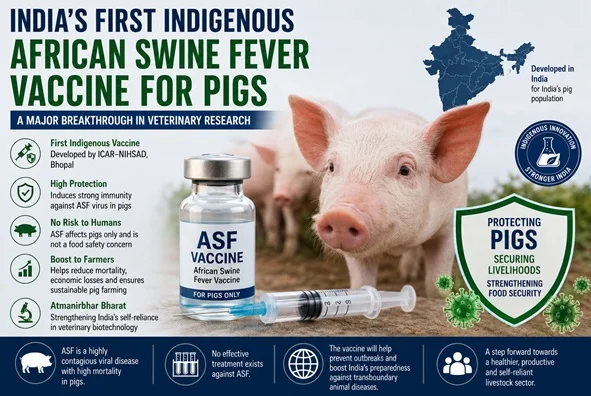
The Indian Council of Agricultural Research (ICAR) dedicated India’s first indigenous African Swine Fever (ASF) vaccine for pigs. Developed by scientists at the ICAR–National Institute of High Security Animal Diseases (ICAR-NIHSAD) in Bhopal, this MA-104 Cell Line-Based Live Attenuated Vaccine represents a landmark breakthrough in veterinary science and animal biosecurity.
What is African Swine Fever (ASF)?
- African Swine Fever (ASF) is a highly contagious viral disease that affects domestic and wild pigs. It is caused by the African Swine Fever Virus (ASFV), a large DNA virus belonging to the Asfarviridae family.
- The disease has an extremely high mortality rate, often approaching 100% in susceptible pig populations. ASF does not infect humans and is not considered a food safety risk, but it causes severe economic damage to the pig farming industry.
Why is ASF a Serious Concern?
- There is no effective treatment once pigs are infected.
- Large-scale outbreaks often require mass culling of pigs to prevent further spread.
- Pig farmers suffer huge financial losses due to mortality, trade restrictions and movement bans.
- The disease threatens food security and the livelihood of millions dependent on pig farming.
Key Features of India's Indigenous ASF Vaccine
- Indigenous Development: Developed entirely by Indian scientists under ICAR. Represents a major step towards self-reliance in veterinary vaccine technology.
- High Protection: Provides effective immunity against circulating ASF virus strains. Significantly reduces mortality among vaccinated pigs.
- Disease Control: Helps prevent large-scale outbreaks. Reduces dependence on imported vaccines and diagnostic technologies.
- Support for Farmers: Expected to minimise economic losses. Strengthens confidence among pig farmers and promotes sustainable pig production.
Significance of the Vaccine
- Strengthening Animal Health: Enhances India's preparedness against transboundary animal diseases. Improves disease surveillance and livestock protection.
- Boost to Veterinary Research: Demonstrates India's growing capabilities in advanced veterinary biotechnology. Encourages further research into vaccines for emerging livestock diseases.
- Economic Benefits: Protects the pig farming sector, especially in the North-Eastern states where pig rearing is an important livelihood. Reduces losses caused by recurring ASF outbreaks.
- Food Security: Ensures a stable supply of pork and supports nutritional security in regions where pork is a major source of protein.
- Atmanirbhar Bharat: Reduces dependence on foreign technologies. Promotes indigenous innovation in the livestock sector.
Challenges Ahead
- Large-scale vaccine production and distribution.
- Ensuring affordability for small and marginal farmers.
- Maintaining cold-chain infrastructure for vaccine storage.
- Continuous surveillance against new virus variants.
- Creating awareness among pig farmers regarding vaccination.
Way Forward
- Expand vaccination programmes in ASF-prone regions.
- Strengthen disease surveillance and rapid diagnostic systems.
- Promote collaboration between research institutions, veterinary departments and state governments.
- Improve farmer awareness through extension services.
- Continue research for broader and longer-lasting protection against emerging ASF strains.
PRELIMS MCQ
Q. With reference to African Swine Fever (ASF), consider the following statements:
- African Swine Fever affects both domestic and wild pigs.
- The disease can be transmitted from pigs to humans.
- India has recently developed its first indigenous vaccine against ASF.
Which of the statements given above is/are correct?
(a) 1 only
(b) 1 and 3 only
(c) 2 and 3 only
(d) 1, 2 and 3
MAINS PRACTICE QUESTION
Q. Discuss the significance of India's first indigenous African Swine Fever vaccine in strengthening animal health, livestock productivity and veterinary research. Also examine the challenges associated with controlling transboundary animal diseases in India.
|
FAQs
What is African Swine Fever (ASF)?
It is a highly contagious viral disease affecting domestic and wild pigs, causing very high mortality but posing no risk to human health.
Which organisation developed India's first indigenous ASF vaccine?
The vaccine has been developed by the ICAR–National Institute of High Security Animal Diseases (NIHSAD), Bhopal, under the Indian Council of Agricultural Research (ICAR).
Does ASF infect humans?
No. African Swine Fever affects only pigs and does not spread to humans.
Why is the vaccine important?
It helps prevent large-scale pig deaths, protects farmers' livelihoods, strengthens India's veterinary research capabilities and reduces dependence on imported technologies.
Which regions of India are expected to benefit the most?
The North-Eastern states and other pig-rearing regions, where pork production is an important source of livelihood and nutrition.
|






 Contact Us
  New Batch : 9555124124/ 7428085757
  Tech Support : 9555124124/ 7428085757