Prelims: Indian Coast Guard (ICG), Vietnam Coast Guard (VCG), India–Vietnam Relations, Maritime Security, Indo-Pacific Region
Mains: GS Paper II (International Relations) & GS Paper III (Security), India–Vietnam Strategic Partnership, Maritime Security, Coastal Security, Indo-Pacific Cooperation, Maritime Diplomacy
Keywords: Indian Coast Guard (ICG), Vietnam Coast Guard (VCG), 7th High-Level Meeting, Chennai, Maritime Security, Coastal Security, Search and Rescue, Maritime Cooperation, Indo-Pacific, India–Vietnam Relations, Operational Coordination |
Why in News?
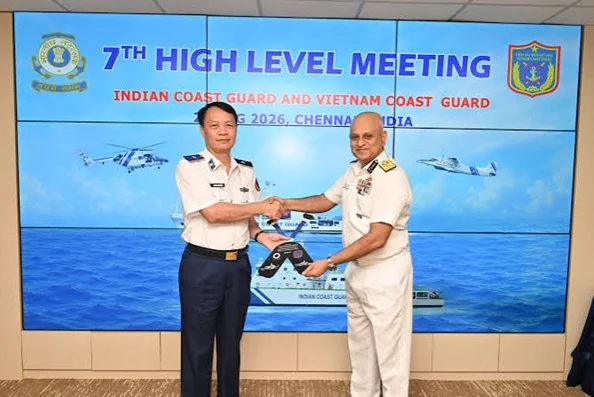
The 7th High-Level Meeting between the Indian Coast Guard (ICG) and Vietnam Coast Guard (VCG) was held in Chennai.
Important Point
- The meeting focused on enhancing professional cooperation, strengthening maritime engagement and deepening operational coordination between the two Coast Guards.
- A delegation of the Vietnam Coast Guard, led by Major General Luong Dinh Hung, Vice-Commandant of the VCG, participated in the meeting and interacted with the leadership of the Indian Coast Guard.
- The engagement reflects the growing importance of maritime security cooperation in India–Vietnam relations, particularly in the strategically important Indo-Pacific region.
About the 7th ICG–VCG High-Level Meeting
- The high-level meeting provides an institutional platform for the two Coast Guards to review their existing cooperation and identify new areas for maritime collaboration.
- During the Chennai meeting, Major General Luong Dinh Hung called on Director-General of the Indian Coast Guard Paramesh Sivamani.
- The discussions focused on strengthening professional exchanges and improving coordination between the two maritime forces.
- Both sides emphasised closer engagement in areas connected with maritime safety, security and operational cooperation at sea.
Key Areas of Cooperation
1. Maritime Security
India and Vietnam have important maritime interests in the Indo-Pacific. Cooperation between their Coast Guards can help strengthen security and stability across the wider maritime region. Regular interaction also allows both forces to exchange experiences related to maritime surveillance and security challenges.
2. Safety of Life at Sea
Protecting fishermen, merchant vessels and other people operating at sea is an important responsibility of Coast Guard organisations. Cooperation can improve coordination in emergencies and strengthen mechanisms for protecting lives in maritime areas.
3. Search and Rescue Operations
Search and Rescue (SAR) cooperation is particularly important during accidents, cyclones, vessel emergencies and other maritime disasters. Professional exchanges and coordinated exercises can help both Coast Guards improve their operational preparedness.
4. Coastal Security
Coastal security involves monitoring activities close to the coastline and preventing illegal or suspicious maritime activities. India has significantly strengthened its coastal security architecture, especially after the 26/11 Mumbai terror attacks, making Coast Guard cooperation an important element of maritime security.
5. Professional Exchanges
Regular meetings, training programmes, ship visits and interaction among personnel help the two organisations learn from each other's operational experience. Such exchanges also improve interoperability and build institutional trust between the two Coast Guards.
Indian Coast Guard (ICG)
- The Indian Coast Guard is an armed force responsible for protecting India's maritime interests and enforcing maritime law.
- It was formally established on 1 February 1977 and functions under the Ministry of Defence.
- The Coast Guard was established under the Coast Guard Act, 1978, which provides the legal framework for its functioning.
Major Functions of ICG
- Protection of India's maritime interests
- Coastal and offshore surveillance
- Search and Rescue operations
- Assistance to fishermen at sea
- Prevention of maritime smuggling
- Marine environment protection
- Enforcement of maritime laws
- Protection of offshore installations
- Support to coastal security
The ICG also works with the Indian Navy, coastal police, customs authorities and other agencies as part of India's wider maritime security architecture.
Vietnam Coast Guard (VCG)
- The Vietnam Coast Guard is responsible for maritime law enforcement and the protection of Vietnam's sovereignty, sovereign rights and national interests at sea.
- Its responsibilities include maritime security, law enforcement, search and rescue support, prevention of illegal activities and protection of maritime resources.
- For Vietnam, an effective Coast Guard is particularly important because of the country's long coastline and its strategic location along the South China Sea.
Why is Vietnam Important for India?
- Vietnam is one of India's important partners in Southeast Asia and occupies a strategically significant position in the Indo-Pacific.
- The two countries upgraded their relationship to a Comprehensive Strategic Partnership in 2016, reflecting the growing depth of bilateral cooperation.
- Vietnam is also important for India's engagement with ASEAN and its broader Act East Policy.
South China Sea and Maritime Significance
- Vietnam is a major coastal state of the South China Sea, one of the world's most strategically important maritime regions.
- The region carries significant international shipping and is also associated with territorial and maritime disputes involving several countries.
- For India, freedom of navigation, peaceful settlement of disputes and respect for international law are important principles for maritime stability.
- India has consistently supported a maritime order based on international law, including the United Nations Convention on the Law of the Sea (UNCLOS), 1982.
India’s SAGAR Vision
- India's maritime engagement can also be understood through its broader vision of regional maritime cooperation.
- The concept of SAGAR — Security and Growth for All in the Region — was introduced by India in 2015.
- It emphasises maritime security, regional cooperation, capacity building, sustainable development and collective responses to common challenges.
- Cooperation between the Indian and Vietnamese Coast Guards complements India's broader effort to build stronger maritime partnerships across the Indo-Pacific.
Importance of Coast Guard Diplomacy
Maritime cooperation is not limited to naval forces. Coast Guards increasingly play an important role in what can be described as maritime diplomacy.
Unlike conventional military engagement, Coast Guard cooperation often focuses on non-traditional security challenges such as:
- Maritime accidents
- Search and Rescue
- Illegal fishing
- Smuggling
- Marine pollution
- Human trafficking
- Natural disasters
- Maritime law enforcement
These areas provide countries with opportunities to build trust while addressing practical security challenges.
Significance for India
- The meeting strengthens India's maritime partnership with an important Southeast Asian country and supports deeper engagement with ASEAN.
- It also helps India expand cooperation on non-traditional maritime security threats and improve operational understanding between maritime law-enforcement agencies.
- For India, such engagements are important for creating a wider network of trusted maritime partners across the Indo-Pacific.
Challenges
- Despite growing cooperation, the Indo-Pacific maritime environment remains complex.
- Territorial disputes in the South China Sea, geopolitical competition among major powers, illegal fishing, maritime crime and environmental threats continue to affect regional stability.
- Differences in operational systems and procedures can also create challenges for coordination between maritime agencies.
- Regular institutional dialogue and joint training are therefore necessary to improve interoperability.
Way Forward
- India and Vietnam can further strengthen Coast Guard cooperation through regular high-level meetings, joint exercises, training programmes and exchange visits.
- The two sides can expand information sharing related to maritime domain awareness, illegal fishing and transnational maritime crime.
- Greater cooperation in Search and Rescue, marine pollution response, disaster management and capacity building can provide practical benefits to both countries.
- Such cooperation can become an important component of the wider India–Vietnam Comprehensive Strategic Partnership and contribute to a secure and stable Indo-Pacific.
UPSC Prelims MCQ
Q. Consider the following statements regarding the Indian Coast Guard (ICG):
- It functions under the Ministry of Defence.
- It was formally established in 1977.
- Search and Rescue at sea is among its important responsibilities.
Which of the statements given above are correct?
(a) 1 and 2 only
(b) 2 and 3 only
(c) 1 and 3 only
(d) 1, 2 and 3
Mains Question
India–Vietnam maritime cooperation has emerged as an important component of India's Indo-Pacific engagement. Discuss the significance of Coast Guard cooperation between the two countries in addressing traditional and non-traditional maritime security challenges.
|
FAQs
Where was the 7th India–Vietnam Coast Guard High-Level Meeting held?
It was held in Chennai, Tamil Nadu.
Which organisations participated in the meeting?
The Indian Coast Guard (ICG) and Vietnam Coast Guard (VCG) participated.
What was the main focus of the meeting?
The meeting focused on professional cooperation, maritime engagement and operational coordination.
Under which ministry does the Indian Coast Guard function?
The Indian Coast Guard functions under the Ministry of Defence.
When was the Indian Coast Guard established?
The Indian Coast Guard was formally established on 1 February 1977.
|




 Contact Us
  New Batch : 9555124124/ 7428085757
  Tech Support : 9555124124/ 7428085757