Prelims: INS Mangrol, Anti-Submarine Warfare Shallow Water Craft (ASW-SWC), Cochin Shipyard Limited (CSL), Abhay Sonar, Mareech Advanced Torpedo Decoy System, Make in India, Aatmanirbhar Bharat.
Mains: GS Paper III – Defence and Security, Maritime Security, Indigenous Defence Manufacturing, Technological Development and Self-Reliance in Defence.
Keywords: INS Mangrol, Indian Navy, Anti-Submarine Warfare, ASW-SWC, Cochin Shipyard Limited, Coastal Security, Indigenous Defence Technology, Maritime Surveillance, Aatmanirbhar Bharat. |
Why in News?
- The Indian Navy is scheduled to commission INS Mangrol on October 12, 2026, at the Naval Dockyard in Mumbai. It is the third Anti-Submarine Warfare Shallow Water Craft (ASW-SWC) built by Cochin Shipyard Limited (CSL).
- Vice Admiral Sanjay Vatsayan, Flag Officer Commanding-in-Chief of the Western Naval Command, is scheduled to preside over the commissioning ceremony.
- Built with more than 80% indigenous content, INS Mangrol reflects India’s growing capabilities in warship construction and the integration of domestically developed weapons and sensors.
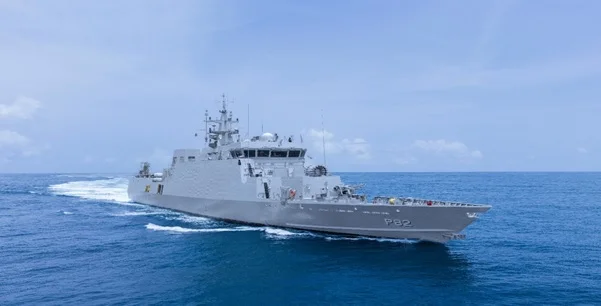
What Is INS Mangrol?
- INS Mangrol is an Anti-Submarine Warfare Shallow Water Craft designed specifically for operations in shallow coastal waters, where the movement of larger warships may be constrained.
- Its primary role is to detect, track and engage hostile submarines operating near the coastline. It can also support maritime surveillance, port security and other low-intensity maritime operations.
Major Technological Features of INS Mangrol
- INS Mangrol is equipped with an Abhay hull-mounted sonar system, which uses sound waves to detect and locate underwater objects.
- Sonar is essential for submarine detection because visibility is limited beneath the sea surface. It helps naval forces identify potential underwater threats and develop an operational picture of surrounding waters.
Anti-Submarine Weapons
- The vessel is equipped with lightweight torpedoes and an indigenous anti-submarine rocket launcher.
- These weapons provide the capability to engage submarine targets once they have been detected and appropriately tracked.
- The combination of underwater detection systems and anti-submarine weapons strengthens the vessel’s role in coastal defence operations.
Mareech Advanced Torpedo Decoy System
- INS Mangrol also features the Mareech Advanced Torpedo Decoy System, designed to help protect naval platforms against incoming torpedo threats.
- The system works by diverting or confusing an incoming torpedo, thereby improving the vessel’s chances of survival.
Propulsion and Manoeuvrability
- The vessel is powered by three diesel engines and a waterjet propulsion system.
- Waterjet propulsion can support manoeuvrability in shallow waters, making the vessel suitable for operations near coastlines, harbours and other confined maritime environments.
Operational Roles of INS Mangrol
INS Mangrol is designed to perform several maritime security functions beyond anti-submarine warfare.
- Anti-submarine warfare: Detecting, tracking and engaging hostile submarines in coastal waters.
- Underwater surveillance: Monitoring underwater activity to improve maritime situational awareness.
- Port and harbour protection: Supporting the security of strategically important ports, naval facilities and coastal approaches.
- Low-intensity maritime operations: Participating in maritime security missions that do not necessarily involve high-intensity naval combat.
- Mine warfare-related tasks: Supporting activities associated with maritime mine warfare.
The vessel can also operate alongside maritime patrol aircraft, helicopters and other warships as part of coordinated anti-submarine operations.
Historical Significance
- INS Mangrol is named after the coastal town of Mangrol in Gujarat’s Junagadh district, a prominent fishing harbour.
- The name also carries forward the legacy of the earlier INS Mangrol (M85), a minesweeper that served the Indian Navy until April 7, 2004.
- The new vessel therefore connects India’s maritime heritage with the modernisation of its naval capabilities.
Strategic Significance for India’s Maritime Security
- India has an extensive coastline and numerous strategically important ports. Protecting these areas against underwater threats is an essential component of maritime security.
- INS Mangrol can strengthen coastal defence by improving the Navy’s ability to monitor and respond to potential submarine activity in shallow waters.
Protecting Maritime Trade
- India relies heavily on maritime routes for international trade and energy supplies. The security of ports, coastal infrastructure and maritime approaches is therefore important for economic stability.
- Anti-submarine warfare vessels can contribute to protecting these critical maritime assets against underwater threats.
Enhancing Security Along the Western Coast
- Mumbai and the wider western maritime region are important for commercial shipping, energy infrastructure and naval operations.
- The induction of specialised shallow-water combatants can strengthen the Navy’s ability to address underwater threats in this strategically significant region.
Supporting Multi-Layered Maritime Surveillance
- Modern maritime security depends on coordination among warships, submarines, maritime patrol aircraft, helicopters, sonar systems and coastal surveillance networks.
- INS Mangrol can contribute to this integrated approach by supporting coordinated operations and information sharing between different naval platforms.
Contribution to Aatmanirbhar Bharat in Defence
- INS Mangrol is significant not only for its operational role but also for its contribution to indigenous defence manufacturing.
- The use of more than 80% indigenous content reflects the growing role of Indian shipyards and domestic defence manufacturers in meeting the Indian Navy’s requirements.
Strengthening the Domestic Defence Industry
- Indigenous warship programmes create opportunities for shipyards, equipment manufacturers, sensor developers and other defence-sector suppliers.
- These programmes can support employment, skill development, technological innovation and long-term industrial capacity.
- However, a high proportion of indigenous content does not automatically imply complete technological independence. Sustained progress also requires reliable domestic supply chains, effective maintenance capabilities and dependable performance of critical systems.
Key Challenges
- Underwater threat detection: Shallow-water environments can complicate sonar-based detection because of variations in depth, underwater noise and coastal activity.
- Technological integration: Effective coordination between sonar, weapons, communication systems and other sensors is essential for successful operations.
- Maintenance and operational availability: Long-term effectiveness depends on trained personnel, timely repairs and the availability of spare parts.
- Evolving submarine technologies: Anti-submarine warfare capabilities must continue to adapt to increasingly sophisticated submarines and changing underwater warfare techniques.
- Joint operational coordination: Effective cooperation with aircraft, helicopters and other warships requires regular exercises, reliable communication and efficient information sharing.
Way Forward
- Strengthen indigenous research and development: Prioritise domestic development of sonar, torpedoes, communication systems and other critical defence technologies.
- Improve network-centric maritime surveillance: Enhance real-time information sharing between warships, aircraft, helicopters and coastal surveillance systems.
- Expand specialised training: Conduct regular anti-submarine warfare exercises to improve crew proficiency and operational readiness.
- Develop domestic maintenance capabilities: Strengthen indigenous supply chains for spare parts, repairs and technical support.
- Improve inter-agency coordination: Enhance information sharing and operational cooperation between the Navy, Coast Guard and other maritime security agencies.
Conclusion
- The commissioning of INS Mangrol represents an important step towards strengthening India’s coastal anti-submarine warfare capabilities and indigenous warship-building capacity.
- Its sonar system, anti-submarine weapons and waterjet propulsion make it suitable for specialised operations in shallow coastal waters.
- However, its long-term operational effectiveness will depend on regular training, maintenance, technological reliability and coordination with other maritime security platforms.
Prelims Practice MCQ
Question: With reference to INS Mangrol, consider the following statements:
- It belongs to the Anti-Submarine Warfare Shallow Water Craft category.
- It has been built by Cochin Shipyard Limited.
- It has more than 80% indigenous content.
- It has been designed primarily for aircraft carrier operations in deep oceans.
Which of the statements given above are correct?
(a) 1 and 2 only
(b) 1, 2 and 3 only
(c) 2, 3 and 4 only
(d) 1, 2, 3 and 4
Mains Practice Question
“Indigenous warship development plays a crucial role in strengthening India’s maritime security and self-reliance in defence.” Analyse this statement in the context of INS Mangrol.
|
FAQs
Q1. What is INS Mangrol?
INS Mangrol is an Anti-Submarine Warfare Shallow Water Craft designed to detect and counter submarine threats in shallow and coastal waters.
Q2. Who built INS Mangrol?
The vessel has been built by Cochin Shipyard Limited (CSL).
Q3. What are its major technological features?
Its major features include the Abhay hull-mounted sonar, lightweight torpedoes, an indigenous anti-submarine rocket launcher, the Mareech Advanced Torpedo Decoy System and waterjet propulsion.
Q4. What percentage of INS Mangrol is indigenous?
According to the provided information, the vessel has more than 80% indigenous content.
Q5. Why is INS Mangrol important for India?
It can strengthen coastal anti-submarine warfare, underwater surveillance, port security and the domestic defence manufacturing ecosystem.
|






 Contact Us
  New Batch : 9555124124/ 7428085757
  Tech Support : 9555124124/ 7428085757