
- UPSC Exam
- State PCS
- One Day Exam
- Current Affairs
- PT Quiz
- Downlaods
- About Coaching
- Blog
- Videos

| Prelims: (Polity & Governance + CA) Mains: (GS 2 – Governance, Welfare Schemes, Service Delivery; GS 3 – Water Resources, Sustainable Development) |
A 2024 government-commissioned survey has revealed that although nearly 98% of rural households now have tap connections under the Jal Jeevan Mission (JJM), only about three-fourths actually receive a regular, safe, and adequate water supply, exposing a gap between coverage and functionality.
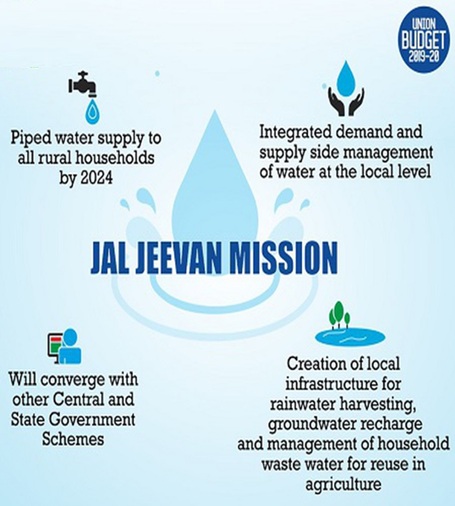
India has historically struggled with rural drinking water access due to groundwater depletion, water quality issues, and institutional fragmentation. Previous schemes focused largely on infrastructure creation rather than service delivery.
Launched in 2019, the Jal Jeevan Mission marked a paradigm shift by prioritising functional household tap connections (FHTCs) and regular service delivery rather than mere installation of infrastructure. It represents one of the largest public investments in water security globally and is central to achieving SDG 6 (Clean Water and Sanitation).
The Jal Jeevan Mission is a flagship programme of the Government of India aimed at providing:
Unlike earlier supply-driven schemes, JJM follows a service delivery approach, where success is measured by regularity, adequacy, and safety of water supply. The programme is implemented through a Centre-State partnership, with cost-sharing arrangements varying across States.
The Jal Jeevan Mission has expanded rural water infrastructure at an unprecedented scale:
However, these certifications are largely based on infrastructure availability, not on actual service delivery, and do not fully capture functionality, water quality, or reliability.
The core objective of JJM is not just installing taps, but ensuring functional and safe water supply. The 2024 Functionality Assessment Survey revealed major gaps:
When availability, regularity, and quality were assessed together, only around 75% of households were found to be benefiting from the scheme as intended, highlighting a significant gap between physical coverage and actual service outcomes.
The survey exposed sharp inter-State disparities:
These variations reflect differences in:
The Jal Jeevan Mission is among the most resource-intensive welfare programmes in India:
The original target of achieving 100% functional coverage by 2024 has now been extended to 2028, acknowledging difficulties related to:
Estimates suggest that addressing remaining uncovered and non-functional households could require nearly ₹4 lakh crore in additional investment.
To improve performance and accountability, JJM relies on:
The 2024 assessment covered over 2.3 lakh households across certified Har Ghar Jal villages, offering a more realistic picture beyond official coverage statistics.
However, the Ministry has noted that survey results are not directly comparable with earlier assessments due to changes in methodology and scope, indicating a need for consistent and standardised monitoring frameworks.
Ensuring long-term success of the Jal Jeevan Mission requires a strategic shift from infrastructure expansion to system sustainability:
Only by focusing on functionality, quality, and sustainability can tap coverage be translated into real improvements in health, productivity, and rural welfare.
FAQsWhat is the main objective of the Jal Jeevan Mission ? To provide functional household tap connections supplying 55 litres of safe drinking water per person per day to all rural households. Why is there a gap between tap coverage and actual water supply ? Because infrastructure availability does not always ensure regular water delivery, adequate quantity, or safe quality due to source, maintenance, and governance challenges. Which States are lagging behind in functionality under JJM ? States such as Bihar, Uttar Pradesh, Nagaland, and Sikkim have reported lower water availability and quantity compliance. What are the major financial challenges facing JJM ? High capital requirements, underutilisation of funds in some years, and the need for additional investments to achieve full functional coverage by 2028. What measures are needed to ensure sustainability of rural water supply ? Strengthening local institutions, improving source sustainability, enhancing water quality monitoring, and integrating water supply with climate resilience and health programmes. |



Our support team will be happy to assist you!


 Contact Us
  New Batch : 9555124124/ 7428085757
  Tech Support : 9555124124/ 7428085757