
- UPSC Exam
- State PCS
- One Day Exam
- Current Affairs
- PT Quiz
- Downlaods
- About Coaching
- Blog
- Videos

| Prelims : (History & Culture, CA) Mains : (GS 1 – Indian Culture, Temple Architecture, Cultural Heritage) |
The South Central Railway has announced the operation of the Amrut Bharat Express connecting Assam with the Telugu-speaking states to facilitate pilgrims travelling to the sacred Kamakhya Temple.
The initiative is expected to improve connectivity for devotees visiting the temple located on Nilachal Hill in Guwahati, one of the most important centres of Shakti worship and Tantric traditions in India.
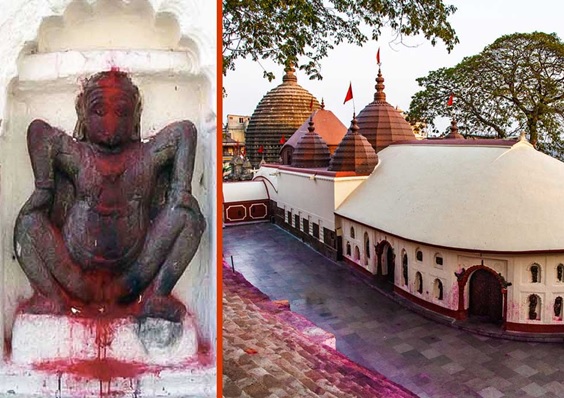
Kamakhya Temple is one of the most revered Hindu pilgrimage sites dedicated to Shakti worship.
The temple is situated on Nilachal Hill along the southern bank of the Brahmaputra River in Guwahati.
It is dedicated to Goddess Sati, regarded as an incarnation of Durga and the consort of Shiva.
The temple holds immense religious significance as a major centre of Tantric worship, attracting devotees, ascetics, and scholars from across India and beyond.
The temple is considered one of the 51 sacred Shakti Peethas of Hinduism.
According to mythology, these sites mark the locations where body parts of Goddess Sati fell after the cosmic event associated with her self-immolation.
The story is linked to the mythological episode involving Shiva, who carried Sati’s body across the universe in grief until Vishnu used his Sudarshan Chakra to dismember it.
Kamakhya is believed to be the site where the goddess’s womb and reproductive organ fell, making it uniquely associated with fertility, feminine power, and creation.
The history of the temple dates back many centuries and reflects multiple phases of destruction and reconstruction.
The earlier structure of the temple was destroyed during medieval invasions by Kala Pahar.
Later, the temple was rebuilt in 1565 CE by Chilarai, a prominent ruler of the Koch dynasty.
The reconstruction revived the temple as a major pilgrimage centre and ensured the continuation of its religious traditions.
One of the most significant events associated with the temple is the Ambubachi Mela.
The festival attracts lakhs of pilgrims, ascetics, and Tantric practitioners from across India and abroad.
It symbolises the sacredness of fertility and feminine power in Hindu tradition.
The temple exhibits a distinctive architectural style known as the Nilachala Style, which blends different architectural traditions.
The structure combines :
This fusion creates a unique architectural identity characteristic of temples in the region.
The temple has a distinctive beehive-shaped dome, surrounded by sculptures depicting various Hindu deities.
It is also notable for being the only temple in Assam with a fully developed ground plan.
The temple complex consists of five chambers, each serving a specific religious or ceremonial purpose:
Interestingly, the superstructure of each chamber displays different architectural features, showcasing the artistic diversity of the temple.
The temple is not only an important pilgrimage site but also a centre of Tantric spiritual traditions.
Unlike many Hindu temples that worship anthropomorphic idols, Kamakhya Temple worships the yoni-shaped stone symbolising the creative energy of the goddess.
This makes it one of the most significant temples representing feminine divinity and fertility in Hindu philosophy.
The introduction of new train services such as the Amrut Bharat Express reflects growing recognition of the temple’s national religious importance.
Key Implications
FAQs1. Where is Kamakhya Temple located ? Kamakhya Temple is located on Nilachal Hill in Guwahati, Assam, on the southern bank of the Brahmaputra River. 2. Which deity is worshipped at Kamakhya Temple ? The temple is dedicated to Goddess Sati (Kamakhya), an incarnation of Goddess Durga and the consort of Lord Shiva. 3. Why is Kamakhya Temple considered a Shakti Peetha ? It is believed to be the site where the womb of Goddess Sati fell, making it one of the 51 sacred Shakti Peethas. 4. What is the Ambubachi Mela ? Ambubachi Mela is an annual festival celebrating the menstruation of Goddess Kamakhya, symbolising fertility and feminine power. 5. What is unique about the architecture of the Kamakhya Temple ? The temple follows the Nilachala style, combining Nagara and Saracenic architectural elements, with a distinctive beehive-shaped dome and five ritual chambers. |


Our support team will be happy to assist you!


 Contact Us
  New Batch : 9555124124/ 7428085757
  Tech Support : 9555124124/ 7428085757