
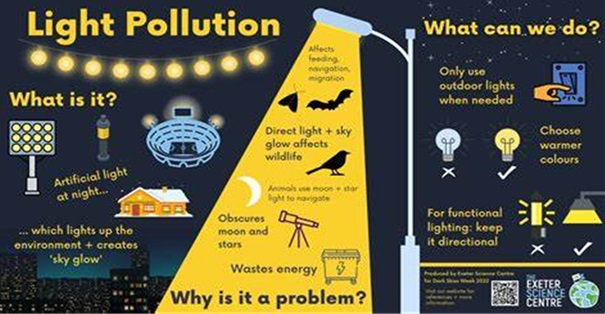
- Light pollution refers to the excessive, misdirected, or obtrusive use of artificial outdoor light.
- It is a growing environmental concern that negatively impacts human health, wildlife, ecosystems, and astronomical observations.
Types of Light Pollution
- Skyglow
- Brightening of the night sky over populated areas.
- Makes it difficult to see stars and celestial bodies.
- Glare:
- Excessive brightness that causes visual discomfort, especially for drivers.
- Light Trespass:
- Unwanted or intrusive light entering someone’s property or home.
- Clutter:
- Bright, confusing, and excessive groupings of light sources, especially in urban areas.
Impact on Human Health
- Disruption of Circadian Rhythm
- The human body has a natural biological clock (circadian rhythm), regulated by the light-dark cycle.
- Exposure to artificial light at night inhibits melatonin production a hormone essential for sleep and brain health.
- Link to Alzheimer's disease (AD)
- A recent study highlighted that exposure to night-time light pollution increases the risk of Alzheimer's disease.
Mechanism:
- Disrupted sleep cycles → poor memory consolidation.
- Chronic melatonin suppression → increased amyloid-beta accumulation in the brain—a hallmark of Alzheimer’s.
Other Health Effects
- Insomnia and poor sleep quality.
- Depression, mood disorders.
- Obesity, diabetes, and cardiovascular diseases due to hormonal imbalances.
- Breast and prostate cancer risks due to long-term melatonin suppression.
Impact on Biodiversity and Ecosystems
Birds and Animals
- Migratory birds rely on stars for navigation. Skyglow and bright city lights confuse their paths, leading to fatal building collisions.
- Artificial light increases visibility of prey, making them vulnerable to predators.
- Disruption in the reproductive cycles of nocturnal animals like frogs, bats, and turtles.
Insects and Pollination
- Artificial lights attract insects, leading to exhaustion and death.
- Pollinator insects like moths are drawn away from flowers, reducing pollination and affecting plant reproduction.
Ecosystem Imbalance
- Change in predator-prey dynamics.
- Alters nocturnal foraging behaviour, habitat selection, and species distribution.
Impact on Astronomy
- Skyglow hampers visibility of celestial objects.
- Makes scientific observations difficult from ground-based observatories.
- Loss of cultural and scientific connection with the night sky.
Impact on Energy and Climate
- Wasted lighting consumes energy, often produced via fossil fuels.
- Increases carbon footprint and contributes to climate change.
Economic Cost
- Billions are spent annually on inefficient or unnecessary lighting.
- Energy wastage adds to urban expenses and electricity load.
Measures to Mitigate Light Pollution
Use of Fully Shielded Fixtures:
- Ensures light is directed downward and not upward into the sky.
Smart Lighting Technologies:
- Motion-sensor lights, time-controlled street lights.
- Reduced Luminosity and Warm Lighting:
- Use of low-intensity, warm colour temperature LEDs.
Legislation and Urban Planning:
- Light pollution regulations in cities and towns.
- Dark Sky" reserves like in Ladakh (India's first).
Public Awareness Campaigns:
- Encourage responsible lighting in homes and businesses.
- Environmental Impact Assessments (EIA):
- Mandatory EIA for major lighting projects near wildlife habitats.
Legal and Policy Aspects
- India does not yet have a dedicated national policy on light pollution.
- However, guidelines are being considered under the Environment Protection Act.
- The International Dark-Sky Association (IDA) promotes dark-sky-friendly lighting globally.
«
»
- SUN
- MON
- TUE
- WED
- THU
- FRI
- SAT