Prelims: World Circular Economy Forum (WCEF), Circular Economy, Sitra, CPCB, Mission LiFE, Extended Producer Responsibility (EPR)
Mains: GS Paper III: Environment, Sustainable Development, Waste Management, Resource Efficiency and Green Economy. |
Why in News?
- The World Circular Economy Forum 2026 will begin in Gandhinagar on September 15, 2026. The event will be jointly inaugurated by Union Minister for Environment, Forest and Climate Change Bhupender Yadav and Gujarat Chief Minister Bhupendra Patel.
- The theme of WCEF 2026 is “Circular Economy: Transition for People and Prosperity”
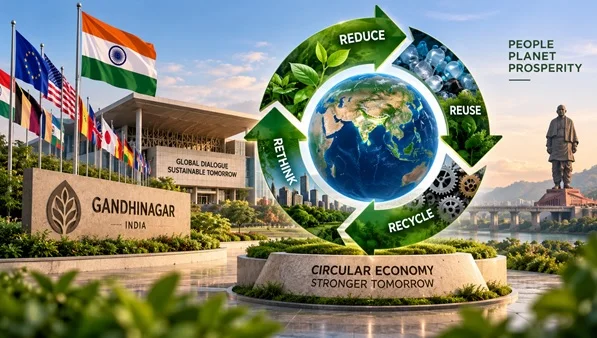
What is the World Circular Economy Forum?
- It is a major global platform dedicated to accelerating the transition towards a circular economy.
- It brings together governments, businesses, researchers, international institutions and innovators to identify practical solutions for reducing resource consumption, minimising waste and keeping materials within the economy for as long as possible.
- The WCEF was initiated by Sitra-the Finnish Innovation Fund. The first forum was organised in Helsinki, Finland, in 2017. WCEF 2026 is its 10th edition.
Who is Organising WCEF 2026?
- WCEF 2026 is being jointly organised by the Finnish Innovation Fund Sitra and India's Central Pollution Control Board (CPCB).
- It is supported by the Ministry of Environment, Forest and Climate Change and the Governments of India and Finland, in coordination with the Government of Gujarat and Gujarat Pollution Control Board.
- This India-Finland partnership is particularly relevant because Finland has been an important international advocate of circular-economy approaches.
What is a Circular Economy?
- A circular economy is an economic system that seeks to minimise waste and maximise the productive use of resources by keeping products, materials and resources in circulation for as long as possible.
- The conventional economy largely follows: Take → Make → Use → Dispose
- A circular economy attempts to replace this with: Reduce → Reuse → Repair → Refurbish → Remanufacture → Recycle → Recover
Circular Economy vs Linear Economy
|
Linear Economy
|
Circular Economy
|
|
Take-Make-Dispose
|
Reduce-Reuse-Recycle
|
|
High raw-material consumption
|
Efficient resource utilisation
|
|
Waste is discarded
|
Waste becomes a resource
|
|
Short product life cycle
|
Longer product life cycle
|
|
Higher environmental pressure
|
Lower environmental footprint
|
|
Disposal-oriented
|
Regenerative approach
|
Major Focus Areas
- The forum will examine circularity across several sectors and policy areas, including energy, finance, governance, sustainable products, industrial solutions, employment, start-ups and youth participation.
- Discussions will also examine how artificial intelligence, digitalisation and technology can support circular systems.
- A major objective will be to connect policy with business implementation by facilitating circular finance and private-sector investment.
Scale of WCEF 2026
The Government of India expects:
- 2,000+ stakeholders
- Representation from 65+ countries
- 125+ exhibitors showcasing circularity solutions
- Participation by policymakers, entrepreneurs, researchers, businesses, innovators and international organisations.
Why is WCEF 2026 Important for India?
- Hosting WCEF gives India an opportunity to present itself not merely as a large developing economy facing waste-management challenges, but also as a potential global laboratory for circular solutions at scale.
- India's large population, expanding urbanisation, manufacturing base and growing consumption create major demand for raw materials. A circular model can help India reduce resource dependence, improve material efficiency and lower waste generation.
- At the same time, circular industries can create economic opportunities in repair, recycling, remanufacturing, waste processing, resource recovery and green manufacturing.
India's Circular Economy Initiatives
- Mission LiFE: Lifestyle for Environment (LiFE) promotes environmentally responsible individual and community behaviour.
- Extended Producer Responsibility (EPR): Under EPR frameworks, producers are assigned responsibility for managing specified products/waste streams after their useful life, including areas such as plastic and electronic waste.
- Swachh Bharat Mission: Promotes scientific waste management, sanitation and cleaner urban and rural environments.
- Waste-to-Wealth: Encourages technologies and business models that convert waste into economically useful resources.
- Vehicle Scrappage Policy: Encourages replacement and scientific scrapping of old and unfit vehicles, supporting recovery and recycling of materials.
- Resource Efficiency: India is increasingly promoting efficient use and recovery of materials across sectors such as metals, plastics, electronics, batteries, construction and automobiles.
Circular Economy and Climate Change
- Manufacturing new products generally requires extraction, processing, transportation and energy.
- Extending product life, recovering materials and reducing unnecessary resource extraction can lower environmental pressures and, in appropriate sectors, reduce greenhouse-gas emissions.
Why the Global South matters
- Many developing economies possess minerals and other raw materials needed for batteries, electronics, renewable-energy technologies and emerging industries.
- WCEF organisers argue that these economies can capture greater economic value by moving beyond raw-material extraction towards processing, reuse, recycling and circular value chains.
- For India, this creates an opportunity to link the circular economy with resource security, green jobs, resilient supply chains and South–South cooperation.
Role of Technology
- Artificial Intelligence can help optimise material flows and waste sorting; digital product tracking can improve traceability; advanced recycling technologies can recover valuable materials; and data-driven systems can help businesses design more efficient supply chains.
- This makes circular economy an intersection of Environment + Economy + Technology + Industry + Governance.
Significance for India's Resource Security
- India's growing economy requires enormous quantities of metals, minerals, energy resources and industrial raw materials.
- Recovering critical materials from used batteries, electronic waste and industrial products can reduce pressure on virgin resources and potentially lower import dependence for selected materials.
- This is especially relevant as the global clean-energy transition increases demand for materials used in EVs, batteries, electronics and renewable-energy systems.
Key Challenges
- Large informal waste sector and need for its effective integration.
- Inadequate segregation and collection of waste in many areas.
- Gaps in recycling infrastructure and technology.
- Difficulty in enforcing EPR and other regulations uniformly.
- Financing constraints for circular businesses and start-ups.
- Consumer preference for new products rather than repair/reuse.
- Need for better data on material flows and waste generation.
Prelims MCQ
Q. With reference to the World Circular Economy Forum (WCEF) 2026, consider the following statements:
- It is being hosted in Gandhinagar, Gujarat.
- WCEF 2026 is the first edition of the forum to be held in South Asia.
- Sitra, the Finnish Innovation Fund, is associated with its organisation.
Which of the statements given above are correct?
A. 1 and 2 only
B. 2 and 3 only
C. 1 and 3 only
D. 1, 2 and 3
Mains Practice Question
Q. “The circular economy is not merely a waste-management strategy but a model for sustainable and resource-secure economic growth.” Discuss.
|
FAQs
1.What is WCEF?
The World Circular Economy Forum is a global platform for advancing circular-economy solutions.
2. Where will WCEF 2026 be held?
Gandhinagar, Gujarat, India on 15-18 September 2026.
3. What is the theme of WCEF 2026?
“Circular Economy: Transition for People and Prosperity.”
4. Why is WCEF 2026 historic for India?
It is the first WCEF hosted in South Asia.
5. What is a Circular Economy?
An economy that keeps products and materials in use for longer, reducing waste and virgin-resource consumption.
|





 Contact Us
  New Batch : 9555124124/ 7428085757
  Tech Support : 9555124124/ 7428085757