Why in News?
India will observe National Engineers’ Day on 15 September 2026 to recognise the contribution of engineers to technological innovation, infrastructure development and nation-building.
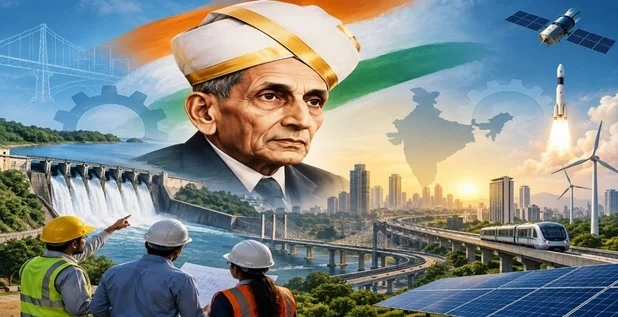
Key Facts
|
National Engineers Day
|
15 September
|
|
2026 Edition
|
59th Engineers’ Day
|
|
2026 Theme
|
Smart engineering for a sustainable future through innovation and digitalization
|
|
Celebrated For
|
Birth Anniversary of M. Visvesvaraya
|
|
Born
|
15 September 1861
|
|
Full Name
|
Mokshagundam Visvesvaraya
|
|
Profession
|
Civil Engineer & Statesman
|
|
Key Position
|
Diwan of Mysore
|
|
Tenure as Diwan
|
1912–1918
|
|
Major Association
|
Krishna Raja Sagara (KRS) Dam in Karnataka
|
|
Key Fields
|
Irrigation & Water Management
|
|
Highest Honour
|
Bharat Ratna (1955)
|
What is National Engineers’ Day?
- National Engineers’ Day is celebrated in the remembrance of birth anniversary of Sir M. Visvesvaraya. The occasion recognises the role of engineers in solving complex problems and contributing to infrastructure, industry, technology and economic development.
Who was Sir M. Visvesvaraya?
- Sir Mokshagundam Visvesvaraya (M. Visvesvaraya) was born on 15 September 1861. He was a distinguished civil engineer, administrator and statesman who made major contributions to India's infrastructure and industrial development.
- He also served as the Diwan of Mysore and became closely associated with the modernisation and economic development of the princely state.
- His contribution went beyond engineering to include governance, industrialisation and economic planning.
Major Contributions of Sir M. Visvesvaraya
- Sir M. Visvesvaraya is particularly remembered for his expertise in water management, irrigation and civil engineering. His engineering work contributed to improved water-resource management and infrastructure development.
- He is closely associated with the Krishna Raja Sagara (KRS) Dam in Mysore and with innovative approaches to water storage and irrigation.
- His career demonstrated how engineering could be used as an instrument of economic and social development.
- His legacy is therefore not limited to individual engineering projects; it represents a larger vision in which technology, infrastructure, industrialisation and effective governance work together for national development.
- Major Books Written by him are 'Reconstructing India' and 'Planned Economy of India'.
- In recognition of his contribution to nation-building, he was awarded India's highest civilian honour, the Bharat Ratna, in 1955.
Engineers and Nation-Building in India
- Engineering has played a central role in India's development journey. Large dams, highways, railway networks, metro systems, airports, power plants and digital infrastructure depend heavily on engineering expertise.
- In the twenty-first century, India's ambitions in space exploration, semiconductor manufacturing, artificial intelligence, clean energy, defence indigenisation, high-speed transportation and digital public infrastructure require a large pool of skilled engineers and researchers.
- India also has a significant position in emerging technologies. According to a 2025 PIB backgrounder, India accounts for nearly 20% of the world's chip-design engineers, while the Stanford AI Index 2024 ranked India first globally in AI skill penetration.
Engineering and Viksit Bharat
- India's goal of becoming a developed economy requires technological capability alongside physical and digital infrastructure. Engineers can contribute to this transformation through indigenous innovation, advanced manufacturing and affordable technological solutions.
- Their contribution will be particularly significant in sectors such as:
- Semiconductor and electronics manufacturing
- Artificial Intelligence and robotics
- Space and satellite technology
- Renewable and nuclear energy
- Electric mobility and battery technology
- Defence and aerospace
- Quantum technologies
- Smart and climate-resilient infrastructure
Challenges Before India's Engineering Ecosystem
- There is a need to reduce the gap between academic education and industry requirements, strengthen research and development, improve industry-academia collaboration and encourage greater innovation.
- India also needs to strengthen domestic capabilities in critical technologies such as advanced semiconductors, AI, quantum computing, aerospace, advanced materials and clean-energy technologies.
FAQs
When is National Engineers’ Day celebrated in India?
It is celebrated every year on 15 September.
Why is Engineers’ Day celebrated on 15 September?
It marks the birth anniversary of Sir M. Visvesvaraya.
Who was Sir M. Visvesvaraya?
He was a renowned Indian civil engineer and statesman.
Which honour was given to M. Visvesvaraya?
He received the Bharat Ratna in 1955.
What is the theme of Engineers’ Day 2026?
Smart engineering for a sustainable future through innovation and digitalization
|






 Contact Us
  New Batch : 9555124124/ 7428085757
  Tech Support : 9555124124/ 7428085757