Why in news?
Madhya Pradesh celebrates its Foundation Day on 1 November every year, commemorating its formation in its reorganised form on 1 November 1956 under the States Reorganisation Act, 1956.
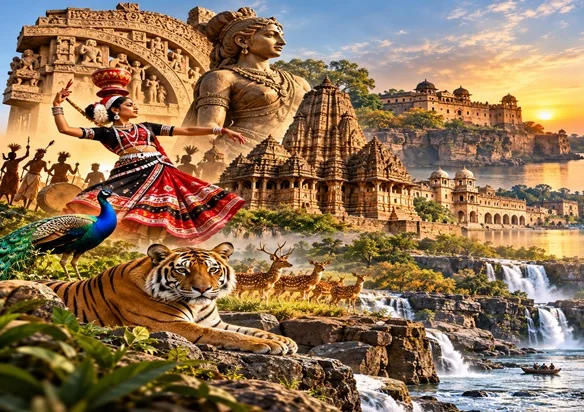
Key Facts
|
Particular
|
Details
|
|
Formation Day
|
1 November 1956
|
|
Formation Act
|
States Reorganisation Act, 1956
|
|
Capital
|
Bhopal
|
|
First Chief Minister of reorganised state
|
Ravishankar Shukla
|
|
First Governor
|
Pattabhi Sitaramayya
|
|
Principal official language
|
Hindi
|
|
High Court
|
Madhya Pradesh High Court, Jabalpur
|
|
Famous river
|
Narmada
|
|
Popular identity
|
Heart of India
|
|
UNESCO World Heritage properties
|
Sanchi, Khajuraho and Bhimbetka
|
|
State separated in 2000
|
Chhattisgarh
|
Historical Background
- Before 1956, central India was divided into several administrative units.
- The major political and administrative territories included:
- The existing Madhya Pradesh, largely comprising the former Central Provinces and Berar.
- Madhya Bharat.
- Vindhya Pradesh.
- Bhopal State.
- Following independence, the integration of princely states and administrative reorganisation created the need for a more systematic state structure.
The States Reorganisation Act, 1956
- The States Reorganisation Commission, established in 1953 under Fazl Ali, examined the restructuring of India's internal boundaries.
- Its recommendations resulted in the States Reorganisation Act, 1956.
- On 1 November 1956, the reorganised Madhya Pradesh came into existence.
- The new state incorporated the existing Madhya Pradesh, with the transfer of its Marathi-speaking Vidarbha region to Bombay State, Madhya Bharat, Vindhya Pradesh and Bhopal State.
- Nagpur, which had been the capital of the former Madhya Pradesh, became part of Bombay State.
- Bhopal was selected as the capital of the reorganised Madhya Pradesh.
- The first Chief Minister of the reorganised Madhya Pradesh was Pandit Ravishankar Shukla.
A major territorial change in 2000
- The territorial evolution of Madhya Pradesh continued after 1956.
- The southeastern region of the state was separated under the Madhya Pradesh Reorganisation Act, 2000.
- On 1 November 2000, Chhattisgarh was established as a separate state.
Constitutional and Legislative Background
- The formation of Madhya Pradesh in 1956 was part of the implementation of the States Reorganisation Act, 1956 under Section 9 of the States Reorganisation Act, 1956.
- The legislation was passed by Parliament under the constitutional framework relating to the formation and reorganisation of states.
|
Article
|
Subject
|
|
Article 1
|
Name and territory of the Union
|
|
Article 2
|
Admission or establishment of new states
|
|
Article 3
|
Formation of new states and alteration of areas, boundaries or names
|
|
Article 4
|
Supplemental, incidental and consequential provisions
|
Geographical Significance
- Madhya Pradesh, popularly known as the Heart of India.
- Its landscape includes plateaus, hills, river valleys, forests and fertile agricultural plains.
|
Feature
|
Details
|
|
Location
|
Central India
|
|
Capital
|
Bhopal
|
|
Major river
|
Narmada
|
|
Other important rivers
|
Chambal, Betwa, Son, Ken and Tapti
|
|
Mountain ranges
|
Vindhya and Satpura
|
|
Important plateau
|
Malwa Plateau
|
|
Major natural resources
|
Forests and minerals
|
Narmada River: The Lifeline of Central India
- The Narmada is one of the most important rivers of central India.
- It originates at Amarkantak in Madhya Pradesh and flows westward through a rift valley between the Vindhya and Satpura ranges.
- It eventually drains into the Arabian Sea through the Gulf of Khambhat.
- The Narmada is also associated with important multipurpose river valley projects, including the Sardar Sarovar Project.
Forests and biodiversity
- Madhya Pradesh has extensive forest areas and is particularly important for tiger conservation.
- Some prominent protected areas include Kanha National Park, Bandhavgarh National Park, Pench National Park, Satpura National Park, Panna National Park and Kuno National Park.
- These protected areas support diverse wildlife populations and play an important role in biodiversity conservation.
Cultural Heritage
- Sanchi: A centre of Buddhist heritage
- Sanchi is famous for its Great Stupa, which is traditionally associated with Emperor Ashoka.
- The site contains stupas, monasteries, temples and other structures that reflect the development of Buddhist architecture over several centuries.
- Khajuraho: An architectural masterpiece
- The Khajuraho temples were primarily constructed under the patronage of the Chandela dynasty.
- They are internationally recognised for their intricate sculptures, elaborate carvings and architectural excellence.
- Bhimbetka: Windows into prehistoric life
- The Bhimbetka Rock Shelters provide important archaeological evidence of prehistoric human life.
- Their rock paintings depict animals, hunting activities, dances and scenes from everyday life.
Economic Importance
- Agriculture: Major crops include Soybean, Wheat, Gram, Rice, Pulses and Mustard. Madhya Pradesh is particularly recognised for soybean cultivation and its contribution to India's pulses and oilseed production.
- Mineral resources: The Panna region is particularly famous for diamond deposits.
|
Mineral
|
Economic importance
|
|
Coal
|
Power generation and industry
|
|
Limestone
|
Cement industry
|
|
Manganese
|
Metallurgical industry
|
|
Bauxite
|
Aluminium production
|
|
Diamond
|
Precious mineral resources
|
- Tourism: The state attracts visitors through heritage tourism, religious tourism, wildlife tourism and eco-tourism. Important destinations include Ujjain, Omkareshwar, Maheshwar, Mandu, Orchha, Gwalior and Pachmarhi.
Tribal Heritage and Social Diversity
- Important tribal communities include Bhil, Gond, Baiga, Korku, Sahariya and Bharia.
- Their traditional knowledge, languages, festivals, art forms and forest-based livelihoods form an important part of the state's cultural identity.
- Traditional Gond painting is particularly recognised for its distinctive patterns, colours and representations of nature.
Prelims MCQs
Q. Madhya Pradesh was reorganised into its present form on 1 November 1956 under which of the following Acts?
(a) Government of India Act, 1935
(b) States Reorganisation Act, 1956
(c) Indian Independence Act, 1947
(d) Constitution (Seventh Amendment) Act, 1956
Mains Practice Question
Q. Discuss the major historical and administrative developments that shaped the formation of Madhya Pradesh in 1956.
|
FAQs
When is Madhya Pradesh Foundation Day celebrated?
1 November.
When was Madhya Pradesh formed in its reorganised form?
1 November 1956.
Who was its first Chief Minister after the 1956 reorganisation?
Ravishankar Shukla.
Which state was carved out of Madhya Pradesh in 2000?
Chhattisgarh.
How many UNESCO World Heritage properties are located in Madhya Pradesh?
Three: Sanchi, Khajuraho and Bhimbetka.
|