Prelims: International Relations, West Asia, Defence Cooperation, International Groupings
Mains: GS Paper II: India and its Neighbourhood, Bilateral and Regional Groupings, International Relations GS Paper III: Security Challenges and Defence
Keywords: Mecca Defence Pact, Collective Defence, Saudi Arabia , Turkey , Pakistan, Strategic Autonomy, Collective Deterrence, West Asia, Defence Diplomacy, Gulf Security, Defence Industrial Cooperation. |
Why in News?
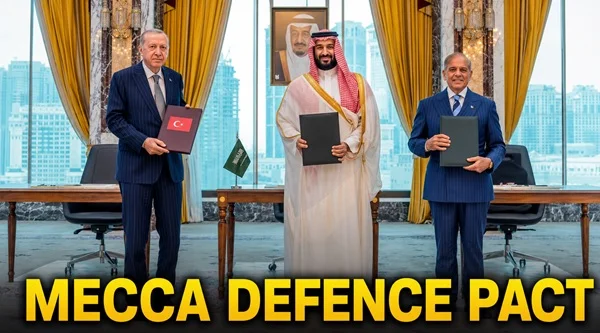
Saudi Arabia, Turkey and Pakistan signed the Mecca Joint Defence Agreement on 7 August 2026 in Mecca.
Important Point
- The most significant reported provision of the agreement is the principle of collective defence, under which an armed attack against any one of the three countries would be regarded as an attack against all three.
- Saudi Arabia–Pakistan: Pakistan has longstanding military and security ties with Saudi Arabia. The Mecca Pact also builds upon the Saudi–Pakistan Strategic Mutual Defence Agreement (SMDA) of September 2025.
- Saudi Arabia–Turkey: Defence relations have expanded rapidly, particularly in defence technology, drones and military-industrial cooperation.
- Pakistan–Turkey: Both countries maintain close defence ties involving military exercises, training, naval cooperation and defence equipment.
Why was the Mecca Defence Pact Signed?
- Rising Regional Tensions: Conflicts and tensions involving Iran, Israel, the United States and regional armed groups have created uncertainty in West Asia. The three countries therefore see greater security cooperation as a way to strengthen deterrence.
- Saudi Arabia’s Strategic Autonomy: Saudi Arabia has traditionally depended heavily on the United States for security. Riyadh is now seeking to diversify its strategic partnerships and reduce excessive dependence on a single external security provider.
- Pakistan’s Strategic Value: Pakistan provides: Military Manpower + Operational Experience + Defence Expertise + Strategic Capability. For Pakistan, closer ties with Saudi Arabia also provide greater diplomatic and strategic space.
- Turkey’s Regional Ambitions: Turkey seeks a larger geopolitical role in West Asia. Its rapidly growing indigenous defence industry, especially in drones, missiles, naval systems and electronic warfare, provides an important instrument of regional influence.
- Defence Industry Development: Saudi Arabia wants to expand indigenous defence production. Cooperation with Turkey and Pakistan could provide technology, military expertise and opportunities for joint production.
- Collective Deterrence: The basic logic is Three Countries → Mutual Support → Higher Cost of Aggression → Stronger Deterrence
Significance
- New Security Architecture in West Asia: The pact indicates that regional powers are increasingly trying to build their own security arrangements instead of depending entirely on external powers.
- Saudi Strategic Diversification: It reflects Saudi Arabia's broader attempt to diversify relations beyond its traditional dependence on Washington.
- Rise of Turkey as a Defence Power: Turkey’s defence industry is becoming an important component of its foreign policy and regional influence.
- Pakistan’s West Asian Role: Pakistan could gain greater importance as a military and security partner in the Gulf.
- Defence Industrial Integration: The combination of Saudi capital, Turkish technology and Pakistani military experience could create significant defence-industrial cooperation.
Is it a ‘NATO of the Muslim World’?
- The collective-defence provision has led to comparisons with NATO's Article 5, but the Mecca Pact should not yet be considered a Muslim NATO.
- NATO has: Integrated Command + Permanent Institutions + Joint Planning + Established Military Structures
- The Mecca Pact currently lacks a comparable unified military command or permanently deployed joint force.
There are also major differences in strategic priorities:
- Saudi Arabia → Gulf Security
- Turkey → Europe + Mediterranean + West Asia
- Pakistan → India-centric Security Concerns
Therefore, the real strength of the pact will depend on how the three countries respond during an actual military crisis.
India Relevance
1. Pakistan Gains Strategic Space
Pakistan could gain greater: Diplomatic Leverage + Defence Technology + Financial Support + Military Cooperation
This could indirectly affect India's security environment.
2. India–Saudi Relations:
India and Saudi Arabia have developed strong cooperation in: Energy + Trade + Investment + Connectivity + Security
If Saudi Arabia becomes more strategically dependent on Pakistan, India will have to carefully manage this relationship.
3. Türkiye–Pakistan Defence Cooperation:
India will need to closely monitor expanding Pakistan–Türkiye defence cooperation, particularly in advanced military technologies.
4. Gulf and Red Sea Security:
India depends heavily on the Gulf and Red Sea for: Energy Supplies + Maritime Trade + Connectivity
Any increase in regional rivalry or instability could directly affect India's economic and strategic interests.
5. Indian Diaspora:
Millions of Indians live and work in Gulf countries. Regional instability can therefore have direct implications for their safety and livelihoods.
6. Limited Immediate Military Impact:
The pact does not automatically mean that Saudi Arabia or Turkey would enter an India–Pakistan conflict.
India is not explicitly identified as an adversary, and the precise military obligations under the agreement remain unclear.
Challenges for India
- Growing Pakistan–Türkiye defence cooperation
- Possible increase in Pakistan's strategic leverage
- Changing balance of power in West Asia
- Protection of Indian energy interests
- Security of maritime trade routes
- Balancing relations with Saudi Arabia and other Gulf countries
- Monitoring possible defence technology transfers to Pakistan
Way Forward
- India should avoid viewing the Mecca Defence Pact automatically as an anti-India military alliance.
- Instead, India should follow a policy of strategic balancing and calibrated diplomacy.
- New Delhi should deepen its strategic partnership with Saudi Arabia in energy, investment, trade, technology and defence while simultaneously strengthening relations with other Gulf partners.
- India should also closely monitor Pakistan–Türkiye defence cooperation, particularly the transfer of advanced defence technologies.
Prelims MCQ
Q. Consider the following statements regarding the Mecca Defence Pact:
- It involves Saudi Arabia, Türkiye and Pakistan.
- It contains a collective-defence principle under which an attack on one member is treated as an attack on all.
- It has established an integrated military command similar to NATO.
- India has been officially identified as an adversary under the pact.
Which of the statements given above are correct?
(a) 1 and 2 only
(b) 1, 2 and 3 only
(c) 2 and 4 only
(d) 1, 2, 3 and 4
Mains Practice Question
Q. “The Mecca Defence Pact represents an emerging attempt by regional powers to reshape the security architecture of West Asia.” Examine the strategic significance of the pact and discuss its implications for India.
|
FAQs
What is the Mecca Defence Pact?
It is a trilateral defence agreement involving Saudi Arabia, Türkiye and Pakistan, aimed at strengthening collective deterrence and defence cooperation.
When was the Mecca Defence Pact signed?
It was signed on 7 August 2026 in Mecca.
What is its most important feature?
Its most important reported feature is collective defence—an attack on one member would be regarded as an attack on all three.
Is the Mecca Defence Pact like NATO?
It contains a NATO-like collective-defence principle, but currently lacks NATO's integrated command, permanent institutions and established joint military structure.
Is the pact against India?
The pact does not explicitly identify India as an adversary. However, deeper Saudi–Pakistan–Türkiye defence cooperation could have indirect strategic implications for India.
|






 Contact Us
  New Batch : 9555124124/ 7428085757
  Tech Support : 9555124124/ 7428085757