Context
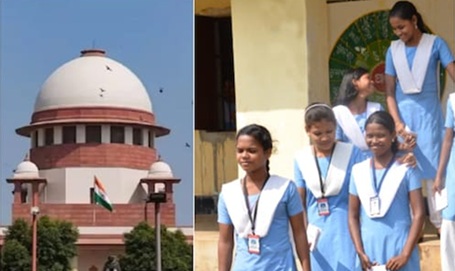
- Recently, the Supreme Court declared in a judgment that menstrual health and access to menstrual hygiene management (MHM) in educational institutions are integral to the fundamental right to life and dignity guaranteed under Article 21 of the Constitution.
- This issue is not only related to health, but also to broader questions of education, gender equality, and human dignity. The judgment was delivered by a bench of Justices J.B. Pardiwala and R. Mahadevan.
Constitutional Perspective of the Judgment
- The Court clarified that dignity is not an abstract ideal but rather refers to conditions in which a person can live without humiliation, exclusion, and unnecessary suffering.
- The lack of access to MHM facilities for menstruating girls exposes them to stigma, stereotypes, and humiliation.
- Due to the lack of safe and hygienic menstrual management, girl students are forced to either remain absent from school or resort to unsafe methods, which directly impacts their dignified lives.
Right to Education and Menstrual Poverty
- The Court also underlined that menstrual poverty deprives girls of the right to a dignified education, equal to that of male students or those from better-off economic backgrounds.
- Disruption of primary or secondary education has long-term and serious consequences. Thus, the lack of MHM facilities also undermines the constitutional guarantee of free and compulsory education.
Widespread Challenges of Menstrual Hygiene
- Social and Cultural Taboos
- Increased Dropout
- Frequent Infections and Health Risks
- Lack of Sanitation Infrastructure and Waste Disposal
Violation of Privacy and Bodily Autonomy
- This decision was based on a writ petition filed by Dr. Jaya Thakur, which highlighted the lack of MHM facilities in schools across the country.
- The Court held that the absence of MHM measures in schools violates the right to privacy and bodily autonomy of female students.
Supreme Court Directives
- The Court issued comprehensive directives to states and union territories, primarily including the following:
- Ensure the availability of functional, gender-segregated toilets in all schools, government and private, urban and rural.
- Provide free oxo-biodegradable sanitary napkins to female students. This should preferably be done through sanitary napkin vending machines in the toilet premises.
- MHM corners should be established in schools, providing spare underwear, spare uniforms, disposable bags, and other essential materials.
Some relevant constitutional provisions
|
Article
|
Name of the Provision
|
Brief Description
|
|
Article 21
|
Right to Life and Personal Dignity
|
Guarantees the right to live with dignity, including health, hygiene, and personal liberty
|
|
Article 14
|
Right to Equality
|
Ensures equality before the law and equal protection of laws
|
|
Article 15
|
Prohibition of Gender-Based Discrimination
|
Prohibits discrimination on grounds of sex and other specified bases
|
|
Article 21A
|
Right to Education
|
Provides free and compulsory education to children aged 6–14 years
|
|
Article 47 (DPSP)
|
Promotion of Public Health
|
Directs the State to improve nutrition levels and public health
|
Dignity, autonomy, and choice
- The Court clarified that a girl has a perfectly legitimate expectation to be able to manage her menstruation with privacy and dignity. Lack of resources cannot be allowed to override her bodily autonomy.
- MHM is not limited to hygiene alone, but also includes freedom of choice, availability of adequate products, water, and clean disposal mechanisms.
The Unreality of the Choice of 'Dignity vs. Education'
- The Court stated that the state cannot force a girl child to choose between dignity and education.
- The unavailability of sanitary napkins creates a gender-specific barrier that impacts school attendance and the continuation of education.
- In a separate section of the judgment, the Court emphasized the need to educate and sensitize male teachers and students about the biological reality of menstruation, so as to avoid harassment, humiliation, or unnecessary questioning of menstruating female students.
RTE Act and Accountability
- If government schools do not comply with Section 19 of the RTE Act, 2009 (standards including separate toilets for boys and girls), the state will be held liable.
- For private schools, non-compliance provides for cancellation of recognition and other punitive actions.
Some Government Initiatives
- Menstrual Hygiene Scheme under the National Health Mission (NHM)
- Construction of toilets in schools under the Samagra Shiksha Abhiyan
- Emphasis on sanitation infrastructure through the Swachh Bharat Mission
Way Forward
- Setting universal sanitation standards in schools
- Regular and free availability of sanitary pads
- Incinerators or eco-friendly solutions for safe disposal
- Making menstrual education part of the school curriculum
- Better coordination between central, state, and private institutions
Conclusion
This Supreme Court decision integrates menstruation into the broader constitutional discourse of health, education, dignity, and equality. It not only provides a rights-based safeguard for girl students but also elevates the state's role from a welfare responsibility to a constitutional one. This decision marks a significant step towards gender justice and dignified education in Indian democracy.






 Contact Us
  New Batch : 9555124124/ 7428085757
  Tech Support : 9555124124/ 7428085757