Prelims : Science & Technology + CA
Mains : GS Paper 3 – Space Technology, Human Spaceflight, Innovation |
Why in News ?
- The Indian Space Research Organisation has launched Mission MITRA in Leh–Ladakh to assess the mental, physical, and behavioural resilience of astronauts.
- The initiative is a significant step in preparing India for human spaceflight missions under the Gaganyaan programme, especially for long-duration missions.
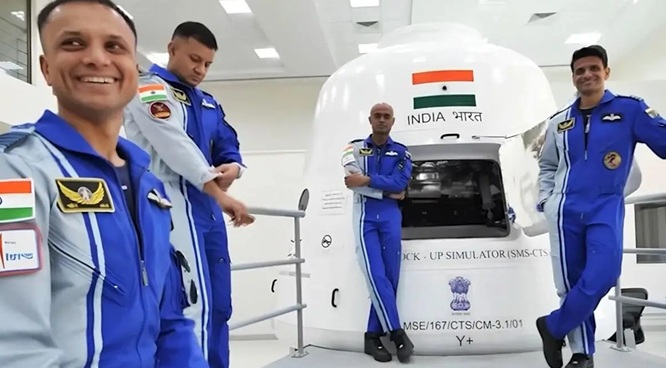
Background and Context
- India is advancing towards human spaceflight through the Gaganyaan programme, which aims to send Indian astronauts into space.
- Human space missions require not only technological readiness but also high levels of psychological stability, team coordination, and adaptability under extreme conditions.
- To simulate such environments on Earth, ISRO has initiated Mission MITRA, using high-altitude terrains as analogues for space-like conditions.
What is Mission MITRA ?
- Mission MITRA (Mapping of Interoperable Traits and Response Assessment) is a team behavioural and performance study conducted by ISRO in collaboration with the Institute of Aerospace Medicine of the Indian Air Force.
- It is designed as a first-of-its-kind experiment in India, focusing on how astronauts and ground teams interact and perform under stress.
- The mission studies human behaviour, decision-making, and physiological responses in challenging operational environments.
Key Features of the Mission
- The study is being conducted in Leh, Ladakh, a region characterised by :
- Low oxygen levels
- Extremely cold temperatures
- Geographical isolation
- These conditions closely resemble aspects of the space environment, making it an ideal testing ground.
- The mission involves :
- India’s designated Gaganyaan astronauts (Gaganyatris)
- A multidisciplinary team including scientists, engineers, psychologists, and medical experts
- It focuses on :
- Team interoperability between crew and ground control
- Decision-making under environmental and operational stress
- Physiological and psychological adaptation to extreme conditions
Objectives of Mission MITRA
- To analyse the interaction and coordination between astronauts and mission control teams in high-pressure environments
- To study human performance, stress tolerance, and behavioural responses in simulated space-like conditions
- To generate insights into effective teamwork and communication, which are critical for mission success
- To enhance preparedness for long-duration and deep-space missions
Significance of the Mission
1. Strengthening Human Spaceflight Readiness
- The mission provides crucial data for improving the training and preparedness of astronauts, ensuring they can operate efficiently in extreme environments.
2. Enhancing Decision-Making Under Stress
- By studying how teams function under pressure, the mission contributes to better operational strategies and crisis management in space missions.
3. Supporting Long-Duration Missions
- Insights from the study will be particularly valuable for future missions involving extended stays in orbit or deep space exploration.
4. Indigenous Capability Development
- It reflects India’s growing capability in human spaceflight research, going beyond hardware to focus on human factors and behavioural science.
Challenges
- Replicating all aspects of the space environment on Earth remains difficult, limiting the scope of simulation.
- Managing extreme environmental conditions in Ladakh poses logistical and operational challenges.
- Integrating findings into actual mission protocols requires continuous research and validation.
Way Forward
- Expand such studies to include longer-duration simulations and diverse environments
- Integrate findings into astronaut training programmes and mission planning
- Strengthen collaboration between space agencies, defence institutions, and research bodies
- Invest in advanced simulation technologies for more accurate space condition replication
Practice Questions
Prelims :
Q. Mission MITRA is related to :
(a) Missile technology testing
(b) Astronaut behavioural and performance study
(c) Satellite communication
(d) Climate monitoring
Mains :
“Discuss the importance of human factor studies such as Mission MITRA in the success of India’s human spaceflight programme.”
FAQs
Q1. What is Mission MITRA ?
A behavioural and performance study for astronauts conducted by ISRO.
Q2. Where is it being conducted ?
Leh, Ladakh.
Q3. What is its main objective ?
To study team coordination, stress response, and decision-making in extreme conditions.
Q4. Which programme is it linked to ?
Gaganyaan human spaceflight programme.
Q5. Why is it important ?
It helps prepare astronauts for real space missions, especially long-duration ones.
|






 Contact Us
  New Batch : 9555124124/ 7428085757
  Tech Support : 9555124124/ 7428085757