Prelims: (Polity & Governance + CA)
Mains: (GS 2 – Decentralisation, Local Governance, Youth Engagement) |
Why in News ?
The Ministry of Panchayati Raj, in collaboration with the Ministry of Education and the Ministry of Tribal Affairs, is jointly organising a National Award Ceremony to felicitate the winners of the Model Youth Gram Sabha initiative.
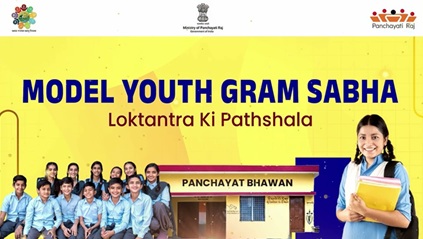
Model Youth Gram Sabha: Concept and Objectives
The Model Youth Gram Sabha is a simulated forum that enables school students to participate in mock Gram Sabha sessions, closely replicating the functioning of real village assemblies.
Inspired by the Model United Nations (Model UN) framework, this initiative aims to:
- Strengthen Janbhagidari (people’s participation)
- Promote participatory local governance
- Build awareness about grassroots democracy among students
- Foster civic responsibility and leadership skills at an early age
It is a flagship initiative of the Ministry of Panchayati Raj, implemented in collaboration with the Ministry of Education and the Ministry of Tribal Affairs.
Institutional Framework and Implementation
- Lead Ministry: Ministry of Panchayati Raj
- Collaborating Ministries: Ministry of Education and Ministry of Tribal Affairs
- Coverage: Rolled out across schools nationwide, including:
- Jawahar Navodaya Vidyalayas
- Eklavya Model Residential Schools (EMRSs)
- State Government Schools
- Recognition: Outstanding schools and student participants are honoured at a National Award Ceremony, reinforcing the importance of civic engagement.
Key Features of the Model Youth Gram Sabha
1. Role-Based Simulation
- Students from Classes 9–12 assume roles such as:
- Sarpanch
- Ward members
- Village secretary
- Anganwadi worker and other village-level officials
2. Mock Gram Sabha Proceedings
- Students conduct mock Gram Sabha meetings.
- They deliberate on:
- Local development issues
- Social welfare challenges
- Public service delivery
- They prepare:
- Village budgets
- Development plans, mirroring real Panchayat processes.
3. Financial Support
Significance for Participatory Governance
- Civic Education: Builds foundational knowledge of constitutional values, Panchayati Raj institutions, and democratic processes.
- Youth Empowerment: Encourages leadership, public speaking, negotiation, and problem-solving skills.
- Democratic Deepening: Promotes early engagement with grassroots democracy, strengthening the long-term culture of participation.
- Inclusivity: Special emphasis on schools serving tribal and rural populations enhances equitable civic exposure.
- Governance Innovation: Introduces experiential learning into civic education, bridging theory and practice.
Challenges and Way Forward
- Uniform Implementation: Ensuring consistency and quality across diverse school systems and regions.
- Teacher Training: Capacity building of educators to effectively guide simulations.
- Sustainability: Integrating the initiative into school curricula and annual academic calendars for long-term impact.
- Monitoring and Evaluation: Developing robust frameworks to assess learning outcomes and civic engagement levels.
- Scaling Best Practices: Sharing successful models and innovations across states and school networks.
FAQs
1. What is the Model Youth Gram Sabha ?
It is a simulated platform where school students participate in mock Gram Sabha sessions to learn about grassroots governance and democratic processes.
2. Which ministries are implementing this initiative ?
The Ministry of Panchayati Raj, in collaboration with the Ministry of Education and the Ministry of Tribal Affairs.
3. Who can participate in the Model Youth Gram Sabha ?
Students from Classes 9 to 12 in schools across India, including JNVs, EMRSs, and state government schools.
4. What activities do students perform during the mock sessions ?
They play roles such as sarpanch and ward members, conduct meetings, discuss village issues, and prepare budgets and development plans.
5. What financial support is provided to schools ?
Each participating school receives ₹20,000 from the Ministry of Panchayati Raj to organise the mock Gram Sabha sessions.
|






 Contact Us
  New Batch : 9555124124/ 7428085757
  Tech Support : 9555124124/ 7428085757