Prelims: mRNA Technology, Cancer Vaccines, Messenger RNA, Neoantigens, Melanoma, Immunotherapy, Immune Checkpoint Inhibitors, PD-1, Precision Medicine, Biotechnology.
Mains: GS Paper II: Health and Healthcare, Cancer Burden, Accessibility and Affordability of Advanced Healthcare, Public Health Challenges.
GS Paper III: Science and Technology, Biotechnology, mRNA Technology, Genomics, Precision Medicine, Emerging Medical Technologies, Research and nnovation. |
Why in News?
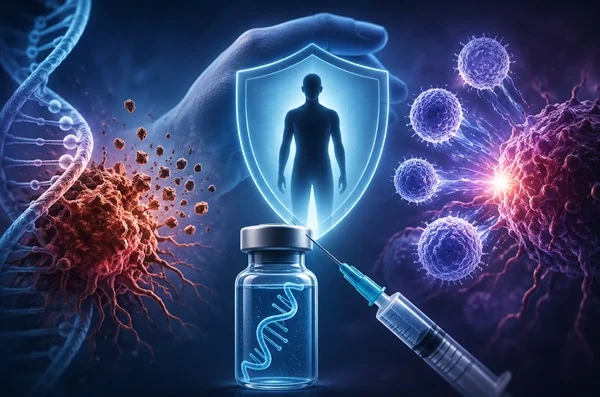
A personalized mRNA-based cancer vaccine, called intismeran autogene (V940/mRNA-4157), jointly developed by Moderna and Merck, has achieved a major milestone in cancer treatment.
Key terms and facts
|
mRNA
|
Messenger RNA carries genetic instructions that cells use for making proteins.
|
|
Neoantigen
|
An abnormal antigen generated by tumour-specific mutations that can potentially be recognized as foreign by the immune system.
|
|
Immunotherapy
|
Treatment that uses or modifies the body's immune system to fight diseases such as cancer.
|
|
Immune Checkpoint Inhibitor
|
A therapy that blocks inhibitory immune pathways, helping immune cells maintain or restore their ability to attack cancer.
|
|
PD-1
|
An immune checkpoint receptor found on immune cells, particularly T cells.
|
|
Melanoma
|
A cancer arising from pigment-producing melanocytes, most commonly in the skin.
|
|
Feature
|
Details
|
|
Therapy
|
Intismeran autogene
|
|
Earlier name
|
mRNA-4157 / V940
|
|
Technology
|
Messenger RNA (mRNA)
|
|
Type
|
Individualized Neoantigen Therapy
|
|
Developers
|
Moderna and Merck
|
|
Cancer studied
|
High-risk resected melanoma
|
|
Combination drug
|
Keytruda (Pembrolizumab)
|
|
Keytruda type
|
Anti-PD-1 immunotherapy
|
|
Major trial
|
INTerpath-001
|
|
Trial phase
|
Phase 3
|
|
Main goal
|
Prevent cancer recurrence and spread
|
|
Targets
|
Up to 34 patient-specific tumour mutations
|
What is Intismeran Autogene?
- Previously known as mRNA-4157 or V940, is an experimental individualized neoantigen therapy (INT). Unlike conventional vaccines that are manufactured identically for millions of people, intismeran is custom-made for each cancer patient.
- Scientists analyse the genetic mutations present in an individual patient's tumour and create an mRNA vaccine carrying instructions associated with selected tumour-specific neoantigens. The treatment can target up to 34 mutations unique to a patient's cancer.
How Does the Personalized Cancer Vaccine Work?
Cancer develops when genetic changes cause cells to grow uncontrollably. These mutations can lead cancer cells to produce abnormal proteins or neoantigens that distinguish them from healthy cells.
- Step 1(Tumour Removal): The patient's melanoma is first surgically removed.
- Step 2 (Genetic Sequencing): Scientists analyse the tumour and identify mutations that distinguish cancer cells from normal cells.
- Step 3 (Neoantigen Selection): Algorithms identify promising neoantigens associated with the patient's tumour.
- Step 4 (Personalized mRNA Vaccine): A unique mRNA treatment containing instructions corresponding to as many as 34 selected tumour mutations is manufactured specifically for that patient.
- Step 5 (mRNA Delivers Instructions): After administration, the mRNA instructs cells to produce selected tumour-associated antigens.
- Step 6 (Immune System Learns the Target): These antigens help activate immune responses, including T-cell responses, capable of recognizing cancer cells carrying those molecular targets.
- Step 7 (Cancer Cells are Targeted): If microscopic cancer cells remain after surgery or later reappear, the immune system may be better prepared to recognize and attack them.
Why is Keytruda Used Along With the Vaccine?
- The cancer vaccine is being tested in combination with Keytruda (pembrolizumab). Keytruda is a type of cancer immunotherapy called an immune checkpoint inhibitor. It targets the PD-1 pathway.
- Cancer can exploit immune checkpoint mechanisms to suppress T-cell activity and escape immune attack. Blocking PD-1 can help restore the ability of T cells to attack cancer.
- The combination therefore follows a complementary strategy:
Intismeran identifies and teaches the immune system what to attack, while Keytruda helps remove an immune “brake” that can prevent T cells from attacking effectively.
What is Melanoma?
- A cancer that develops from melanocytes, the cells responsible for producing the pigment melanin. It most commonly occurs in the skin and can become particularly dangerous when it spreads to other organs.
- Researchers initially focused on melanoma partly because it tends to have a relatively high number of genetic mutations, providing more potential neoantigens for personalized vaccines to target.
What Did the Phase 3 Trial Find?
In August 2026, Moderna and Merck announced that the trial met its primary endpoint of recurrence-free survival (RFS) and the important secondary endpoint of distant metastasis-free survival (DMFS). The breakthrough establishes strong evidence for the approach in resected high-risk melanoma, not for all cancers.
Why is this Being Called a Breakthrough after More Than a Century?
- In 1891, American surgeon William B. Coley experimented with bacterial infections/toxins to stimulate immune responses against tumours. His work later earned him recognition as an early pioneer or “father” of cancer immunotherapy.
- Scientists subsequently spent decades attempting to develop effective therapeutic cancer vaccines. Many approaches struggled because:
- tumours are genetically complex
- different patients' cancers carry different mutations
- cancer cells can suppress immune responses
- suitable tumour-specific targets are difficult to identify
- cancers evolve over time
- immune response generated by a vaccine does not necessarily translate into clinical benefit.
Is This the World's First Cancer Vaccine?
- Cancer vaccines are preventive or therapeutic. HPV and Hepatitis B vaccines prevent cancer-causing infections, while therapeutic vaccines treat existing cancer.
- Sipuleucel-T (2010) was the first FDA-approved therapeutic cancer vaccine; Moderna–Merck achieved the first positive Phase 3 mRNA cancer therapy result.
|
Preventive Vaccine
|
Personalized Cancer Vaccine
|
|
Given mainly before disease develops
|
Given to a cancer patient
|
|
Prevents cancer-causing infection
|
Helps immune system target existing/residual cancer
|
|
Usually same formulation for many people
|
Designed individually for each patient
|
|
Eg: HPV vaccine
|
Eg: Intismeran autogene
|
|
Targets infectious agents/antigens
|
Targets tumour-specific neoantigens
|
Why Did mRNA Technology Make This Possible?
It carries genetic instructions that cells use to produce proteins. For personalized cancer treatment, mRNA offers several advantages:
- Rapid Design: Once relevant tumour mutations have been identified, an mRNA sequence can be designed around selected targets.
- Multiple Targets: A single personalized treatment can encode multiple neoantigens rather than focusing on only one tumour target. Intismeran can incorporate targets corresponding to as many as 34 tumour mutations.
- Personalization: The vaccine can be adapted to the unique genetic characteristics of an individual's tumour.
- Platform Technology: The basic technological platform can potentially be adapted to different patients and different cancers by changing the genetic instructions encoded in the mRNA.
Why is the Breakthrough Important?
- Major Step Towards Personalized Medicine
- Proof of Concept for Personalized Cancer Vaccines
- New Role for mRNA Technology
- Potential to Reduce Cancer Recurrence
- Combination Immunotherapy
Challenges and Limitations
- High Cost: Each vaccine must be designed and manufactured specifically for one patient, potentially making the treatment substantially more expensive and complex.
- Manufacturing Complexity: The process requires tumour biopsy/surgery, sequencing, computational analysis, vaccine design, manufacturing, quality testing and delivery.
- Time: Cancer treatment can be time-sensitive, while personalized manufacturing necessarily involves several steps before treatment can begin.
- Not Proven for Every Cancer: Tumours with fewer identifiable neoantigens or immunologically “cold” tumour environments may be more difficult to treat through the same approach.
- Long-Term Survival Data: The Phase 3 trial is continuing to evaluate overall survival. More follow-up will therefore be necessary to determine the treatment's long-term impact.
Why is the Development Important for India?
According to IARC's GLOBOCAN 2022 estimates, India recorded approximately 1.41 million new cancer cases, and 916,827 cancer deaths in 2022. The emergence of personalized mRNA cancer vaccines is relevant in several ways.
- Precision Medicine: India will increasingly require genomic sequencing, molecular diagnostics and bioinformatics capacity as oncology moves toward personalized treatments.
- Biotechnology Ecosystem: mRNA platforms create opportunities for Indian biotechnology, pharmaceutical and research institutions to develop capabilities in RNA therapeutics, genomics and advanced vaccine manufacturing.
- Genomic Diversity: Research involving genetically diverse populations will be important to ensure that advances in precision medicine work effectively across populations.
- Public Health Policy: India will need to balance investment in expensive frontier treatments with proven cancer-control measures such as prevention, vaccination, tobacco control, screening, early diagnosis and affordable treatment.
Prelims MCQ
Q. Intismeran autogene, recently seen in the news, is associated with:
(A) Prevention of HIV infection
(B) Personalized mRNA-based cancer therapy
(C) Gene therapy for sickle-cell disease
(D) Universal influenza vaccination
Main Practice Question
Q. Recent advances in personalized mRNA-based cancer vaccines have opened new possibilities in cancer treatment. Explain the role of mRNA technology in cancer immunotherapy. What challenges could limit its widespread adoption in countries like India?
|
FAQs
What is a personalized mRNA cancer vaccine?
It uses a patient’s tumour mutations to train the immune system to attack cancer cells.
What is intismeran autogene?
It is an experimental personalized mRNA cancer therapy developed by Moderna and Merck.
Which cancer is it being tested against?
It is being tested mainly against high-risk melanoma.
Is it the world’s first cancer vaccine?
Sipuleucel-T, approved in 2010, was the first FDA-approved therapeutic cancer vaccine.
What is the role of Keytruda?
It blocks the PD-1 pathway, helping immune cells attack cancer.
|






 Contact Us
  New Batch : 9555124124/ 7428085757
  Tech Support : 9555124124/ 7428085757