- The Ministry of Road Transport and Highways (MoRTH) has released a draft notification proposing the mandatory adoption of Vehicle-to-Vehicle (V2V) communication systems in newly manufactured motor vehicles from 1 October 2028.
- The proposal is based on the newly developed AIS-230 standard and is currently in the draft stage, meaning it has not yet become law and will take effect only after final approval and notification.
- The initiative aims to enhance road safety by enabling vehicles to communicate with each other in real time, forming a key component of India's Intelligent Transportation System (ITS).
Why is it in the News?
- MoRTH has issued a draft amendment to the AIS-230 automotive standard.
- The draft proposes making V2V communication mandatory for all newly manufactured L, M and N category vehicles from 1 October 2028.
- Vehicles voluntarily equipped with V2V systems from 1 October 2027 must comply with the AIS-230 standard.
- The notification is currently open for stakeholder feedback and has not yet been enacted.
What is Vehicle-to-Vehicle (V2V) Communication?
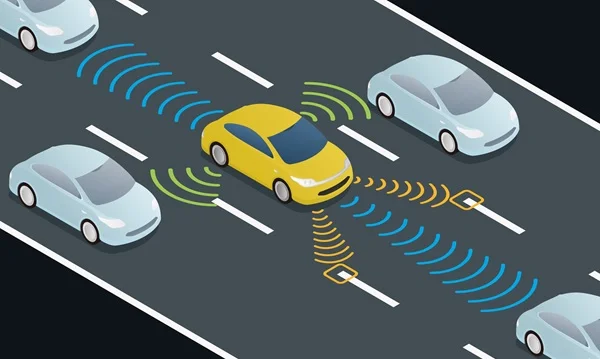
Vehicle-to-Vehicle (V2V) communication is a wireless technology that enables nearby vehicles to exchange real-time information without human intervention.
The system continuously shares information such as:
- Vehicle speed
- Position
- Direction of movement
- Acceleration
- Braking status
- Hazard warnings
This allows vehicles to warn each other about potential dangers before they become visible to the driver.
How Does V2V Work?
Every vehicle fitted with a V2V system contains an On-Board Unit (OBU) that continuously broadcasts and receives safety messages from nearby vehicles. Using Cellular Vehicle-to-Everything (C-V2X) technology, vehicles exchange data several times every second.
The information is processed instantly to generate warnings regarding:
- Sudden braking ahead
- Possible forward collisions
- Unsafe lane changes
- Wrong-way driving
- Hazardous road conditions
- Approaching emergency vehicles
Unlike traditional driver assistance systems, V2V works even when the hazard is outside the driver's line of sight.
Difference Between V2V and ADAS
|
Vehicle-to-Vehicle (V2V)
|
Advanced Driver Assistance Systems (ADAS)
|
|
Communicates with nearby vehicles
|
Uses onboard sensors
|
|
Uses wireless communication
|
Uses cameras, radar and LiDAR
|
|
Can detect hidden hazards
|
Limited by sensor visibility
|
|
Provides information beyond line of sight
|
Detects only visible surroundings
|
|
Complements ADAS
|
Works independently using sensors
|
MoRTH has clarified that V2V is not a replacement for ADAS but a complementary technology that significantly improves road safety.
AIS-230 Standard
AIS-230 is the new Indian automotive standard developed specifically for factory-installed V2V communication systems.
The standard specifies minimum requirements for:
Technical Requirements
- Radio performance
- Frequency stability
- Receiver sensitivity
- Output power
Navigation Requirements
- Global Navigation Satellite System (GNSS) positioning
Electrical Requirements
- Electrical performance
- Electromagnetic Compatibility (EMC)
- Electromagnetic interference protection
Cybersecurity Requirements
- Communication security
- Cybersecurity protocols
- Data integrity
- Secure message exchange
Functional Requirements
- Road safety applications
- System reliability
- Environmental performance
Vehicles Covered Under the Draft
The proposal applies to the following categories:
Category L
- Motor vehicles with fewer than four wheels
- Motorcycles
- Scooters
Category M
- Passenger vehicles with four or more wheels
- Cars
- SUVs
- Buses
Category N
- Goods-carrying vehicles
- Mini trucks
- Trucks
- Commercial cargo vehicles
Frequency Band Allocated
The V2V communication system will operate in the: 5.875 GHz – 5.925 GHz frequency band
Important points:
- Dedicated for Intelligent Transportation System (ITS) applications.
- Exempted from licensing requirements.
- License exemption notified by the Department of Telecommunications (DoT) on 10 June 2026.
- Supports reliable low-latency communication between vehicles.
Safety Features Supported Under AIS-230
- The standard provides for the phased introduction of several advanced safety applications, including:
- Emergency Brake Alert (EBA) :-Warns following vehicles when a vehicle ahead brakes suddenly.
- Forward Collision Warning (FCW) :-Alerts drivers about an imminent collision with a vehicle in front.
- Wrong-Way Driving Alert :-Detects vehicles moving in the wrong direction and issues warnings.
- Emergency Vehicle Alert :-Notifies nearby drivers about approaching ambulances, police vehicles and fire engines.
Additional future applications may include:
- Hazardous road warnings
- Lane-change assistance
- Traffic congestion alerts
- Intersection collision warnings
Rollout Timeline
From 1 October 2027
- Vehicles voluntarily equipped with V2V communication systems must comply with AIS-230.
From 1 October 2028
- All newly manufactured vehicles in Categories L, M and N must be equipped with AIS-230-compliant V2V communication systems.
The phased implementation is intended to provide manufacturers, suppliers and testing agencies adequate time to prepare.
Benefits of V2V Communication
The proposed system is expected to provide several advantages:
Improved Road Safety
- Reduces accidents by providing early hazard warnings.
Better Situational Awareness
- Drivers receive information about hazards beyond their field of vision.
Faster Emergency Response
- Vehicles can make way for ambulances and emergency responders more efficiently.
Reduced Traffic Congestion
- Better coordination among connected vehicles can improve traffic flow.
Support for Autonomous Driving
- Provides essential communication infrastructure for future connected and autonomous vehicles.
Complements ADAS
- Enhances the effectiveness of existing Advanced Driver Assistance Systems.
Intelligent Transportation System (ITS)
V2V communication forms an important part of the broader Intelligent Transportation System (ITS).
ITS integrates:
- Smart vehicles
- Digital communication networks
- Navigation systems
- Traffic management
- Road infrastructure
The objective is to improve:
- Road safety
- Traffic efficiency
- Mobility
- Environmental sustainability
Challenges
Despite its benefits, implementation may face certain challenges:
- Increased manufacturing costs
- Cybersecurity and data privacy concerns
- Need for nationwide communication infrastructure
- Standardisation among different automobile manufacturers
- Public awareness and acceptance
- Compatibility with older vehicles not equipped with V2V systems
Significance for India
- India records one of the highest numbers of road accident fatalities globally.
- The proposed V2V framework represents a significant step toward creating a connected mobility ecosystem capable of preventing accidents before they occur.
- By enabling vehicles to exchange real-time safety information, the AIS-230 standard is expected to improve situational awareness, strengthen intelligent transportation systems, support future autonomous mobility, and contribute to reducing road accidents across the country.
Frequently Asked Questions (FAQs): MoRTH Draft on Vehicle-to-Vehicle (V2V) Communication
1. Why is the MoRTH V2V proposal in the news?
Answer :-The Ministry of Road Transport and Highways (MoRTH) has issued a draft notification proposing mandatory Vehicle-to-Vehicle (V2V) communication systems for all newly manufactured L, M and N category vehicles from 1 October 2028 under the AIS-230 standard.
2. Is the V2V communication system mandatory in India now?
Answer :-No. The proposal is currently a draft notification. It will become mandatory only after the government finalizes and officially notifies the rules.
3. What is Vehicle-to-Vehicle (V2V) communication?
Answer :-Vehicle-to-Vehicle (V2V) communication is a wireless technology that enables nearby vehicles to exchange real-time information such as speed, location, direction, braking status and hazard warnings to improve road safety.
|






 Contact Us
  New Batch : 9555124124/ 7428085757
  Tech Support : 9555124124/ 7428085757