Why in News?
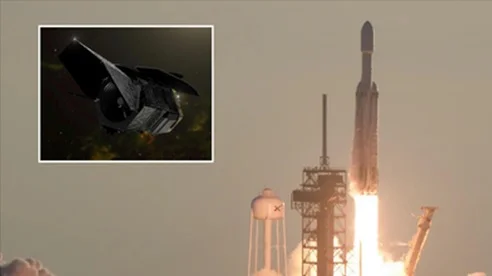
Recently, NASA’s newest flagship space observatory, the Nancy Grace Roman Space Telescope, was successfully launched from Florida aboard a SpaceX Falcon Heavy rocket.
What is the Nancy Grace Roman Space Telescope?
- The Nancy Grace Roman Space Telescope is NASA’s next-generation space observatory designed to conduct large-scale surveys of the universe.
- Named after Nancy Grace Roman, NASA’s first Chief Astronomer, the telescope will observe vast regions of space at unprecedented speed and scale.
- Its primary mission is expected to last five years, although NASA estimates that it may have enough fuel to operate for up to another five years.
Key Features
|
Feature
|
Details
|
|
Name
|
Nancy Grace Roman Space Telescope
|
|
Agency
|
NASA
|
|
Launch Vehicle
|
SpaceX Falcon Heavy
|
|
Launch Site
|
Kennedy Space Center, Florida
|
|
Approximate Cost
|
$4.3 billion
|
|
Destination
|
Lagrange Point 2 (L2)
|
|
Distance from Earth
|
About 1.6 million km
|
|
Primary Mission
|
5 years
|
|
Major Focus
|
Dark Matter, Dark Energy, Exoplanets and Galaxy Evolution
|
|
Major Instrument
|
Wide Field Instrument
|
|
Experimental Instrument
|
Coronagraph
|
How is Roman Different from the Hubble Space Telescope?
- One of Roman’s most important advantages is its extremely wide field of view.
- Its field of view is expected to be more than 100 times wider than Hubble’s.
- Its Wide Field Instrument has sensitivity comparable to Hubble but can survey the sky approximately 1,000 times faster.
- For example, a survey of the Milky Way that would take Hubble roughly 100 years could be completed by Roman in about one month.
- Therefore, Roman is designed less as a replacement for Hubble and more as a wide-field survey telescope that can scan enormous portions of the sky.
Studying Dark Matter and Dark Energy
- A major objective of the Roman Space Telescope is to investigate dark matter and dark energy, two poorly understood components that dominate the universe.
- According to current estimates:
- Ordinary matter: about 5%
- Dark Matter: about 27%
- Dark Energy: about 68%
Dark Matter
- Dark matter does not emit, absorb, or reflect light in a way that allows it to be directly observed. Scientists infer its existence primarily through its gravitational effects on visible matter and light.
- Roman will study billions of galaxies and their distribution to improve scientists’ understanding of how dark matter shapes the universe.
Dark Energy
- Dark energy is associated with the accelerating expansion of the universe.
- By studying the distribution and evolution of galaxies and other cosmic objects, Roman will help scientists investigate how the universe has expanded over time and what role dark energy has played in this expansion.
Creating a Massive 3D Map of the Universe
- Roman is expected to create one of the most comprehensive three-dimensional maps of the universe ever produced.
- Its major survey is expected to examine more than 2 billion galaxies.
- Such a massive dataset will allow scientists to study:
- The distribution of galaxies
- The large-scale structure of the universe
- The effects of dark matter
- The expansion history of the universe
- The evolution of galaxies over cosmic time
- This information could provide important clues about the fundamental nature of dark matter and dark energy.
Searching for Thousands of Exoplanets
- Another major objective of Roman is the search for exoplanets, or planets orbiting stars outside our Solar System.
- NASA expects Roman to discover thousands of new planets and provide one of the most comprehensive statistical studies of planetary systems.
- The telescope will particularly contribute to the discovery of planets that are difficult to detect using conventional methods.
Experimental Coronagraph
- Roman also carries an experimental coronagraph.
- A coronagraph is designed to block the intense light from a star so that much fainter objects, such as planets orbiting that star, can potentially be observed directly.
- The technology could help advance future efforts to obtain direct images of exoplanets.
Roman vs Hubble vs James Webb
Roman will complement, rather than replace, NASA’s existing major space telescopes.
|
Feature
|
Hubble Space Telescope
|
James Webb Space Telescope
|
Nancy Grace Roman
|
|
Primary Strength
|
High-resolution observations
|
Deep and highly sensitive observations
|
Wide-field surveys
|
|
Major Wavelengths
|
Optical, UV, Infrared
|
Primarily Infrared
|
Primarily Infrared
|
|
Field of View
|
Relatively narrow
|
Relatively narrow
|
More than 100× wider than Hubble
|
|
Key Focus
|
Stars, galaxies, planets and nebulae
|
Early universe, galaxies and stars
|
Dark Energy, Dark Matter, Exoplanets
|
|
Approach
|
Detailed observations
|
Deep observations
|
Large-scale panoramic surveys
|
- Roman will also complement major projects such as the European Space Agency’s Euclid mission and the Vera C. Rubin Observatory in Chile.
- Once Roman identifies interesting objects, the James Webb Space Telescope can conduct more detailed follow-up observations.
What is Lagrange Point 2?
- The Roman Space Telescope is heading towards Lagrange Point 2 (L2).
- L2 is a region in space associated with the Sun-Earth system, located approximately 1.5 million kilometres beyond Earth in the direction away from the Sun.
- Space telescopes can operate near L2 while maintaining a stable relationship with the Earth and Sun.
- The James Webb Space Telescope also operates near L2.
- Roman is expected to take more than three months to reach its destination.
Successful Falcon Heavy Launch
- The telescope was launched aboard SpaceX’s Falcon Heavy rocket from NASA’s Kennedy Space Center in Florida.
- Several minutes after launch, Falcon Heavy’s two reusable side boosters successfully returned and landed at Cape Canaveral.
- The Roman telescope subsequently separated successfully from the rocket’s upper stage and began its journey towards L2.
- The mission reportedly launched months ahead of schedule and within its planned budget.
Mission Duration and Future Refuelling
- Roman has been designed for a primary mission of around five years.
- NASA estimates that the spacecraft may carry enough fuel to operate for up to five additional years.
- The telescope has also been designed with the possibility of future robotic refuelling, should suitable in-space refuelling technology become available.
- This could potentially extend the scientific lifetime of the mission.
Who Was Nancy Grace Roman?
- Nancy Grace Roman joined the newly established NASA in 1959 and became the agency’s first Chief Astronomer.
- She played an important role in promoting the development and use of space-based observatories.
- Her contributions to the development of space astronomy earned her the nickname “Mother of Hubble.”
- Roman died in 2018 at the age of 93.
- The Roman Space Telescope is NASA’s first space telescope named after a woman.
Roman’s Primary Mirror
- The Roman Space Telescope has a primary mirror approximately 2.4 metres (nearly 8 feet) in diameter, similar in size to Hubble’s primary mirror.
- An interesting feature of Roman’s history is that its mirror was originally surplus hardware from a spy satellite programme.
- The National Reconnaissance Office (NRO) donated the mirror to NASA more than a decade ago, helping reduce the cost and development time of the mission.
Why is the Roman Space Telescope Important?
- The mission could significantly expand our understanding of the universe by:
- Mapping billions of galaxies across large regions of space.
- Improving our understanding of Dark Matter and its gravitational effects.
- Investigating the nature and role of Dark Energy.
- Discovering thousands of exoplanets.
- Providing a statistical census of planetary systems.
- Studying the evolution and distribution of galaxies.
- Supporting detailed follow-up observations by the James Webb Space Telescope.
- Advancing technologies for the direct imaging of exoplanets.
Prelims Question
Q. With reference to the Nancy Grace Roman Space Telescope, consider the following statements:
- It is a NASA space observatory designed to study dark matter and dark energy.
- It will operate near the Sun-Earth Lagrange Point 2.
- Its field of view is more than 100 times wider than that of the Hubble Space Telescope.
- It has been designed primarily to replace the James Webb Space Telescope.
Which of the statements given above are correct?
-
1, 2 and 3 only
-
1 and 4 only
-
2 and 3 only
-
1, 2, 3 and 4
Mains Question
.“The future of astronomy lies not only in observing deeper into space but also in surveying larger portions of the universe.” Discuss with reference to the Nancy Grace Roman Space Telescope.
|
FAQs
What is the Nancy Grace Roman Space Telescope?
It is NASA’s next-generation space observatory designed for large-scale surveys of the universe, including research on dark matter, dark energy, galaxy evolution and exoplanets.
Where will the Roman Space Telescope be located?
It will operate near Lagrange Point 2 (L2), approximately 1.6 million kilometres from Earth.
Which rocket launched the Roman Space Telescope?
It was launched aboard SpaceX’s Falcon Heavy rocket.
How much wider is Roman’s field of view compared with Hubble?
Roman’s field of view is expected to be more than 100 times wider than Hubble’s.
How many exoplanets could Roman discover?
NASA expects the telescope to discover thousands of exoplanets during its mission.
How long will the Roman Space Telescope operate?
Its primary mission is planned for five years, with the possibility of an additional five years depending on available fuel and mission conditions.
|






 Contact Us
  New Batch : 9555124124/ 7428085757
  Tech Support : 9555124124/ 7428085757