Prelims: (Science & Technology + CA)
Mains: (GS 3 – Environment, Pollution, Science & Technology) |
Why in News ?
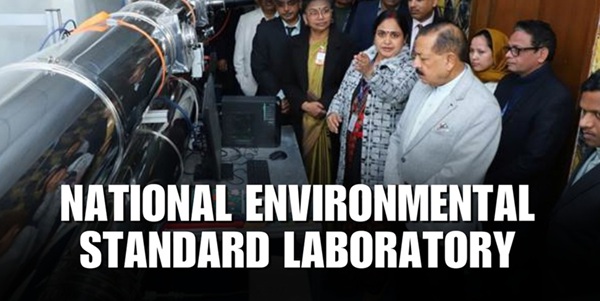
Recently, the CSIR–National Physical Laboratory (NPL) established the National Environmental Standard Laboratory (NESL), a specialised national facility to test and recalibrate air pollution monitoring instruments and environmental sensors under Indian conditions.
What is the National Environmental Standard Laboratory (NESL) ?
The National Environmental Standard Laboratory (NESL) is a newly established national facility designed to test, validate, and recalibrate instruments used in air pollution monitoring systems and environmental sensing networks.
- It aims to ensure the accuracy, reliability, and credibility of environmental data generated across India.
- The laboratory supports evidence-based policymaking by strengthening the measurement backbone of India’s environmental governance framework.
- NESL plays a crucial role in ensuring high-quality data for the National Clean Air Programme (NCAP).
Location:
- CSIR–National Physical Laboratory (NPL), New Delhi
Objectives and Key Features of NESL
Core Objectives
- To establish national reference standards for environmental monitoring instruments.
- To reduce dependence on foreign laboratories for testing and calibration.
- To improve transparency and trust in pollution data used by regulators and courts.
Key Features
- Instrument Testing and Recalibration: NESL tests and recalibrates air quality monitors, emission analysers, and environmental sensors under Indian climatic and pollution conditions.
- Reference Gases and Protocols: Provides standard reference gases, calibration protocols, and testing methodologies aligned with global benchmarks.
- Industrial Emission Audits: Supports validation and audit of industrial emission monitoring systems.
- Smart City Monitoring Support: Assists in validating sensor networks used in smart city air quality monitoring and municipal surveillance systems.
- Domestic Validation Ecosystem: Enables manufacturers, industries, and urban local bodies to certify instrument performance within the country.
Significance for Air Quality Governance
- Strengthening NCAP: Reliable data is critical for identifying pollution hotspots, tracking progress, and evaluating mitigation measures under the National Clean Air Programme.
- Boost to MSMEs and Start-ups: Indigenous manufacturers can demonstrate product quality at lower cost, improving market access and competitiveness.
- Regulatory Compliance and Transparency: Supports tightening regulatory norms on emission monitoring, reducing disputes over data credibility.
- Atmanirbhar Bharat in Environmental Technology: Encourages domestic innovation and reduces reliance on imported calibration services.
Role of CSIR–National Physical Laboratory
The CSIR–National Physical Laboratory (NPL) functions as India’s premier institution for measurement science and standards.
Key Facts about the Council of Scientific and Industrial Research (CSIR)
- CSIR is a cutting-edge R&D organisation working across diverse scientific and technological domains.
- It undertakes research, design, and development of scientific and industrial instruments and systems.
- Provides testing, calibration, maintenance, and technical services to industry.
- Promotes human resource development in instrumentation and applied sciences.
- Acts as an ecosystem enabler for innovation and industrial growth.
- Headquarters: New Delhi
Way Forward
- Integration of NESL services with State Pollution Control Boards and urban local bodies can significantly enhance data-driven environmental regulation.
- Expansion of similar standard laboratories across regions can decentralise environmental monitoring capacity.
- NESL can strengthen India’s credibility in global environmental reporting and climate commitments by ensuring internationally comparable datasets.
FAQs
1. What is the primary purpose of NESL ?
To test, recalibrate, and standardise air pollution monitoring instruments under Indian conditions.
2. Which national programme does NESL support ?
The National Clean Air Programme (NCAP).
3. Where is the National Environmental Standard Laboratory located ?
At CSIR–National Physical Laboratory, New Delhi.
4. How does NESL help MSMEs and start-ups ?
By providing affordable, domestic testing and validation facilities.
5. Why is calibration of pollution monitoring instruments important ?
Because inaccurate instruments lead to unreliable data, flawed policy decisions, and weak enforcement.
|






 Contact Us
  New Batch : 9555124124/ 7428085757
  Tech Support : 9555124124/ 7428085757